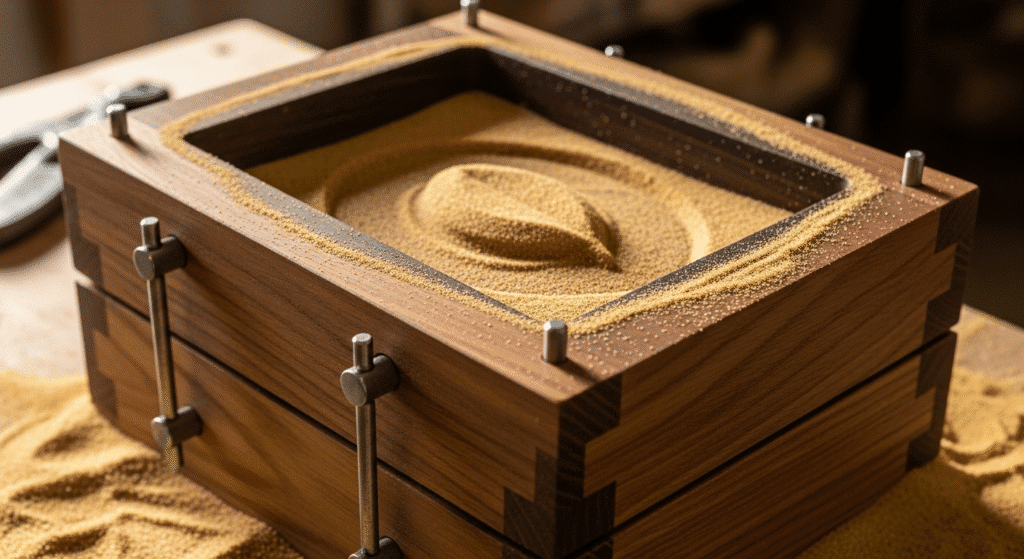
A sand casting flask is the rigid frame that holds your sand mold together during metal casting. Building your own flask gives you complete control over size and quality while saving hundreds of dollars compared to buying commercial ones.
Most hobbyist metal casters can build a sturdy wooden flask in about two hours with basic woodworking tools. You’ll create two matching frames—the cope (top half) and drag (bottom half)—that align perfectly to produce clean, accurate castings.
Here’s everything you need to build a reliable sand casting flask:
Wood Materials:
Basic Tools:
Hardware:
For Metal Flask Construction:
Your flask should be 2-3 inches larger than your biggest casting pattern on all sides. This extra space ensures proper sand compaction and prevents weak spots that could cause mold failure.
A 12″ x 10″ x 4″ flask handles most hobbyist projects perfectly. It’s large enough for substantial castings but still manageable when filled with sand.
Measure your largest pattern first, then add 6 inches to both length and width. The depth depends on your pattern height—add at least 2 inches above and below your tallest pattern.
Cut four pieces of wood for each frame half using your measured dimensions. Your cope and drag should be identical in length and width, though the cope can be slightly deeper if needed.
Make sure all cuts are perfectly square—use a miter saw if available. Even small angle errors will prevent proper alignment and cause casting defects.
Sand all cut edges smooth to prevent splinters and ensure tight joints. Label each piece clearly (cope vs. drag, left vs. right) to avoid mix-ups during assembly.
Create strong corner joints by drilling pilot holes before inserting screws. This prevents the wood from splitting and ensures maximum strength.
Apply wood glue to each joint before screwing for extra durability. Use at least two screws per corner, positioning them diagonally for the best hold.
Check that each frame sits completely flat on your workbench. Any warping or twisting will cause alignment problems and poor castings.
Use corner clamps to hold pieces square while the glue dries. Let the assembly cure for at least an hour before moving to the next step.
Drill matching holes in both frames for alignment pins—typically two pins positioned diagonally across from each other. These pins ensure perfect registration every time you close the flask.
Use ½-inch wooden dowels or metal pins that extend about 2 inches from the drag frame. The corresponding holes in the cope should be slightly larger to allow easy insertion.
Test the alignment repeatedly before finalizing. The frames should come together smoothly without forcing, but shouldn’t wobble when closed.
Install sturdy handles on opposite sides of each frame for safe lifting. Position them at the balance point so the flask doesn’t tilt when carried.
Mount hook-and-eye latches or toggle clamps to keep the flask tightly closed during pouring. You’ll need at least two latches on opposite sides.
Test the closure mechanism with the flask weighted down. It should hold securely even when you shake the assembly—loose flasks cause dangerous metal leaks.
Apply a coat of linseed oil or polyurethane to protect the wood from moisture. This prevents warping and extends your flask’s life significantly.
Round all inside corners slightly with sandpaper. Sharp corners create weak spots in the sand mold that can break during pouring.
Mark the parting line clearly on both frames. A visible line helps you position patterns correctly and maintain consistent results.
Test your completed flask with actual molding sand before your first casting. Pack it firmly and check that both halves separate cleanly without sand sticking.
Metal flasks last forever and handle high-temperature alloys better than wood. Build them from angle iron or rectangular steel tubing welded at the corners.
Use 1.5-inch angle iron for small flasks, or 2-inch for larger sizes. Cut pieces with an angle grinder and weld all joints completely for maximum strength.
Add reinforcement plates at the corners if you’re casting heavy items regularly. Paint with high-temperature primer to prevent rust.
Metal flasks cost more initially but pay off through durability. They’re essential if you’re doing production casting or working with brass and bronze frequently.
Pine works perfectly for beginners and occasional use. It’s cheap, easy to work with, and strong enough for aluminum casting. Hardwoods like oak last longer but cost more and require better tools.
Use 1.5 to 2-inch thick lumber for flasks up to 16 inches wide. Larger flasks need 2.5 to 3-inch thick walls to resist the pressure of packed sand without bowing.
Avoid plywood for flask construction. It delaminates when exposed to moisture from the sand and doesn’t provide enough strength at the joints where you need it most.
Start with one medium-sized flask (12″ x 10″) to learn the basics. Build additional sizes as your projects demand them. Most hobbyists eventually need 3-4 different sizes.
Yes, sealing prevents moisture absorption and warping. Use boiled linseed oil, polyurethane, or even simple paste wax. Reapply annually for best results.
Wooden flasks work well up to about 24″ x 18″. Beyond that size, the weight of sand becomes difficult to manage and metal construction becomes more practical.