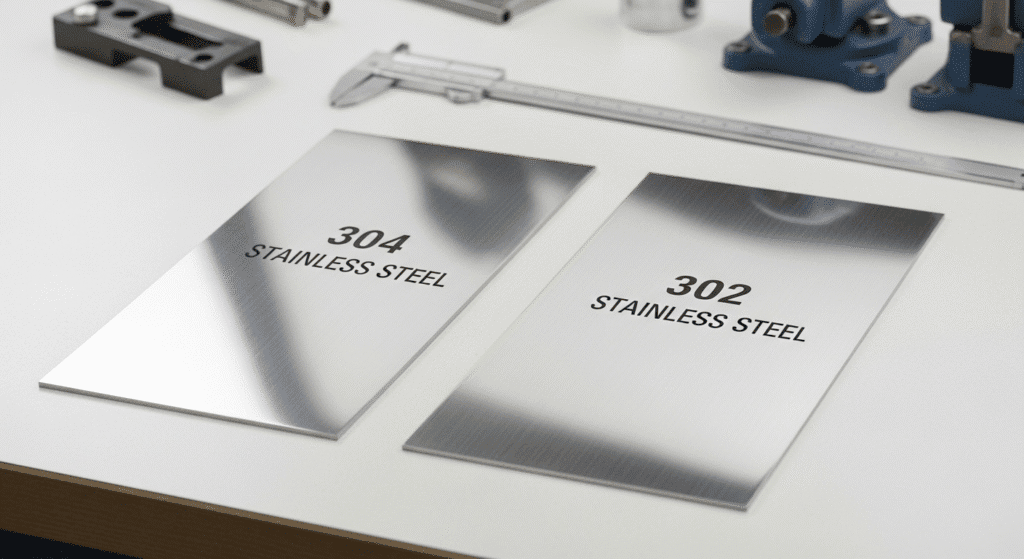
Type 304 stainless steel offers better corrosion resistance and weldability, while 302 provides higher strength for applications like springs and fasteners. If you’re working with food equipment, doing extensive welding, or need general-purpose corrosion resistance, choose 304. If you need high-strength wire, springs, or cold-worked parts with minimal welding, choose 302.
The difference comes down to carbon content. 302 contains up to 0.15% carbon, giving it higher strength but making it prone to weld sensitization. 304 was developed as a low-carbon improvement (0.08% max carbon) that trades some strength for better corrosion resistance and easier fabrication.
| Element | AISI 302 (wt%) | AISI 304 (wt%) |
|---|---|---|
| Carbon (C) | ≤ 0.15 | ≤ 0.08 |
| Chromium (Cr) | 17.0-19.0 | 18.0-20.0 |
| Nickel (Ni) | 8.0-10.0 | 8.0-10.5 |
| Manganese (Mn) | ≤ 2.00 | ≤ 2.00 |
| Silicon (Si) | ≤ 1.00 | ≤ 0.75 |
| Phosphorus (P) | ≤ 0.045 | ≤ 0.045 |
| Sulfur (S) | ≤ 0.03 | ≤ 0.03 |
| Nitrogen (N) | Not specified | ≤ 0.10 |
Both are 18-8 austenitic alloys, meaning they contain roughly 18% chromium and 8% nickel. The chromium forms a protective oxide layer that prevents rust. The nickel stabilizes the austenitic structure, giving both grades their non-magnetic properties and toughness down to -196°C (liquid nitrogen temperature).
304’s slightly higher chromium range (18-20% vs 17-19%) adds to its corrosion resistance. The lower carbon content prevents chromium carbide precipitation during welding, which is why 304 became the preferred grade for most applications.
302 delivers higher strength. In the annealed condition, 302 reaches a minimum tensile strength of 585 MPa compared to 304’s 515 MPa. The yield strength follows the same pattern: 240 MPa for 302 versus 205 MPa for 304.
This strength advantage comes from carbon. Carbon atoms in the steel lattice create obstacles that prevent dislocations from moving, making the material harder and stronger. When cold-worked, 302 can achieve tensile strengths exceeding 1500 MPa in spring wire applications.
304 sacrifices some strength for better corrosion behavior. The lower carbon content reduces the risk of sensitization—a phenomenon where chromium combines with carbon at grain boundaries during heating (450-850°C range). This depletes chromium near the boundaries, creating paths for corrosion to attack.
Here’s how they compare mechanically:
| Property (Annealed) | 302 Stainless | 304 Stainless |
|---|---|---|
| Tensile Strength | ≈ 585 MPa (min) | ≈ 515 MPa (min) |
| Yield Strength (0.2%) | ≈ 240 MPa (min) | ≈ 205 MPa (min) |
| Elongation at break | ~50-60% | ~40% |
| Hardness (Rockwell B) | ≤ 92 HRB (max) | ≤ 92 HRB (max) |
304’s corrosion advantage shows up in real-world conditions. Un-welded 302 and 304 perform similarly in mild environments like indoor air or fresh water. The difference emerges in three scenarios: after welding, in acidic conditions, and during prolonged exposure to moisture or chemicals.
If you weld 302 without post-weld annealing, the heat-affected zone becomes vulnerable to intergranular corrosion. 304 is less prone to this issue, and 304L (with ≤0.03% carbon) virtually eliminates it.
304 excels in formability. You can stamp it into complex shapes, deep-draw it into sinks or cookware, and roll it into curved architectural panels. The lower carbon content means 304 work-hardens more gradually, allowing more severe forming operations before requiring intermediate anneals.
302 can be formed, but the higher carbon content causes it to work-harden faster. This is advantageous when you want the formed part to gain strength, but problematic for complex shapes requiring multiple forming stages. Deep drawing operations or severe bends may crack 302 where 304 would succeed.
304 is readily weldable by all common methods: TIG, MIG, stick welding, and resistance welding. Use 308L filler metal for most applications. The welds match the base metal’s corrosion resistance without post-weld treatment.
302 requires more care when welding. Use 308L filler metal (low carbon) to minimize sensitization. After welding, consider post-weld annealing to dissolve any chromium carbides that formed and restore full corrosion resistance to the weld zone.
Without post-weld annealing, 302 welds may show reduced corrosion resistance compared to the base metal. Avoid oxyacetylene welding with 302 because carbon pickup from the flame worsens sensitization.
Both grades machine similarly, which is to say they’re both challenging. The machinability rating for both 302 and 304 is approximately 45-50%, compared to 100% for free-machining 1212 steel. This means you’ll cut slower, apply more cutting force, and replace tools more frequently than when machining carbon steel.
304 machines slightly easier than 302 because it’s softer (lower carbon content). But the difference is marginal—machinists don’t usually distinguish between them. If machinability is critical to your application, specify 303 instead, which contains added sulfur specifically to improve chip formation.
Both 302 and 304 handle elevated temperatures similarly. They can operate continuously at temperatures up to 870°C (1600°F) and intermittently to 925°C (1700°F) without excessive scaling.
One important note: if components will be heated into the 450-870°C range and then exposed to corrosive environments, use 304 or 304L. This temperature range promotes carbide precipitation in 302, which can later corrode.
Both grades stay tough at cryogenic temperatures. Unlike carbon steels that become brittle below freezing, austenitic stainless steels maintain ductility down to liquid nitrogen temperatures (-196°C).
Raw material costs for 302 and 304 are nearly identical. Both contain similar amounts of chromium and nickel—the expensive alloying elements. The slight difference in carbon content (which is inexpensive) doesn’t affect material pricing.
Availability tells a different story. 304 is stocked by virtually every metal supplier in every product form: sheet, plate, bar, wire, tubing, pipe, and castings. You can walk into most metal warehouses and buy 304 in common sizes off the shelf.
302 requires more effort to source. Spring wire manufacturers stock 302 readily because it’s the preferred material for that application. But 302 sheet, plate, or structural shapes may require contacting specialty suppliers or accepting longer lead times.
Choose 304 if you need:
Choose 302 if you need:
When in doubt, choose 304. It’s the safer, more versatile option that covers a broader range of applications. The improved weldability and corrosion resistance prevent problems down the road, and the universal availability saves time in procurement.