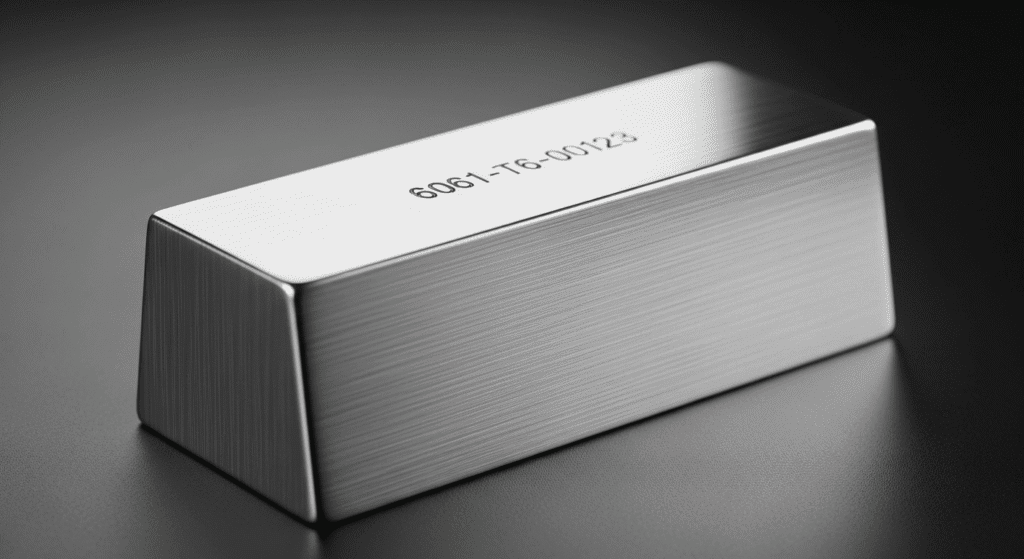
6061 aluminum alloy is the workhorse of the structural aluminum world. Introduced in 1935 as “Alloy 61S,” it’s become the go-to general-purpose aluminum across virtually every major industry—and there’s a reason. This medium-to-high strength precipitation-hardened alloy delivers impressive mechanical strength, corrosion resistance that actually works in real environments, weldability that doesn’t cause headaches, and machinability that keeps production costs reasonable.
If you’re designing aircraft structures, automotive components, marine vessels, or architectural frames, odds are 6061 fits what you need. This guide walks through the chemistry, mechanical properties, real-world applications, and practical decision-making to help you figure out if 6061 is the right call or when you should reach for something else.
Chemical Composition and How It Works
6061 is classified in the 6xxx series of aluminum alloys, which means magnesium and silicon are its principal alloying elements. The combination of these elements, along with controlled additions of copper and chromium, creates a material that responds exceptionally well to heat treatment.
Mechanical Properties: Strength Across Different Tempers
6061’s properties depend entirely on its temper—the heat treatment you apply. That flexibility is huge: you can dial in strength and ductility to match your exact needs.
Mechanical Properties Comparison:
Property
6061-O (Annealed)
6061-T4 (Naturally Aged)
6061-T6 (Artificially Aged)
Ultimate Tensile Strength
≤150 MPa
180–210 MPa
290–310 MPa
Yield Strength
83–110 MPa
~110 MPa
240–270 MPa
Elongation (%)
10–18%
10–16%
8–10%
Hardness (Brinell)
~30 HB
~50 HB
~95 HB
Physical Properties: Why 6061 Is Lightweight and Thermally Efficient
6061’s physical properties make it ideal for applications demanding light weight, thermal management, or dimensional stability across temperature ranges.
Density: 2.70 g/cm³ — approximately one-third the weight of steel (7.85 g/cm³).
Thermal Conductivity: ~150–170 W/(m·K) at room temperature — significantly higher than stainless steel.
Coefficient of Thermal Expansion: 23×10⁻⁶ K⁻¹ — typical for aluminum alloys. This moderate expansion must be considered in precision assembly designs where temperature variations occur. The alloy will expand noticeably with temperature changes, requiring careful clearance calculations.
Melting Range: 582°C to 652°C (solidus to liquidus). This is lower than pure aluminum (660°C) due to alloying elements, which affects welding temperatures and casting operations.
Specific Heat Capacity: ~897 J/(kg·K) — similar to pure aluminum, meaning the alloy can absorb or release moderate amounts of thermal energy.
Where 6061 Excels: Applications Across Industries
6061’s balanced properties have earned it a reputation as “structural aluminum”—the go-to alloy when you need reliable, predictable performance. Its applications span nearly every major industry:
Aerospace & Aviation: Aircraft wings, fuselages, and stabilizers in commercial and military aircraft. Especially common in amateur-built and light aircraft. 6061 is also used in spacecraft components and satellite structures where its dimensional stability and weldability provide significant advantages over higher-strength alloys that are difficult to fabricate.
Automotive & Transportation: Vehicle chassis, wheel spacers, truck frames, suspension components, and brake systems. The Audi A8 luxury car’s space frame and Plymouth Prowler’s chassis were made extensively from 6061 aluminum extrusions. 6061 also appears in motorcycle frames, high-end bicycle frames, drive shafts, and engine components. In mass transit, it’s used in structural members of high-speed trains, subway cars, bus bodies, and truck trailers.
Marine Applications: Boat hulls and decks (especially smaller craft), structural boat fittings, docks, gangways, and marine hardware like masts and spars. Many SCUBA tanks and high-pressure gas cylinders use 6061-T6 for its combination of strength, corrosion resistance, and toughness. Coastal infrastructure like ladders, steps, and framework exposed to saltwater spray also commonly employ 6061.
Construction & Architecture: Structural framing for roofs, bridges, cranes, and scaffolding. 6061 extrusions serve as angles, channels, and I-beams in building structures. Many modern building facades, window frames, door frames, and roofing systems use 6061 for structural support members. In civil engineering, it’s used for piping, tubing, and railings. The alloy also appears in architectural awnings, canopies, and railway infrastructure components.
6061 is heat-treatable—that’s a huge advantage. Controlled heating and cooling let you engineer the properties you need.
O (Annealed): The soft, ductile condition. Heat to ~415°C for 2–3 hours and cool slowly. Annealing relieves internal stress and maximizes your ability to bend and form, but sacrifices strength. Use O when formability matters and strength isn’t critical.
T4 (Solution Heat-Treated and Naturally Aged): Solution heat-treat at ~530°C, then quench (rapid water cool) to trap elements in a supersaturated solution. Let it sit at room temperature for several days and precipitation hardening starts naturally. T4 gives you intermediate strength (between O and T6) with retained formability. Pick T4 for complex shapes you’ll form before final hardening.
T6 (Solution Heat-Treated and Artificially Aged): The most common temper for 6061. Solution heat-treat at ~530°C, quench, then age artificially by heating to ~160°C for controlled time to precipitate Mg₂Si and harden. Typical aging: 8–18 hours at 160°C (some use two-step aging). Result: maximum strength—roughly twice as strong as O condition. T6 boosts hardness and strength through precipitation hardening, but you sacrifice ductility (drops to 8–10% elongation).
T651: Essentially T6 with an added stress-relief step. After solution treating and aging, the material is slightly stretched or compressed (minor plastic deformation) to relieve residual stresses from quenching. 6061-T651 is common for thick plates to prevent distortion during machining. Its mechanical properties are equivalent to T6.