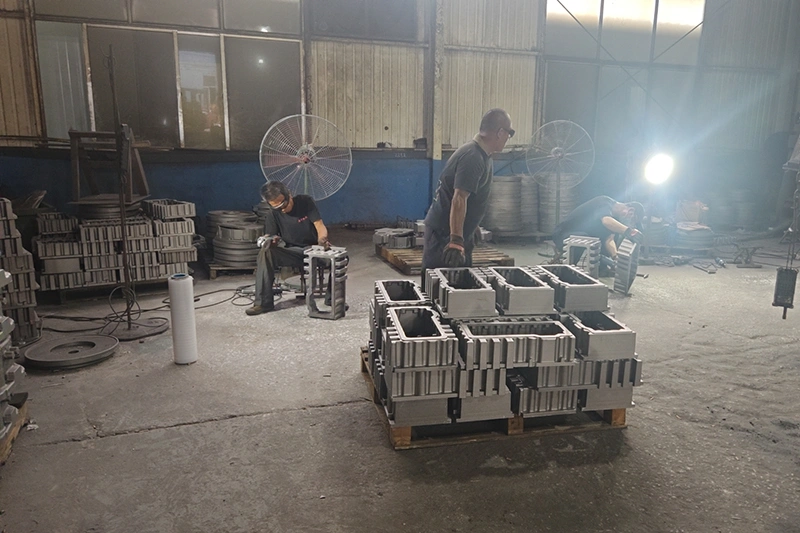
Foundry sand is clean, uniformly sized silica sand used to form molds and cores for metal casting. The sand grains are coated with bonding agents like bentonite clay or chemical resins that hold the mold shape when you pour molten metal into it.
The term “foundry sand” specifically refers to the sand used in foundries, which are facilities that melt and cast metal. This sand is different from beach sand or construction sand because it has consistent grain size, high silica content (typically 95% or higher), and carefully controlled properties.
Sand casting works because the sand can withstand extreme temperatures without melting or breaking down. When molten iron at 2,800℉ pours into a sand mold, the sand stays stable while the metal cools and solidifies.
Foundries use sand casting to make everything from engine blocks to manhole covers. Almost all casting metals work with sand molds, including iron, steel, aluminum, brass, and bronze.
The process is cost-effective because you can reuse the sand multiple times. After a casting cools, workers break apart the sand mold, clean the casting, and recondition the sand for the next use.
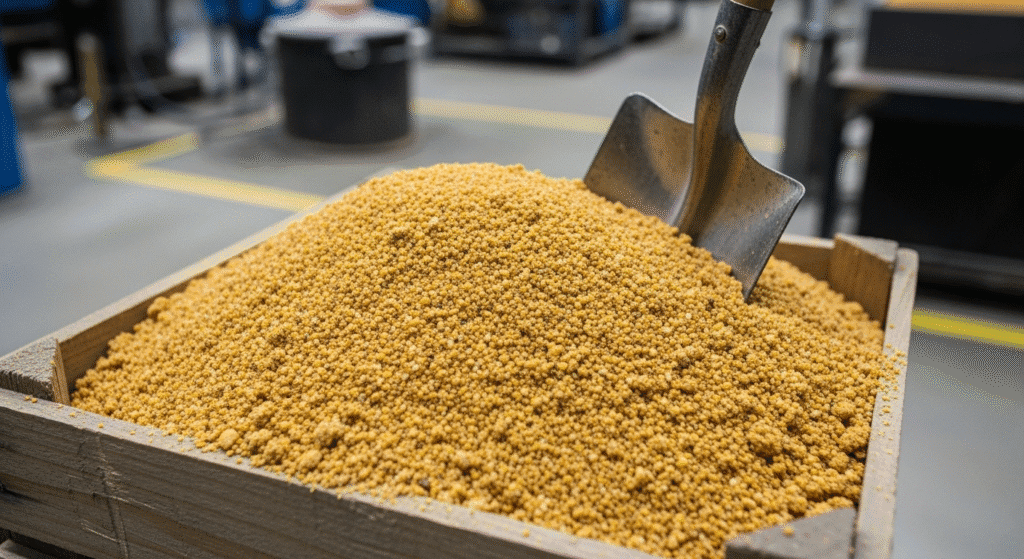
The composition of foundry sand varies based on the casting method, but all types share a base of high-purity silica sand. The silica content must exceed 95% to handle the thermal stress of molten metal, with most foundry sands containing between 97.2% and 98.7% silica.
Here’s how the three main types compare in composition:
| Sand Type | Silica Content | Binder Type | Binder Percentage | Additives |
|---|---|---|---|---|
| Green Sand | 85-95% | Bentonite clay | 4-10% | 2-10% carbonaceous materials (sea coal) |
| Chemically Bonded Sand | 93-99% | Chemical resins | 1-3% | Epoxy, sodium silicate, furyl alcohol, phenolic urethanes |
| Resin Coated Sand | 93-99% | Thermosetting resin | 1-3% | Phenolic or furan resin coating |
Several physical properties determine whether foundry sand will produce quality castings. These properties affect how the mold holds its shape, releases gases during pouring, and produces a smooth casting surface.
Grain size determines the surface finish of your casting. Finer sand grains create smoother surfaces but reduce permeability, while coarser grains allow better gas escape but leave rougher finishes.
Permeability measures how easily gases can pass through the sand. The American Foundry Society recommends a permeability range of 90 to 105 for most applications. If permeability is too low, trapped gases create defects like blowholes and porosity.
Grain shape affects both mechanical strength and how well the sand packs together. The optimal mixture contains about 60% spherical grains and 40% angular grains. Spherical grains improve permeability and gas flow, while angular grains increase mechanical interlock and mold strength.
Particle size distribution in waste foundry sand is typically very fine. Research shows that 85-90% of WFS particles are smaller than 100 micrometers, which is about the width of a human hair.
Temperature resistance is critical since foundry sand must withstand molten metal without breaking down. Silica sand remains stable up to approximately 3,000℉, which covers the melting points of common casting metals.
Three main types of foundry sand dominate the metal casting industry. Each type uses different binding systems and serves specific applications based on the required precision, production volume, and metal being cast.
Green sand produces more castings by tonnage than all other sand types combined. The name comes from the uncured state of the sand, which remains “green” or wet even when you pour molten metal into the mold.
The typical composition includes 85-95% silica sand, 4-10% bentonite clay as the binder, and 2-10% carbonaceous additives to improve the casting surface finish. You add water (2-7% moisture content) to activate the clay binder.
Green sand offers major advantages in production speed and cost. You can recycle it immediately after shakeout without waiting for chemical curing, and the equipment needed is relatively simple compared to other methods.
Automotive foundries and general iron foundries rely heavily on green sand. It works well for medium-to-large production runs where some surface roughness is acceptable.
The main limitation is dimensional accuracy. Green sand molds have less rigidity than chemically bonded molds, which can lead to minor dimensional variations in complex castings.
Chemically bonded sand consists of 93-99% silica sand mixed with 1-3% chemical binder. Common binders include epoxy resins, sodium silicates, furyl alcohol, and phenolic urethanes.
A catalyst triggers the curing reaction when you mix the sand and binder. The curing creates strong chemical bonds between sand grains without requiring moisture, producing rigid molds with excellent dimensional stability.
Foundries always use chemically bonded sand for cores, which are sand forms that create hollow spaces and internal features in castings. Steel foundries and non-ferrous foundries also use it for external molds when precision matters.
The superior strength allows you to create highly intricate shapes with thin walls and fine details. Chemically bonded molds maintain their dimensions better than green sand during metal pouring.
The trade-off is cost and reclamation. Chemical binders are more expensive than bentonite clay, and you need additional processing to remove the binder coating before reusing the sand.
Resin coated sand, also called no-bake sand, features sand grains pre-coated with thermosetting resin like phenolic or furan resins. The resin coating acts as both the binder and the mold-forming agent.
This type delivers the highest mechanical strength and dimensional stability of all foundry sands. The strong resin bonds create molds that resist erosion from flowing molten metal, reducing defects like cuts and washes.
You use resin coated sand for applications requiring high precision and excellent surface finish. Examples include pump housings, valve bodies, and aerospace components where tight tolerances are critical.
The resin coating creates a smoother casting surface compared to green sand because the fine resin particles fill gaps between sand grains. This reduces metal penetration, which occurs when molten metal seeps between sand grains.
The main drawback is environmental impact. Resin binders release volatile organic compounds (VOCs) during pouring, requiring specialized ventilation systems to protect workers and comply with air quality regulations.
The sand casting process transforms foundry sand into temporary molds that shape molten metal. Here’s how it works from start to finish:
A pattern maker builds a replica of the final part, usually from wood, plastic, or metal. The pattern is slightly larger than the final casting to account for metal shrinkage as it cools.
Workers pack foundry sand around the pattern inside a two-part box called a flask. The sand gets rammed or compressed to achieve the right density and strength. Once the sand is firmly packed, they remove the pattern, leaving a cavity in the sand that matches the part shape.
The foundry melts metal in a furnace to temperatures between 1,300℉ and 3,000℉ depending on the alloy. They pour the liquid metal into the mold cavity through a channel called a sprue. The metal flows through the mold, filling all the cavities and taking the shape of the sand mold.
The casting remains in the sand mold while the metal cools and solidifies. Cooling times range from minutes to hours depending on the size and thickness of the casting. The sand insulates the metal and controls the cooling rate.
After cooling, workers shake or vibrate the casting to break apart the sand mold. They separate the casting from the loose sand, then clean and inspect the part. The used sand gets collected, screened, and reconditioned for reuse.
Each ton of metal poured typically uses several tons of sand. The ability to reclaim and reuse this sand makes the process economically viable for high-volume production.
Yes, foundry sand can be recycled both within foundries and in alternative applications outside the metal casting industry. Recycling reduces waste, conserves natural resources, and cuts costs for foundries and construction companies.
Approximately 2.6 million tons of spent foundry sand get beneficially reused outside of foundries every year in the United States. Iron, steel, and aluminum foundry sands represent 96% of the foundry sand that goes to beneficial use applications.
The U.S. Environmental Protection Agency supports the beneficial use of silica-based spent foundry sands from iron, steel, and aluminum foundries. EPA studies show that constituent concentrations in these sands fall below health and environmental benchmarks when used in soil-related applications.
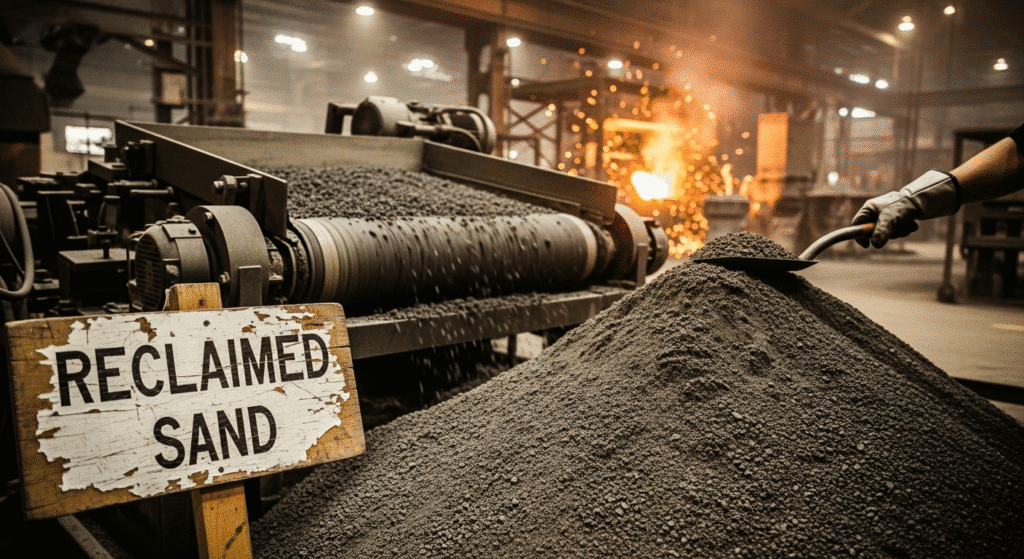
Foundry sand has uniform grain size, high silica content (95%+ vs. variable for regular sand), and consistent properties needed to withstand molten metal temperatures up to 3,000℉. Regular sand from beaches or riverbeds has mixed particle sizes, variable composition, and isn’t tested for thermal stability or permeability.
Silica-based foundry sand from iron, steel, and aluminum foundries is not classified as hazardous waste by the EPA. However, it does contain crystalline silica, so workers must avoid breathing the dust. Used foundry sand may also contain trace metals or binder residues that require testing before reuse in soil-contact applications.
Green sand can be reused hundreds of times with proper reconditioning between uses. Foundries typically add 5-40% new sand to each batch to replace losses during shakeout and maintain sand properties. Chemically bonded sand requires thermal or mechanical reclamation to remove binder coatings before reuse.