Picking the wrong cast iron can wreck your project. I’ve seen engineers spec malleable iron for high-stress applications, only to deal with cracked components three months later. The opposite mistake? Over-engineering with ductile iron when malleable would’ve saved 30% on machining costs.
Here’s the thing: both materials look similar on paper. They’re both “improved” versions of brittle gray cast iron. But their microstructures, manufacturing processes, and performance characteristics are fundamentally different.
This guide breaks down exactly what separates ductile iron from malleable iron so you can make the right call for your next project.
Both materials belong to the cast iron family, but they achieve their ductility through completely different mechanisms.
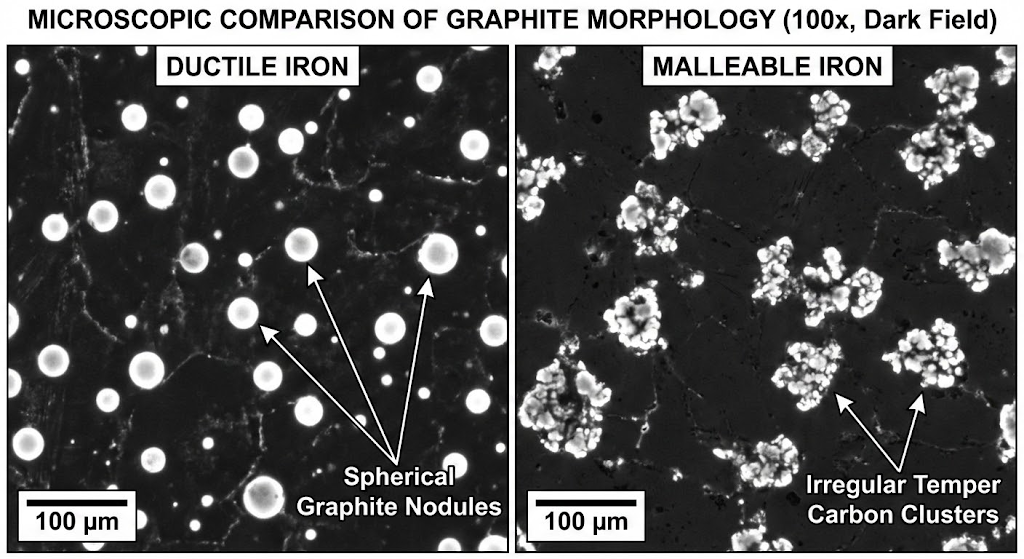
Ductile iron gets its properties directly during the casting process. Foundry workers add a small amount of magnesium or cerium to molten iron, and this triggers graphite to form as tiny spherical nodules instead of the flakes you’d see in gray iron.
You might hear it called spheroidal graphite (SG) iron or nodular iron. Same material, different names.
The carbon content runs between 3.0% and 3.9%. What makes ductile iron special is that it comes out of the mold ready to use. No secondary heat treatment required for most grades.
Malleable iron takes a completely different path. You start with white iron, which is extremely hard and brittle. Then you put it through a lengthy annealing process that transforms the microstructure.
The heat treatment runs 40 to 100+ hours at temperatures between 900-970°C. During this time, the carbon in the iron forms irregular clusters called “temper carbon.” These clusters give malleable iron its flexibility.
Carbon content is lower than ductile iron, typically 2.0% to 3.0%. Three main types exist: blackheart (ferritic), whiteheart, and pearlitic, each with different properties.
The microstructure is where these materials really diverge. Look at them under a microscope, and you’ll immediately spot the difference.
| Feature | Ductile Iron | Malleable Iron |
|---|---|---|
| Graphite shape | Spherical nodules | Irregular rosette-like clusters |
| Formation mechanism | Mg/Ce addition during solidification | Heat treatment of white iron |
| Matrix structure | Ferritic, pearlitic, or mixed | Ferritic or pearlitic |
| Typical appearance | “Bull’s-eye” structure | Temper carbon dispersed in matrix |
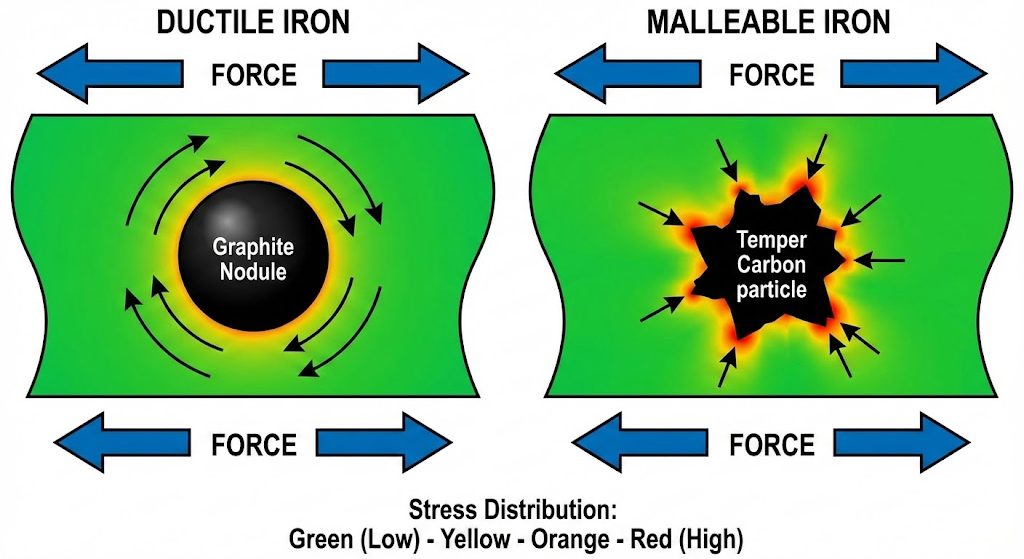
Graphite shape determines how the material handles stress. Round shapes spread stress evenly. Sharp or irregular shapes concentrate stress at their edges.
In ductile iron, those spherical nodules act like tiny shock absorbers. When a crack tries to propagate through the material, it has to go around each nodule. This dramatically improves fatigue resistance and impact toughness.
Malleable iron’s irregular graphite clusters don’t perform quite as well. They still provide decent ductility, way better than gray iron’s graphite flakes. But they can’t match the stress distribution of perfectly spherical nodules.
I’ve always thought of it like this: ductile iron has ball bearings embedded in steel, while malleable iron has gravel. Both are better than having glass shards (gray iron), but one clearly handles stress better.
Numbers tell the real story. Here’s how these materials stack up in actual performance testing.
| Property | Ductile Iron | Malleable Iron |
|---|---|---|
| Tensile Strength | 60,000-120,000 psi (414-1380 MPa) | 50,000-90,000 psi (340-620 MPa) |
| Yield Strength | 40,000-90,000 psi (275-620 MPa) | 32,000-70,000 psi (220-480 MPa) |
| Elongation | 6-25% | 3-15% |
| Impact Resistance | Excellent | Good (especially at low temperatures) |
| Hardness | 150-300 HB | 150-270 HB |
Ductile iron wins on raw strength. The best ductile iron grades can hit 120,000 psi tensile strength. Malleable iron tops out around 90,000 psi.
The elongation numbers reveal something interesting though. High-ductility ductile iron grades can stretch up to 25% before breaking. That’s exceptional for any cast iron.
ASTM A536 covers ductile iron castings. The grade naming system is straightforward: 65-45-12 means 65 ksi minimum tensile strength, 45 ksi minimum yield strength, and 12% minimum elongation.
Common ductile iron grades include:
Malleable iron falls under ASTM A220 and ISO 5922. The ISO system uses letters to indicate type (W for whiteheart, B for blackheart, P for pearlitic) followed by strength and elongation values.
The manufacturing process is the fundamental difference between these materials. One is simple and fast. The other is complex and slow.
The whole process happens in a single day. Properties develop as the metal solidifies. No waiting around.
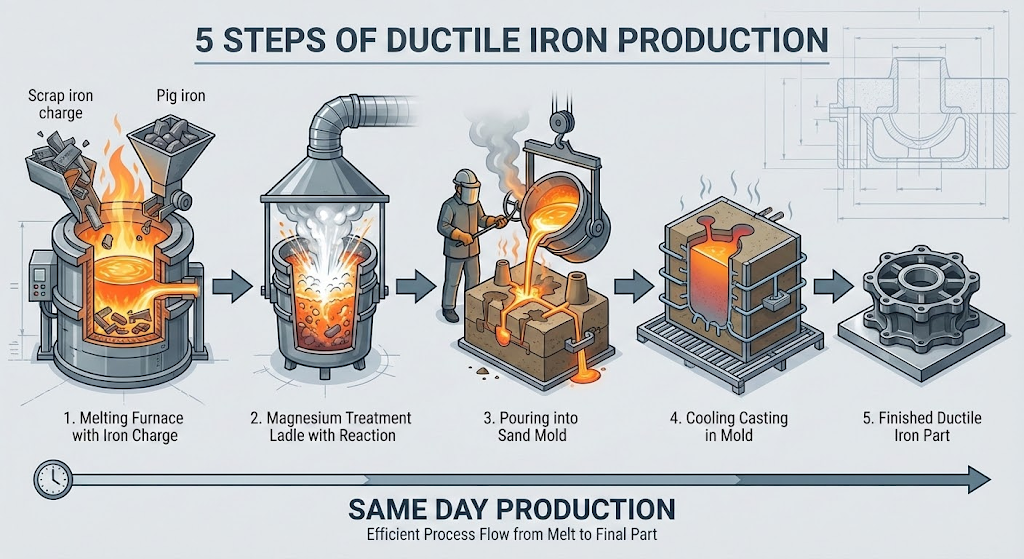
That annealing step is the killer. You’re tying up furnace capacity for days, burning energy the entire time. This is why malleable iron costs more to produce despite using similar raw materials.
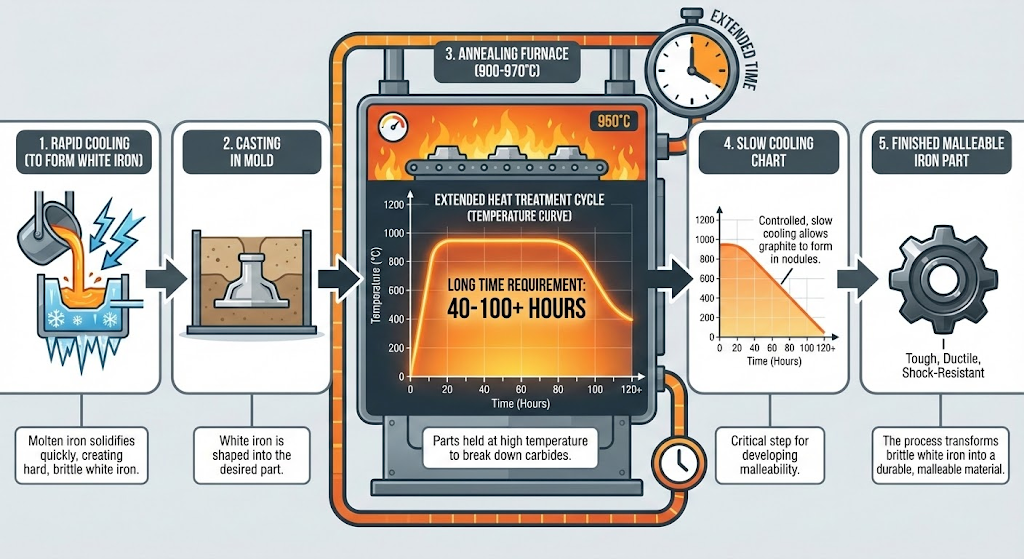
Ductile iron beats malleable iron on almost every production metric. Single-step process means lower energy costs and faster turnaround. No specialized annealing furnaces needed.
There’s also a size limitation with malleable iron. You can only cast sections up to about 25-50mm thick. Anything larger won’t cool fast enough to form the white iron structure you need for annealing.
Ductile iron has no such limitation. You can cast massive sections without worrying about the microstructure. This opens up applications that malleable iron simply can’t handle.
Material selection isn’t complicated once you know what to look for. Here’s my decision framework.
Go with ductile iron if you need tensile strength above 80,000 psi. Malleable iron simply can’t reach those numbers.
Dynamic loading and impact applications demand ductile iron. The spherical graphite structure handles cyclic stress far better than temper carbon clusters.
Large castings over 50mm section thickness require ductile iron. Malleable iron can’t be produced in those sizes.
Corrosion resistance matters more in harsh environments. Ductile iron performs better in marine applications, chemical processing, and buried service.
Large production volumes favor ductile iron economics. The faster production cycle and lower energy costs add up quickly.
Thin-section castings under 25mm are malleable iron territory. The material excels at small, intricate shapes.
Extensive machining after casting tips the scale toward malleable iron. The graphite acts as a chip breaker and lubricant, making it significantly easier to cut than ductile iron.
Low-temperature applications can favor malleable iron. It maintains impact resistance at cold temperatures where some ductile iron grades become brittle.
Small production runs with tight budgets sometimes make malleable iron the economical choice for simple parts.
| Requirement | Recommended Material |
|---|---|
| High strength (>80 ksi tensile) | Ductile iron |
| Large castings (>50mm section) | Ductile iron |
| Thin sections (<25mm) | Malleable iron |
| Extensive machining | Malleable iron |
| High impact/dynamic loads | Ductile iron |
| Low-temperature service | Either (malleable has slight edge) |
| Welding required | Neither (consider steel) |
One important note: neither material welds well. If your design requires welded assemblies, you should probably be looking at steel instead.
Cost analysis for cast iron isn’t just about material price. You have to consider the entire production cycle.
Raw material costs run slightly higher for ductile iron because of the magnesium addition. But this difference is small, maybe 5-10%.
Processing costs tell a different story. Malleable iron’s 40-100+ hour heat treatment consumes enormous amounts of energy and furnace time. Ductile iron skips this entirely.
Lead times favor ductile iron dramatically. You can have ductile iron castings in days. Malleable iron needs weeks just for the annealing cycle.
For large-scale production, ductile iron almost always wins on total cost. The manufacturing efficiency outweighs any material cost differences.
Small runs of simple parts can favor malleable iron, especially if extensive machining is required. The improved machinability reduces secondary processing costs.