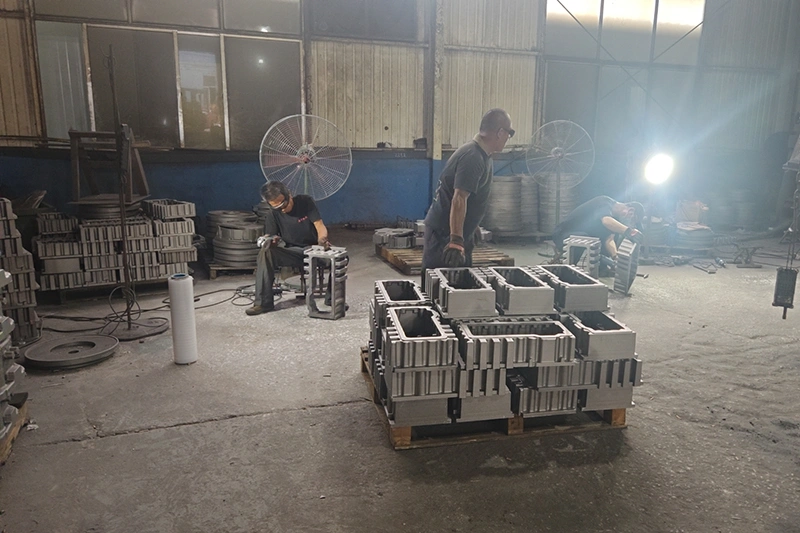
Spec sheets often list “cast iron” and “ductile iron” as if they’re interchangeable. They’re not.
I’ve seen engineers spec gray iron for high-impact applications, only to watch parts crack after a few months in service. I’ve also watched procurement teams pay 40% more for ductile iron when gray iron would have performed identically. Both mistakes hurt the bottom line.
The difference between these materials comes down to one thing: the shape of graphite inside the metal. That microscopic detail determines whether your part will bend or shatter, whether it will dampen vibration or transmit it, and whether you’re spending the right amount of money for your application.
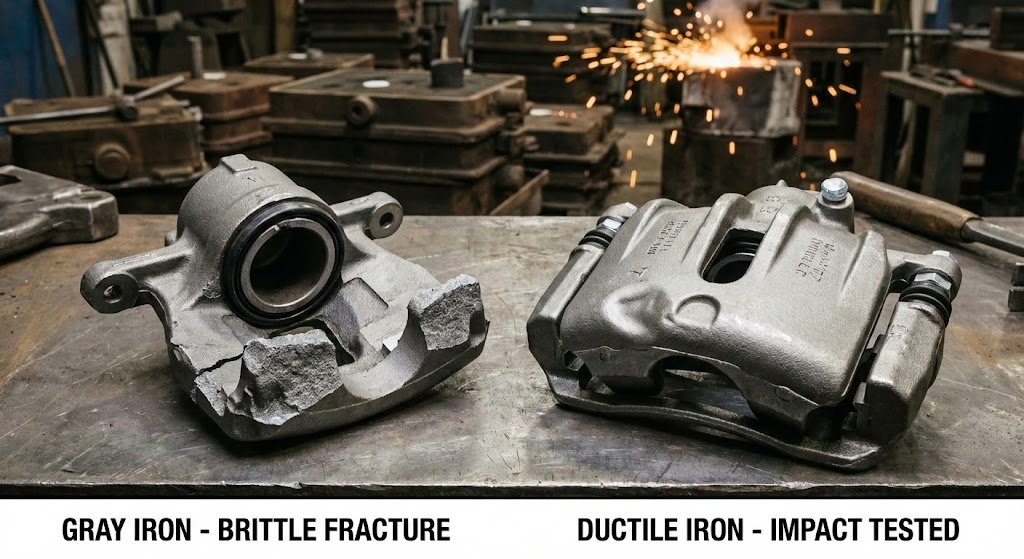
The graphite structure separates these materials. Gray iron contains graphite in flat, flake-like formations scattered throughout the metal matrix. Ductile iron contains graphite in spherical nodules.
This isn’t a subtle difference. Under a microscope, gray iron looks like it’s filled with tiny razor blades. Ductile iron looks like it’s embedded with ball bearings.
Foundries create ductile iron by adding a small amount of magnesium to molten gray iron. The magnesium causes graphite to precipitate as spheres instead of flakes during solidification. The final product contains just 0.03-0.06% residual magnesium, but that trace amount transforms the material’s behavior.
| Property | Gray Iron | Ductile Iron |
|---|---|---|
| Iron Content | 96-98% | 93-94% |
| Carbon Content | 2-4% | 3.2-3.6% |
| Silicon Content | 1-3% | 2.2-2.8% |
| Magnesium | None | 0.03-0.06% |
| Graphite Shape | Flakes | Spherical nodules |
The composition numbers look similar. The performance numbers don’t.
Ductile iron delivers roughly double the tensile strength of gray iron, with impact resistance that’s three to four times higher.
| Property | Gray Iron | Ductile Iron |
|---|---|---|
| Tensile Strength | 20,000-60,000 psi | 60,000-100,000+ psi |
| Yield Strength | Not measurable | 40,000-90,000 psi |
| Elongation | Less than 1% | 2-18% |
| Impact Resistance | 2 ft-lbs | 7+ ft-lbs |
These aren’t theoretical differences. When a gray iron part receives an impact, it shatters. When a ductile iron part receives the same impact, it deforms and absorbs the energy.
Gray iron fractures before it bends. The graphite flakes act as internal stress concentrators, creating weak points throughout the material. When load increases, cracks propagate instantly along these flake boundaries.
This brittleness means engineers can’t measure yield strength for gray iron. The material doesn’t transition from elastic to plastic deformation. It simply breaks.
Some applications benefit from this behavior. Gray iron’s predictable failure mode makes it suitable for sacrificial components where controlled fracture is preferable to unpredictable deformation.
Spherical graphite nodules distribute stress evenly across the metal matrix. Instead of creating stress concentration points, the rounded shapes stop crack propagation.
When a crack encounters a nodule, it wraps around the sphere instead of continuing through the material. This crack-arresting behavior gives ductile iron steel-like strength while maintaining iron’s casting advantages.
Foundry engineers describe ductile iron this way: it machines like cast iron but performs like steel.
Gray iron excels at thermal management and vibration damping. The same graphite flakes that weaken the material also conduct heat efficiently and absorb mechanical vibrations.
Thermal conductivity in gray iron runs 20-25% higher than ductile iron. The flake structure creates continuous heat pathways through the material. Ductile iron’s nodules interrupt these pathways, reducing heat transfer efficiency.
Vibration damping shows an even larger gap. Gray iron absorbs vibration energy at low stress levels where ductile iron continues to transmit it. Machine tool bases, engine blocks, and precision equipment housings often specify gray iron specifically for this property.
Machinability favors gray iron by a significant margin. The graphite flakes create natural chip-breaking points and lubricate the cutting surface. Shops report 15-25% cost savings when machining gray iron versus ductile iron components of similar complexity.
Cost differences compound these advantages. Gray iron averages $0.60 per pound compared to $0.85 per pound for ductile iron. For high-volume production runs, this 40% material cost premium adds up quickly.
Application selection follows directly from material properties. Gray iron dominates where thermal management or vibration control matters. Ductile iron dominates where strength and impact resistance matter.
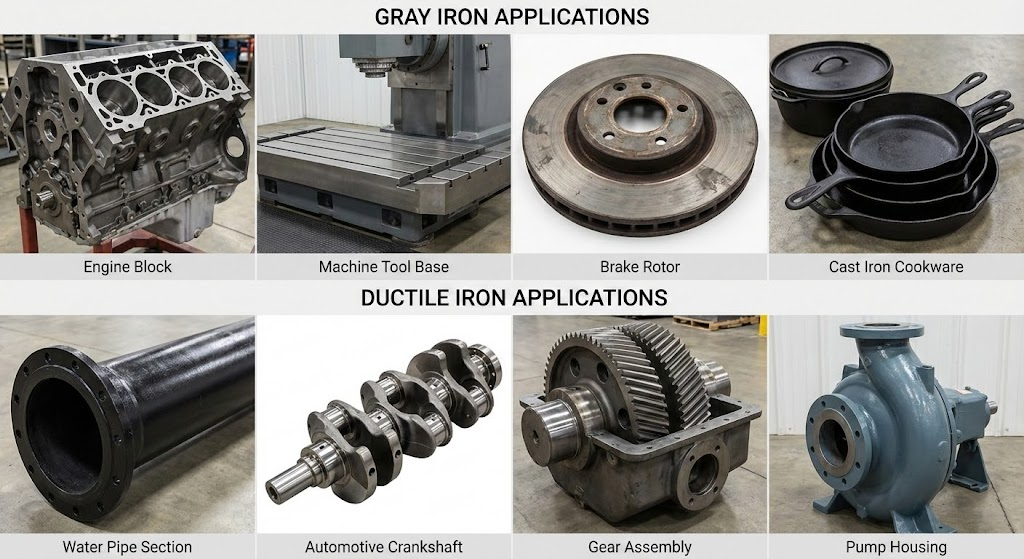
Match the material to your application requirements. Neither material is universally superior.
| Requirement | Choose Gray Iron | Choose Ductile Iron |
|---|---|---|
| Primary concern is cost | Yes | No |
| Vibration damping needed | Yes | No |
| Thermal conductivity critical | Yes | No |
| High strength required | No | Yes |
| Impact or fatigue loading | No | Yes |
| Pressure containment | No | Yes |
| Complex shapes with stress risers | No | Yes |
| Extensive machining planned | Yes | Maybe |
| Welding required | Neither is ideal | Neither is ideal |
Your foundry partner can help navigate these tradeoffs. Most experienced foundries evaluate your application and recommend the appropriate material based on actual requirements, not assumptions.
Gray iron and ductile iron share the same base elements but deliver dramatically different performance. The graphite shape determines everything: flakes create brittleness, thermal conductivity, and damping capacity. Nodules create strength, ductility, and impact resistance.
Specify gray iron when you need heat management, vibration control, or maximum cost efficiency in low-stress applications. Specify ductile iron when strength, impact resistance, or fatigue life drive your requirements.
Getting this decision right saves money and prevents failures. Getting it wrong costs both. Talk to your foundry early in the design process to optimize material selection for your specific application.