Strike a chisel against ductile iron and it produces a small curl. Strike gray iron and you get dust. This simple test reveals the fundamental difference between these two materials – and explains why choosing wrong can mean the difference between a component that lasts decades and one that fails without warning.
The difference comes down to graphite structure. In gray iron, graphite forms as flakes that act as stress concentrators. In ductile iron, magnesium addition forces graphite into spheroidal nodules that distribute stress evenly. This single microstructural variation drives every performance characteristic that matters for material selection.
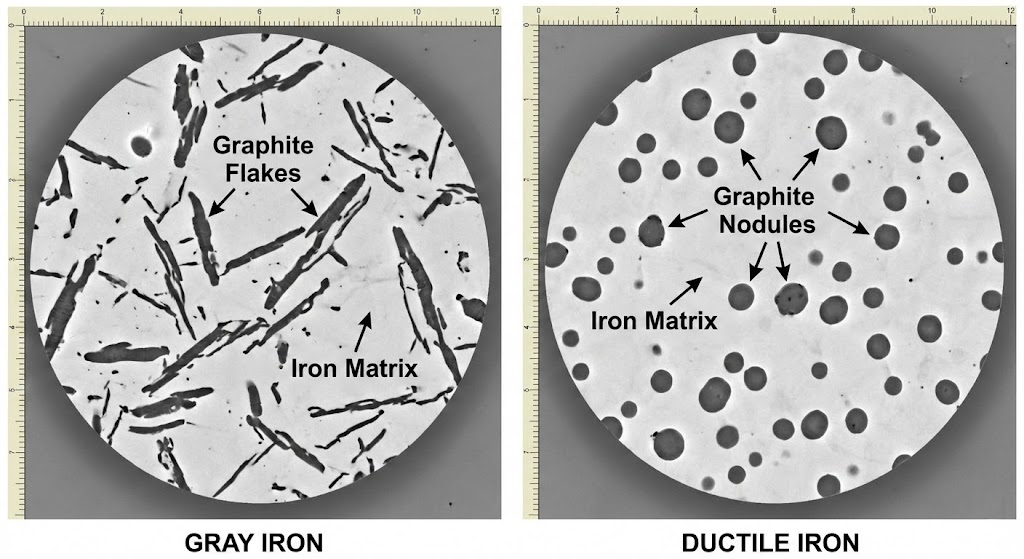
The critical difference is graphite morphology – flakes versus nodules. Everything else flows from this distinction.
Gray iron forms during slow cooling, allowing graphite to precipitate as interconnected flakes throughout the matrix. These flakes provide excellent properties for certain applications, but they also create internal stress risers that limit tensile strength and eliminate meaningful ductility.
Ductile iron requires a nodularizing treatment – typically magnesium or cerium addition – that forces graphite into spheroidal shapes. As one technical source describes it, “the graphite has a nodular/spherical shape conferring higher strength and ductility as opposed to gray iron which is flake shaped.”
The flake structure in gray iron is not a defect to be corrected. For vibration damping, thermal conductivity, and machinability, those flakes provide advantages that nodular graphite cannot match. I recommend understanding this distinction before defaulting to ductile iron simply because it is “stronger.”
The base compositions are similar, but the key difference is the nodularizing agent.
| Element | Gray Iron | Ductile Iron |
|---|---|---|
| Carbon | 2-4% | 3.2-3.6% |
| Silicon | 1-3% | 2.2-2.8% |
| Magnesium | None | 0.03-0.06% |
That small magnesium addition – just 0.03-0.06% – transforms the material’s behavior completely. However, it also adds cost and processing complexity. Do not specify ductile iron unless your application genuinely requires its properties.
For any application requiring impact resistance, pressure containment, or meaningful elongation, ductile iron is non-negotiable. Gray iron’s brittleness makes it unsuitable for dynamic loading conditions.
The numbers tell the story clearly. Ductile iron resists a minimum of 7 foot pounds of impact versus just 2 pounds for gray iron – a 3.5x advantage. Elongation differences are even more dramatic: 18% for ASTM A536 Grade 60-40-18 versus less than 1% for gray iron.
With yield and ultimate tensile strength so close together, gray iron is classified as a “brittle material” per ASTM standards. It fails without warning under shock loads.
Specify ductile iron for:
ASTM A536 uses a straightforward naming convention: Tensile-Yield-Elongation in ksi/ksi/%. Select grade based on your minimum elongation requirement.
| Grade | Tensile (ksi) | Yield (ksi) | Elongation | Matrix | Best Application |
|---|---|---|---|---|---|
| 60-40-18 | 60 | 40 | 18% | Ferritic | Maximum ductility, impact toughness |
| 65-45-12 | 65 | 45 | 12% | Ferritic-pearlitic | General purpose |
| 80-55-06 | 80 | 55 | 6% | Pearlitic | Higher strength, wear resistance |
| 100-70-03 | 100 | 70 | 3% | Pearlitic | High strength applications |
| 120-90-02 | 120 | 90 | 2% | Tempered martensite | Maximum strength |
In lower-strength grades like 60-40-18, a fully ferritic matrix yields high elongation and impact toughness. In higher-strength grades like 100-70-03, a predominantly pearlitic matrix provides strength and wear resistance but sacrifices ductility.
For most applications requiring ductile iron, I recommend starting with 65-45-12. It provides balanced properties without over-specifying. Move to higher grades only when you need specific strength or wear characteristics that justify the reduced elongation.
Pressure containment is where ductile iron’s advantages become mandatory, not optional. Both ASME B31.1 and B31.3 restrict gray iron use in toxic, flammable, and steam service for good reason.
As one industry engineer noted, “Grey cast iron is more brittle than ductile iron so piping should impose minimal forces on the valves.” Another practitioner put it more directly: “The standard for any valve manufacturer is ductile. The advice is to stick to the standard material configuration.”
Gray iron’s brittleness means piping systems cannot impose significant forces on custom valve castings without risking sudden failure. For any pressure-containing application, specify ASTM A536 and select grade based on elongation and strength requirements.
Gray iron excels in three areas where ductile iron cannot compete: vibration damping, thermal conductivity, and machinability. For these applications, gray iron is the superior choice – not the budget alternative.
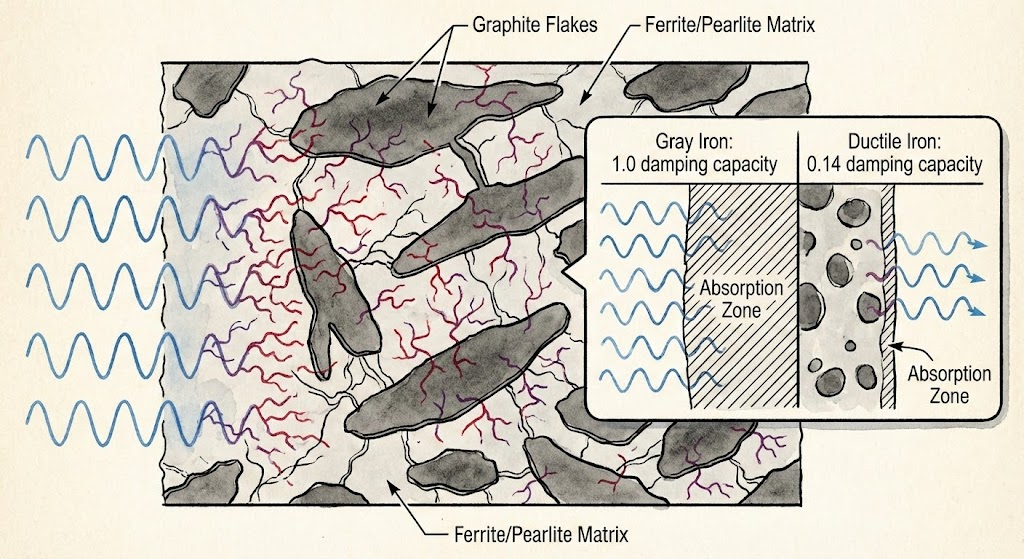
Gray iron’s damping capacity is approximately 7 times higher than ductile iron. The relative damping capacity of gray iron is 1.0, while ductile iron measures just 0.14.
This dramatic difference comes from the graphite flake structure. Those interconnected flakes absorb and dissipate vibration energy through internal friction. Nodular graphite simply cannot match this behavior.
Specify Class 30-35 gray iron for:
Important: Higher-strength gray iron grades (Class 40+) sacrifice damping capacity. If you specify Class 50 for a machine base, you are paying for strength you may not need while losing the damping performance you actually want. For damping-critical applications, I recommend Class 30-35 specifically.
Gray iron’s thermal conductivity is 46 W/m versus 36 W/m for ductile iron – 28% higher. Heat transfer occurs through the graphite flake network, creating continuous conductive paths through the material.
This advantage matters for:
Gray iron’s superior resistance to thermal shock comes from the same graphite flake structure. The flakes accommodate thermal expansion differences between the graphite and iron matrix, reducing thermal stress concentration.
ASTM A48 classifies gray iron by tensile strength. The class number equals the nominal tensile strength in ksi.
| Class | Tensile (ksi) | Characteristics | Best Application |
|---|---|---|---|
| 20-25 | 20-25 | Excellent machinability, maximum damping | Low-stress, damping-critical |
| 30-35 | 30-35 | Balanced properties, good damping | General purpose, machine bases |
| 40-45 | 40-45 | Higher strength, reduced damping | Moderate strength requirements |
| 50-60 | 50-60 | Maximum strength, difficult machining | Wear-resistant applications |
The trade-off is consistent: Grade 20, 25, 30, and 35 gray cast irons have excellent machinability and high damping capacity. Grade 40, 45, 50, 55, and 60 gray cast irons are generally more difficult to machine with lower damping capacity.
Gray iron machines significantly faster than ductile iron. As one industry source confirmed, “gray cast iron is much easier to machine than ductile iron.”
The graphite flakes provide internal lubrication during cutting operations. This results in:
Both feed and speeds can be higher for gray iron compared to ductile iron. When common defects in sand castings require post-casting machining, gray iron’s machinability advantage can significantly reduce total part cost.
The following table provides direct comparison of key properties. Use these values for material selection decisions.
| Property | Gray Iron | Ductile Iron | Advantage |
|---|---|---|---|
| Tensile Strength | 20,000-60,000 psi | 60,000-120,000 psi | Ductile 2-3x higher |
| Impact Resistance | 2 ft-lbs | 7+ ft-lbs | Ductile 3.5x higher |
| Elongation | <1% | 2-18% | Ductile 10-18x higher |
| Damping Capacity | 1.0 (relative) | 0.14 (relative) | Gray 7x higher |
| Thermal Conductivity | 46 W/m | 36 W/m | Gray 28% higher |
| Compressive Strength | 3-4x tensile | ~1.3x tensile | Gray 2-3x higher |
Note the compressive strength difference. Gray iron’s compressive strength is typically three to four times its tensile strength, while ductile iron’s compressive strength is only about 1.3x tensile. For applications in pure compression, gray iron may be the more economical choice.
Ductile iron’s strongest type (to ASTM A536) achieves a tensile strength of 827 N/mm2, while the toughest gray iron equivalent (SAE G4000) reaches only 276 N/mm2. When tensile strength drives your selection, ductile iron is clearly superior.
Material selection must consider total cost: raw material, processing complexity, and post-casting machining. Ductile iron’s higher performance comes with higher processing requirements.
Gray iron costs less due to simpler manufacturing. The alloy melts, pours, and solidifies without requiring special treatment.
Ductile iron requires nodularizing agents – primarily magnesium – that add both material cost and process complexity. Timing is critical: do not exceed 25 minutes per ladle to avoid spheroidizing recession, which degrades nodularity.
The inoculation window means ductile iron production requires more careful process control. Foundries must manage ladle temperature, treatment timing, and pouring rate more precisely than with gray iron.
Gray iron’s machinability advantage often offsets its lower strength. Consider these factors:
For parts requiring significant machining, calculate total cost: material + machining + performance requirements. A custom grey iron casting that machines faster may cost less overall than a ductile iron part that requires slower, more careful machining.
Follow this sequence to select the appropriate material for your application.
Step 1: Does the application require impact resistance or pressure containment?
Step 2: Is vibration damping critical?
Step 3: Is thermal conductivity critical?
Step 4: Is machinability or cost the primary concern?
Step 5: Is tensile strength above 60 ksi required?
If your application does not clearly require ductile iron’s strength and ductility, gray iron is often the more economical choice. Do not over-specify.
Material selection between ductile iron and gray cast iron should match application requirements – not assumptions about which material is “better.” Gray iron excels where damping, thermal conductivity, and machinability matter. Ductile iron excels where strength, impact resistance, and elongation are critical.
The key deliverable from this guide is ASTM grade specification. For ductile iron, select from A536 grades based on elongation requirements. For gray iron, select from A48 classes based on strength and damping needs.
Ready to discuss your specific casting requirements? Our foundry team can help you select the right material and grade for your application. Contact us with your specifications, loading conditions, and performance requirements to get started.