Sand cast motor housings can hold CT8-CT10 on as-cast features and H7 on machined bearing bores — but only when you specify the right tolerance class for each surface. The mistake I see most often is treating every dimension the same. A motor housing has three or four surfaces that demand tight control and dozens that don’t. Getting that allocation wrong either drives cost through the roof or produces housings that won’t accept bearings without rework.
This article maps ISO 8062 CT grades to specific motor housing features, defines the mating surface specifications that bearing manufacturers actually require, and lays out the finishing sequence from shakeout to final inspection.
Sand casting dimensional accuracy follows ISO 8062-3, which defines 16 Casting Tolerance (CT) grades from CT1 (tightest) to CT16 (loosest). For motor housings, the achievable CT grade depends on the molding method and part envelope size.
| Molding Method | Part <=200 mm | Part 200-500 mm | Part >=500 mm |
|---|---|---|---|
| Shell molding | CT6-CT7 | CT6-CT8 | CT7-CT8 |
| Green sand (machine) | CT7-CT8 | CT8-CT9 | CT9-CT10 |
| Resin sand | CT7-CT9 | CT8-CT10 | CT9-CT10 |
| Manual green sand | CT10-CT12 | CT10-CT12 | CT11-CT13 |
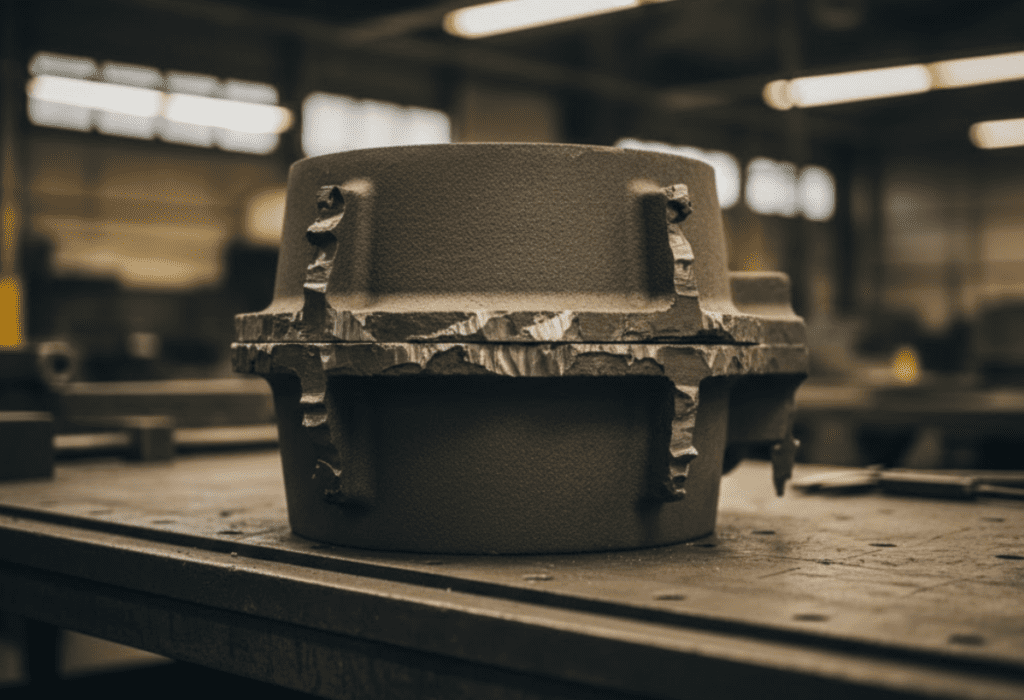
What those numbers mean in practice: a 250 mm motor housing diameter cast in machine-molded green sand at CT9 has a tolerance of roughly +/-1.6 mm on as-cast surfaces. At CT10, that opens to +/-2.0 mm. Neither value is adequate for bearing bores or mating flanges, which is precisely why those features require machining.
The gating system has more influence on as-cast accuracy than most engineers realize. Uneven metal flow creates differential shrinkage, and the result is dimensional scatter that no amount of post-machining can fully correct on thin-walled sections. I always recommend running solidification simulation before committing to a gating layout — the cost of simulation is trivial compared to scrapping a batch of housings because bore concentricity drifted.
One detail that catches people: dimensions crossing the parting line pick up an additional +/-0.75 mm tolerance due to cope-to-drag mismatch. For motor housings, keep critical bearing bore axes in the same mold half whenever possible.
CT grades apply only to as-cast surfaces. The moment a surface gets machined, specify tolerances per ISO 286 (H7, H6, etc.) and GD&T callouts on the machined drawing. Mixing CT grades and machining tolerances on the same feature creates confusion at the foundry.
A motor housing has four categories of surfaces, each with different tolerance requirements. Specifying them correctly is where most of the engineering value lies.
Bearing housing bore tolerance depends on the load condition and whether the outer ring rotates. Per SKF and Koyo recommendations, most electric motors have a stationary outer ring with point loading, which calls for an H7 clearance fit. Precision applications use H6.
For motors subject to vibration or shock loads, transition fits (K6-K7) or light interference fits (M7) prevent the outer ring from creeping in the bore. Cast iron housings generally need fits one grade tighter than catalog values because the material’s lower elasticity provides less grip than steel housings.
Surface roughness on bearing seats must reach Ra 0.8-1.6 um, achieved through fine boring or grinding. Roundness tolerance follows IT3-IT4 for standard bearing classes (Class 0 and 6) and IT2-IT3 for precision classes (Class 5 and 4). These geometric tolerances are non-negotiable — a perfectly sized bore with poor roundness will still cause bearing vibration.
The spigot joint between the motor housing and end shield is a location fit, typically H7/h6 or H7/js6. This joint establishes coaxiality between the bearing bores at each end of the housing. Misalignment here directly translates to shaft deflection and premature bearing failure.
A warped mating face undermines bore alignment just as fast as an oversized bore. Specify IT7 flatness on end shield mounting surfaces with Ra <=3.2 um.
Mounting surfaces need flatness control (IT7-IT8) but not the tight diametral tolerances of bearing bores. Surface finish of Ra 3.2-6.3 um from face milling is adequate. The critical dimension is the centerline height from mounting feet to shaft center, which NEMA and IEC frame standards define.
Cooling fin areas, general wall sections, and cosmetic surfaces remain as-cast at CT10-CT12. Specifying machining on these surfaces adds cost with zero functional benefit.
The finishing path for a motor housing follows a specific sequence. Skipping steps or reordering operations creates problems that compound downstream.
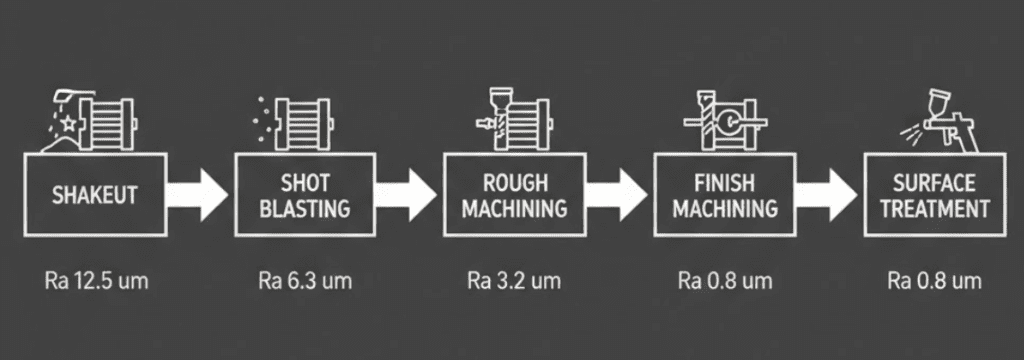
After shakeout, castings go through shot blasting to remove scale and adhered sand. This step also reveals surface defects — porosity, sand inclusions, cold shuts — that would otherwise hide until machining. Inspect before committing machining time.
Rough machining removes the bulk of the casting allowance. For motor housings over 20 kg, the Required Machining Allowance (RMA) per ISO 8062 is 2.5-3.5 mm for green sand and 3.0-4.0 mm for resin sand. Leave 0.5-1.0 mm of stock for finish passes.
The metallurgical reason rough machining comes first: removing material releases residual stress from solidification. An Eng-Tips machinist with experience in thin-wall cast iron cylinders found that alternating outside and inside cuts, with rest periods between operations for stress equalization, allowed holding tolerances within 0.025-0.075 mm on walls as thin as 1.5-2.3 mm. The same principle applies to motor housing bores — rough both ends, let the casting sit, then finish.
Finish passes bring bearing bores to their final H7 or H6 tolerance. CNC boring achieves +/-0.01 mm on diameter with surface finishes of Ra 0.8-1.6 um. For housings requiring Ra below 0.8 um on bearing seats, add a grinding operation after boring.
Surface roughness progresses predictably through the finishing stages: as-cast surfaces start at Ra 6.3-12.5 um, rough machining brings them to 3.2-6.3 um, finish machining reaches 0.8-1.6 um, and grinding can achieve 0.1-0.4 um where needed.
After machining, deburr all edges and intersections. Motor housings typically receive powder coating or liquid paint for corrosion protection. Mask bearing bores and mating surfaces before coating — any coating buildup on these features changes the fit dimensions.
Dimensional tolerances alone don’t capture what motor housing bores actually need. GD&T callouts control form, orientation, and location — the parameters that determine whether bearings run true.
The most critical GD&T callout for motor housings is bore alignment between the drive end and non-drive end bearing seats. Timken catalogs specify concentricity of 0.003 mm between bearing cylinders, perpendicularity of bearing face to shoulder of 0.002 mm, and parallelism of mounting faces of 0.002 mm. These are aggressive values — even temperature variation in the inspection room can push a part out of tolerance at these levels.
My recommendation: use total runout instead of concentricity for bore alignment. ASME Y14.5-2018 actually removed concentricity as a GD&T control, and for good reason. Total runout simultaneously controls off-center position, roundness, and cylindricity in a single callout. It captures the functional requirement — will the shaft run true in these bores — better than concentricity alone. And it can be measured with a V-block and dial indicator rather than requiring CMM computation of a derived median axis.
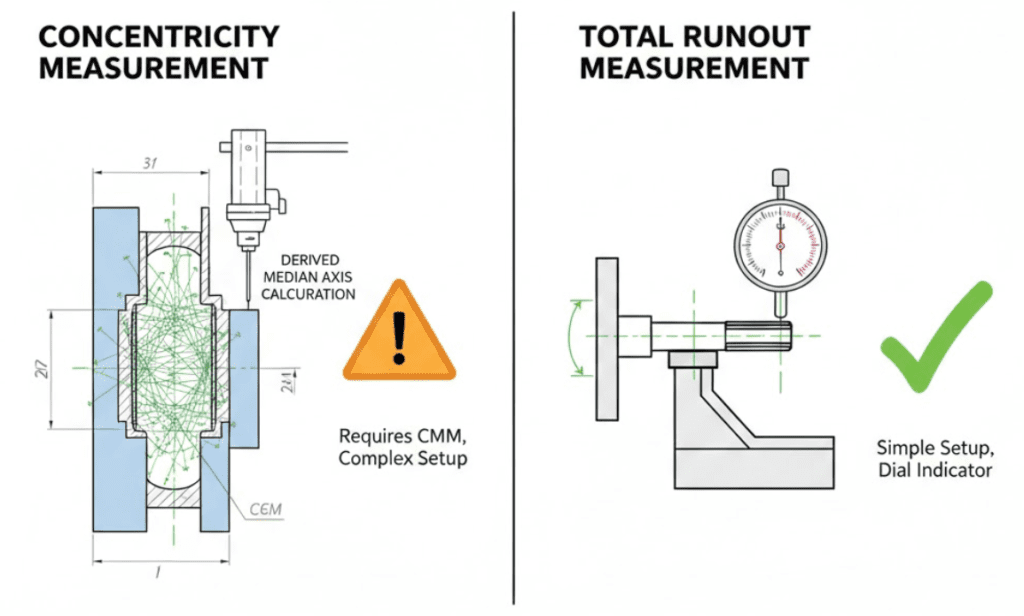
Specify total runout of 0.010-0.025 mm for general industrial motors and 0.005-0.010 mm for precision or high-speed applications. These values are achievable with proper fixturing during finish boring.
Prepare separate drawings for the raw casting and the finished part. The casting drawing shows as-cast tolerances per CT grade and RMA allowances. The machining drawing shows final dimensions, GD&T callouts, and surface finish requirements. This separation tells the foundry exactly what they must deliver and tells the machine shop exactly what the incoming material looks like.
The most expensive mistake in motor housing specifications isn’t loose tolerances — it’s tight tolerances on surfaces that don’t need them. One Practical Machinist forum engineer described labeling nearly every feature with +/-0.01 mm and receiving a quote at double the expected cost. On a typical motor housing, only the bearing bores, spigot joints, and mounting face flatness need machined tolerances. Everything else can remain as-cast at CT10-CT12 without any functional consequence. Start your specification by identifying the three or four surfaces that actually contact bearings, end shields, or mounting hardware, then tighten only those.