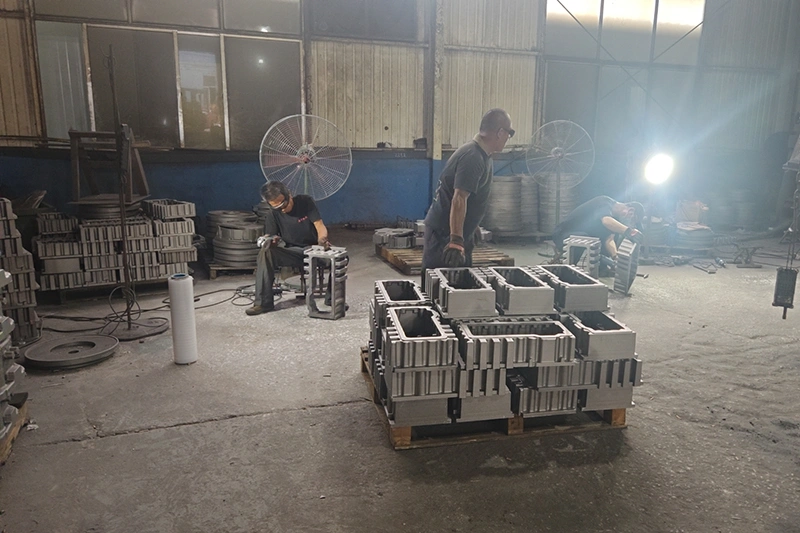
“We often don’t understand a customer’s design intent for a part.” That observation from Jeff Taylor, a casting engineer at C.A. Lawton Co., captures the single biggest problem in counterweight casting orders. Engineers specify every dimension, every surface finish, every bolt hole location — but almost never specify the one parameter that determines whether the counterweight actually works: weight tolerance.
A counterweight that comes back 4% heavier or lighter than planned throws off the entire balance calculation. The casting dimensions can be perfect, the surface finish flawless, and the part still fails its fundamental purpose. Before designing the pattern, consider that weight accuracy starts long before the casting is poured — it starts with material selection and tolerance specifications that most engineers leave off the drawing entirely.
Gray iron ASTM A48 Class 30 is the right default for most counterweight applications, and there is no reason to fight that consensus. At a density of 7.15 g/cm3, it delivers high mass per unit volume at the lowest casting cost — approximately $1,206/ton in green sand. Gray iron also offers excellent damping capacity (relative rating of 1.0 compared to 0.14 for ductile iron), which matters for counterweights on equipment subject to vibration.
The decision gets more nuanced at the mounting points. Gray iron has essentially zero elongation — it is a brittle material. For static counterweights on cranes, elevators, or fixed equipment, that brittleness is irrelevant because the loads are predictable and compressive. But when mounting bolt holes experience cyclic loading, vibration, or impact forces, gray iron fractures without warning.
That is when ductile iron becomes necessary. ASTM A536 Grade 65-45-12 provides 65 ksi tensile strength with 12% elongation, giving mounting points the ability to absorb shock loads without cracking. The density is comparable at 7.1-7.3 g/cm3, so the weight penalty is minimal. The cost penalty is real — roughly 9% more per ton — but it is justified whenever the counterweight bolts to something that moves.
| Property | Gray Iron A48 Class 30 | Ductile Iron A536 65-45-12 | Steel |
|---|---|---|---|
| Density | 7.15 g/cm3 | 7.1-7.3 g/cm3 | 7.85 g/cm3 |
| Tensile Strength | 30 ksi (207 MPa) | 65 ksi (448 MPa) | Varies |
| Elongation | ~0% | 12% | Varies |
| Relative Cost | Baseline | +9% | +30-50% |
Steel counterweights at 7.85 g/cm3 deliver the highest density per volume, but casting cost and machinability rarely justify the premium outside of space-constrained applications where every cubic inch counts.
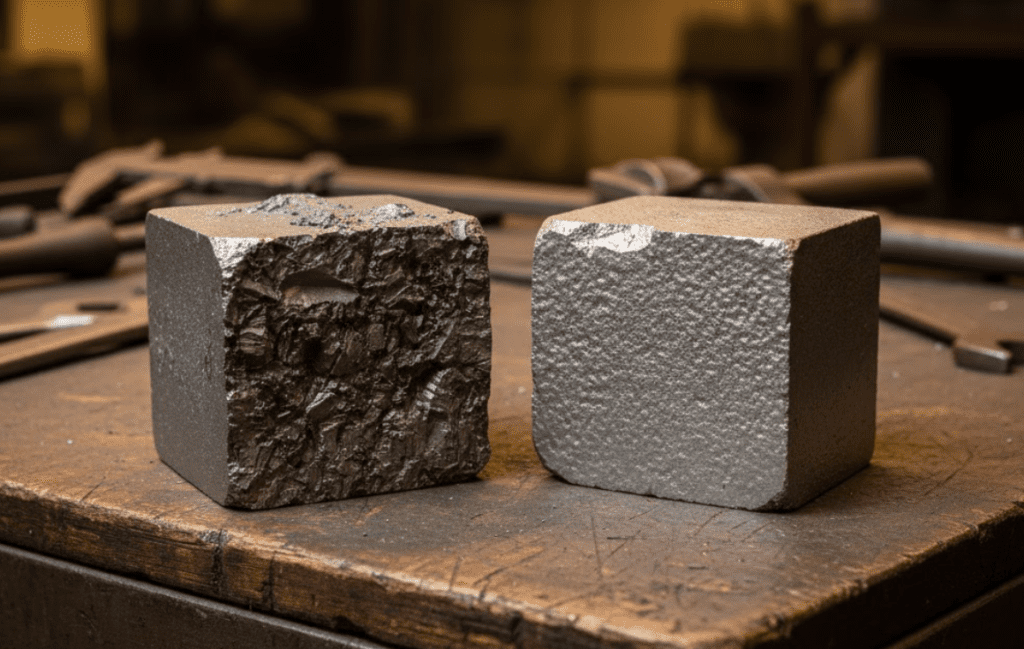
Before designing the pattern, the fundamentals of sand casting design apply to counterweights just as they do to any casting — but with one important difference. On a pump housing, the critical output is dimensional accuracy. On a counterweight, the critical output is weight. Every design decision that affects material distribution affects the final as-cast weight.
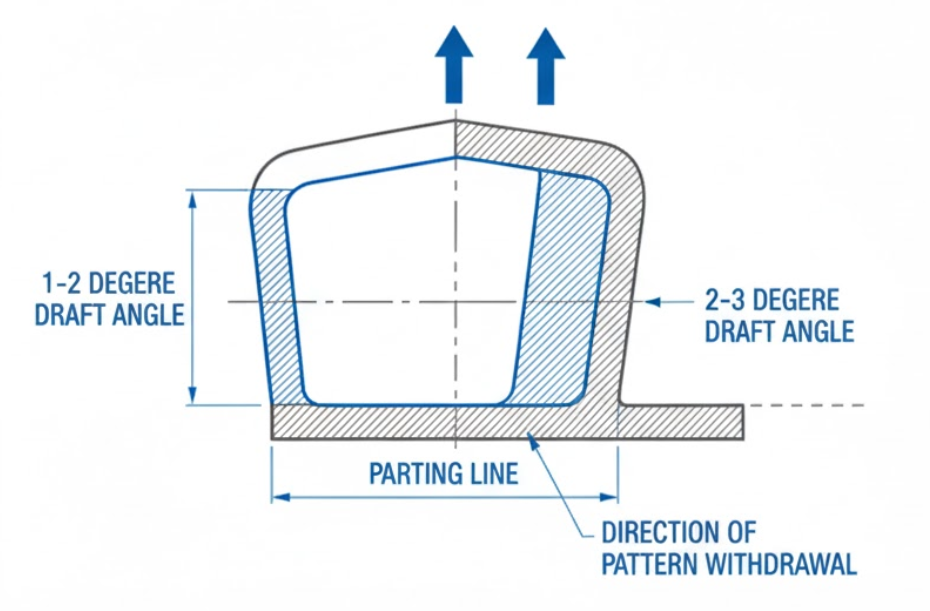
Draft angles of 1-2 degrees on external surfaces and 2-3 degrees on internal surfaces are non-negotiable. Each degree of draft adds 0.017 inches per inch of draw to the dimension, which adds material and therefore weight. Skipping draft to “save weight” destroys the mold during extraction and creates scrap.
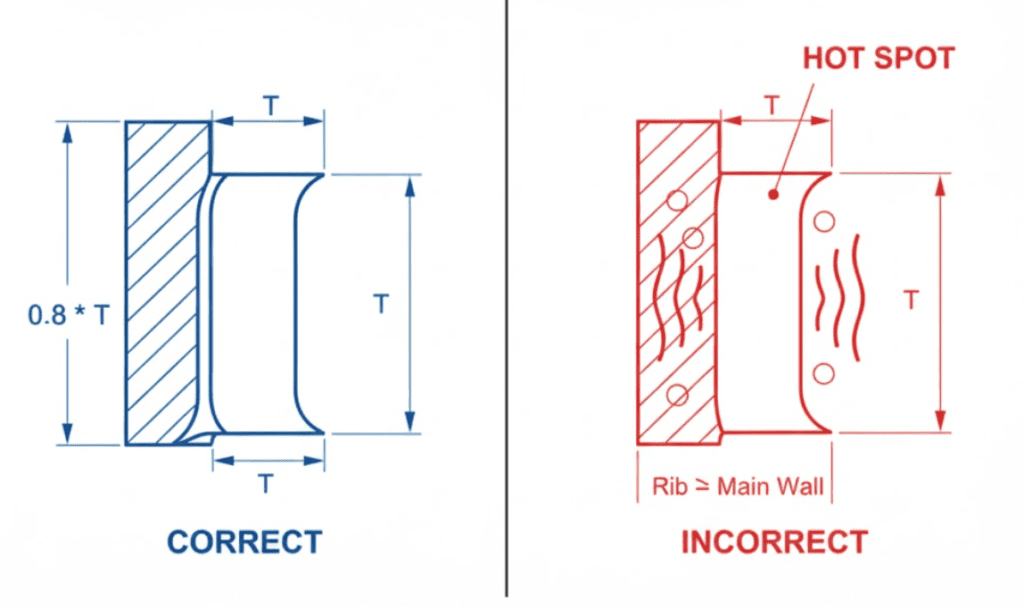
Wall thickness should be at least 0.150 inches, with adjacent sections varying by no more than 20-30%. Rapid cross-sectional changes create hot spots that cause shrinkage voids — unpredictable internal cavities that throw off weight consistency from casting to casting. If the design includes reinforcing ribs, the Penticton Foundry engineering team recommends keeping rib thickness at approximately 80% of the adjoining section. This allows ribs to solidify first, preventing shrinkage defects that accumulate inside the casting where you cannot see them.
Section transitions should follow a 1:4 taper ratio. Sharper transitions concentrate stress and create feeding problems during solidification.
For mounting surfaces, avoid using a core as your primary datum. As Jeff Taylor explains, cores can shift position slightly during mold assembly, and when all other dimensions reference that shifted core, the errors cascade. Use machined surfaces as datum points instead, and add machining allowance to accommodate the inevitable core shift. The machining allowance should account for both dimensional variation and the need to reach sound metal below the as-cast surface.
Weight tolerance is the most under-specified parameter on counterweight casting drawings. Everyone agrees that “precise weight calculation is critical,” but drawings rarely include an actual tolerance band or verification method. That gap between acknowledging weight is important and actually specifying it is where most counterweight orders fall short.
Typical industry practice for cast iron counterweights falls in the range of +/-2% to +/-5% of target weight. Where you fall in that range depends on the application. Static ballast on a crane boom can tolerate +/-5%. Counterweights for precision balancing equipment or rotating machinery need +/-2% or tighter.
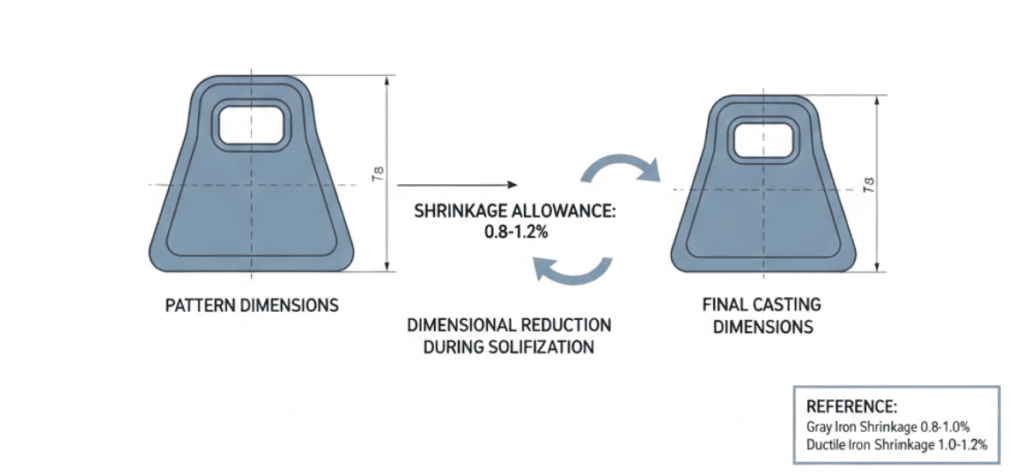
The material choice directly affects weight predictability through shrinkage allowance. Gray iron shrinks 0.8-1.0% during solidification; ductile iron shrinks 1.0-1.2%. The pattern must be oversized to compensate. An uncompensated 0.2% shrinkage difference on a 500 kg counterweight translates to roughly 1 kg of weight deviation — enough to affect balance calculations in precision applications.
The GB/T 11351 standard defines 16 weight tolerance grades (MT1 through MT16) for castings. For production runs, the nominal weight is established by averaging at least 10 castings from the first qualified batch, then measuring subsequent castings against that baseline. Specify the MT grade on your drawing. If you leave it off, the foundry defaults to dimensions and surface quality, not weight — because that is what most customers measure.
Here is how to specify tolerances correctly: put the target weight, the acceptable tolerance band, and the verification method on the drawing. “Target weight: 250 kg +/-2% (245-255 kg), verified by calibrated scale per GB/T 11351 MT grade [X].” Without this line, you are hoping the foundry guesses that weight is a functional requirement.
Green sand casting handles the majority of counterweight production. At roughly $1,206/ton for gray iron, it is the most economical process and accommodates counterweights from a few kilograms to several tons. Sand casting tolerances in green sand typically achieve CT8-CT12 dimensional grades, which is adequate for most counterweight geometries.
Resin sand casting costs approximately 13% more (around $1,365/ton for gray iron) but delivers meaningful quality improvements: CT7-CT10 dimensional tolerance, fewer internal defects from porosity and sand inclusions, and more rigid molds that resist deformation during pouring. Those fewer internal defects translate directly to more consistent as-cast weight from piece to piece.
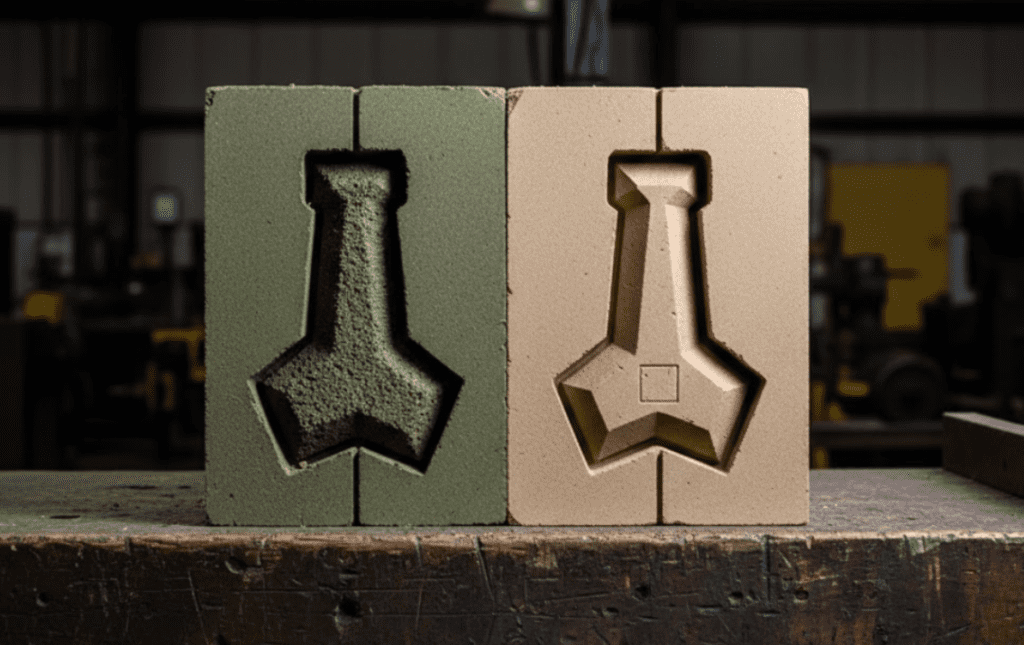
For standard counterweights with +/-5% weight tolerance, green sand is sufficient and the cost savings are real. For precision counterweights requiring +/-2% weight tolerance or tighter, the 13% premium for resin sand is worth it — not for the surface finish improvement, but for the weight consistency that comes from fewer internal voids.
As-cast surface finish in sand casting runs 200-500 RMS. For counterweights, this finish is typically acceptable on all surfaces except mounting faces and bolt hole locations, which require machining. Outdoor counterweights benefit from a zinc-rich primer plus polyester topcoat for corrosion protection; indoor applications need only a standard primer.
The most common mistake in counterweight orders is treating them like any other casting — specifying geometry and letting the foundry figure out the rest. A counterweight is a functional mass, and the foundry needs to know that weight is a controlled parameter, not a byproduct of getting the dimensions right. Start your RFQ with the target weight and tolerance band, then the material grade, then the geometry. That sequence tells the foundry exactly what matters most and lets them adjust pattern dimensions, gating, and process selection to hit your weight target.