KT METAL CASTING LOGO

KT Metal Castings Blogs

What Is Centrifugal Casting

Centrifugal casting is a metal casting process that uses rotational force to produce cylindrical parts. The process involves pouring molten metal into a spinning mold where centrifugal force pushes the metal against the mold walls. This creates parts with dense, uniform structures and minimal defects. The technique produces hollow cylindrical…

What Is the Difference Between Gravity Casting and Centrifugal Casting

The main difference between gravity casting and centrifugal casting is how molten metal fills the mold. Gravity casting relies on gravity to fill the mold, making it ideal for simpler parts. Centrifugal casting uses high-speed rotation to force metal outward, which improves density and is suited for cylindrical parts. What…

What Is the Difference Between Sand Casting and Centrifugal Casting

The main difference between sand casting and centrifugal casting is how the mold and metal interact. Sand casting uses static sand molds and gravity to form parts, while centrifugal casting spins a mold rapidly to force molten metal outward. Centrifugal casting produces denser, more precise parts with fewer impurities. What…

Expendable Mold Casting vs Investment Casting: What is the Relationship

The main difference between expendable mold casting and investment casting is that investment casting is a type of expendable mold casting that uses a ceramic shell built around a wax pattern. All investment casting is expendable, but not all expendable mold casting uses the same detailed, precise process. What is…

What is Expendable Mold Casting

Expendable mold casting is a metal forming process where the mold gets destroyed to remove the finished part. The mold is made from materials like sand, plaster, or ceramic that break apart after the metal cools and hardens. This process differs from permanent mold casting where the same mold creates…

What is The Differences Between Cast Aluminum and Cast Iron

The main difference between cast aluminum and cast iron is density; cast aluminum is light (≈ 2.7 g/cm³) while cast iron is heavy (≈ 7.2 g/cm³). Aluminum cools fast, dissipates heat, resists corrosion, and machines easily. Iron handles higher compressive loads, retains heat, costs less per kilogram, and melts at…

Types of Metal Casting Surface Finish

Foundries smooth cast parts with finishes such as as-cast, shot-blasted, tumble-deburr, machined, ground, polished, bead-blasted, powder-coated, anodized, and electroplated. Each step lowers roughness—from 200-500 µin Ra in sand cast to ≤4 µin Ra after precision polishing—while adding corrosion or cosmetic benefits and improving dimensional fidelity. Mechanical Surface Modification Processes Abrasive…

Guide to Determining the Weldability of Aluminum Castings

Aluminum castings vary widely in their ability to be welded successfully. The alloy series, casting process, and part identification are important in determining whether you can weld a cast aluminum part and which filler metal to use. This guide breaks down each aluminum casting series (1xx.x through 7xx.x) with specific…

How to Weld Cast Aluminum

Weld cast Aluminum by first cleaning the surface with a stainless steel brush and degreaser. Preheat the part to 300°F (150°C) to reduce cracking. Use AC TIG welding with 4047 filler rod for best results. Post-weld, allow slow cooling to avoid stress and cracking. Differentiating Casting Methods and Their Impact…

What Is the Difference Between Investment Casting and Permanent Mold Casting

The main difference between investment casting and permanent mold casting is the mold type and application. Investment casting uses disposable ceramic molds for high-detail parts and complex shapes. Permanent mold casting uses reusable metal molds for faster production and stronger, less intricate parts. Investment Casting Investment casting, also known historically…

CONTACT

contact Us
by email or form
Please feel free to contact us.
Email: [email protected]
We will response your inquiries within 48 hours.
Office: Weifang City, Shandong Province, China.
©︎ 2025 KT METAL CASTINGS Inc.
We Are Here To Help!
Get A Free Quote Within 48 Hours!
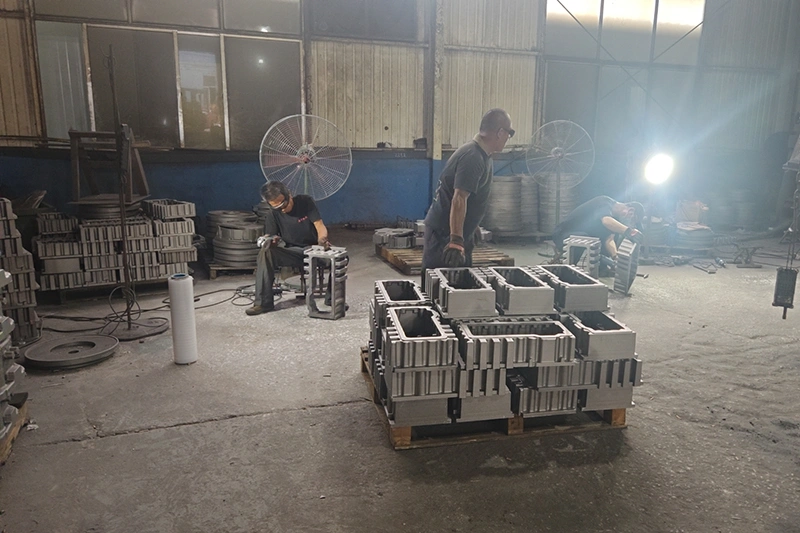
two men work in a warehouse on sand casting, with a fan providing airflow in the background