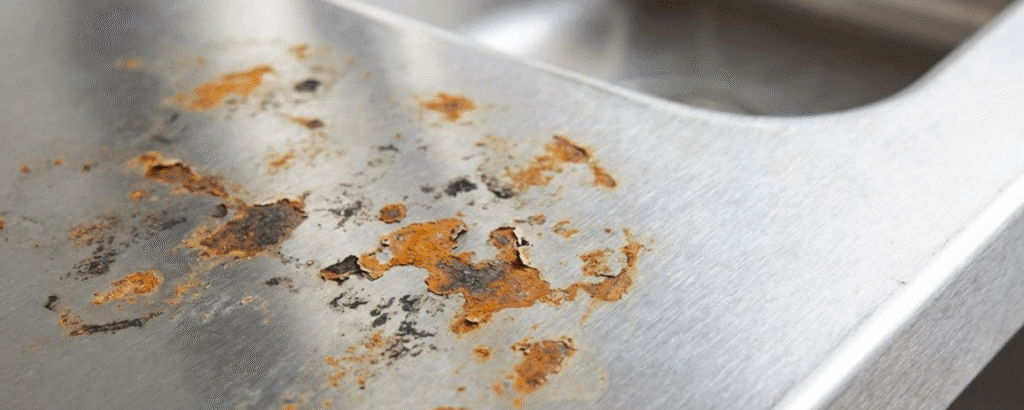
You bought a shiny new stainless steel refrigerator, expecting it to look perfect forever. Six months later, rusty spots appear near the handle. What went wrong?
You’re not alone. Thousands of homeowners feel cheated when their “stainless” steel products start rusting. Some even wonder if they got scammed with fake stainless steel.
Here’s the truth: stainless steel CAN rust.
Stainless steel fights rust with an invisible shield made of chromium oxide.
Every piece of stainless steel contains at least 10.5% chromium. When this chromium meets oxygen in the air, it forms a protective layer just a few nanometers thick. You can’t see it, but it’s there, blocking moisture and oxygen from reaching the iron underneath.
Here’s what makes stainless steel special compared to regular steel: when iron rusts, the rust flakes off and exposes fresh metal to more corrosion. But chromium oxide sticks firmly to the surface. It doesn’t peel away.
Yes. Absolutely yes.
The word “stainless” means stain-resistant, not stain-proof. When the protective chromium oxide layer gets damaged or overwhelmed, rust can form on any stainless steel surface.
Think of it like sunscreen. Your skin doesn’t burn easily when you’re wearing SPF 50, but stay in the sun long enough without reapplying, and you’ll still get burned.
Two main categories destroy the protective layer: environmental factors and physical damage.
Rust already appeared? You can probably fix it at home.
Mix baking soda with water until you get a thick paste. Apply it to the rusty area and let it sit for 30 minutes. Scrub gently with the grain using a soft cloth, then rinse and dry completely. This works for most light surface rust.
For stubborn spots, soak a cloth in white vinegar and lay it over the rust for 30 minutes or longer. The acetic acid dissolves rust without scratching the surface. Rinse thoroughly afterward.
Bar Keepers Friend contains oxalic acid, which removes rust effectively and safely. I’ve used it on stainless steel sinks and cookware for years with great results.
Pro tip: Always scrub in the direction of the metal grain, and test any cleaner on a hidden spot first.
Not all stainless steel handles the same environments equally. The two most common grades differ significantly in chloride resistance.
| Feature | 304 Stainless Steel | 316 Stainless Steel |
|---|---|---|
| Chromium | 18% | 16-18% |
| Nickel | 8% | 10-14% |
| Molybdenum | None | 2-3% |
| Chloride tolerance | 100-200 ppm | 1,000-2,000 ppm |
| Cost | Standard | 20-30% higher |
| Best for | Indoor, kitchen use | Coastal, marine, pools |
Live more than 10 miles from the ocean? Grade 304 handles everyday use perfectly. It’s what you’ll find in most kitchen appliances and sinks.
Live near the coast or own a pool? Spend the extra money on 316. The added molybdenum gives it roughly 10 times the salt resistance of 304.
Stainless steel rusts when its protective chromium oxide layer gets damaged or overwhelmed. But preventing rust is surprisingly simple.
Clean with mild soap. Dry completely. Avoid steel wool and bleach. Choose the right grade for your environment.
Follow these basics, and your stainless steel can easily last 50 years or more.
When in doubt, remember the golden rule: mild soap, soft cloth, dry thoroughly. Your stainless steel will thank you.