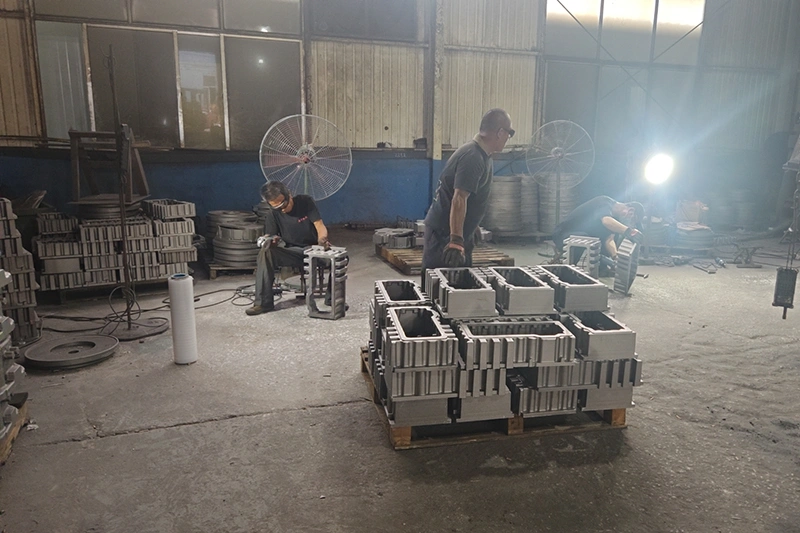
When a purchasing spec says “ductile iron flywheel,” the foundry decides your flywheel’s performance. Per ASTM A536, that could mean 60 ksi tensile with 18% elongation — or 120 ksi with 2%. The range within a single material family is wider than the difference between material families themselves.
The typical type-level decision — gray iron versus ductile iron versus steel — misses the real performance differentiator. Choosing the right ASTM grade within a material family determines flywheel behavior under rotational stress far more than the broad iron-or-steel question. What follows covers the material grades, mechanical properties, and quality standards that belong in every flywheel casting specification.
Three material families dominate sand-cast flywheel production: gray iron, ductile iron, and cast steel. The fundamental difference comes down to graphite morphology — the shape of graphite particles in the iron matrix.
Gray iron (ASTM A48) contains flake-shaped graphite that acts as internal stress concentrators. These flakes promote crack propagation, giving gray iron less than 1% elongation. It is classified as a brittle material. However, gray iron’s compressive strength runs 3-4x its tensile strength, which is why it performs well in static or low-RPM applications where vibration damping matters. Flywheels in slow-speed presses and compressors have used gray iron successfully for decades.
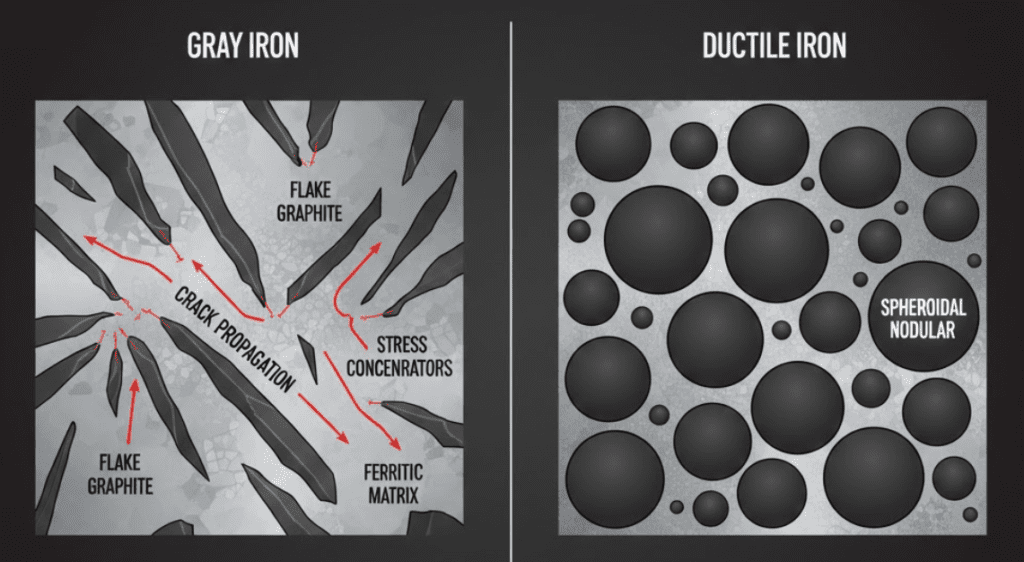
Ductile iron (ASTM A536) replaces those flakes with spheroidal graphite nodules, achieved through magnesium or cerium addition during melting. The round nodules eliminate stress concentration points. Elongation jumps from near-zero to 2-18% depending on grade, and tensile strength spans from 60 ksi to 120 ksi across standard grades. For rotating components experiencing centrifugal tensile stress, this difference determines whether the part absorbs energy before fracture or shatters without warning.
Cast steel (ASTM A27) offers the highest tensile strength and elongation but costs more and requires more complex sand casting process control. It earns its place in high-stress, high-RPM flywheel applications where iron grades cannot meet safety margins.
I recommend ductile iron as the default starting point for most industrial flywheel applications. Gray iron still works for low-RPM flywheels when properly specified by class — do not dismiss it entirely based on the automotive aftermarket bias against it.
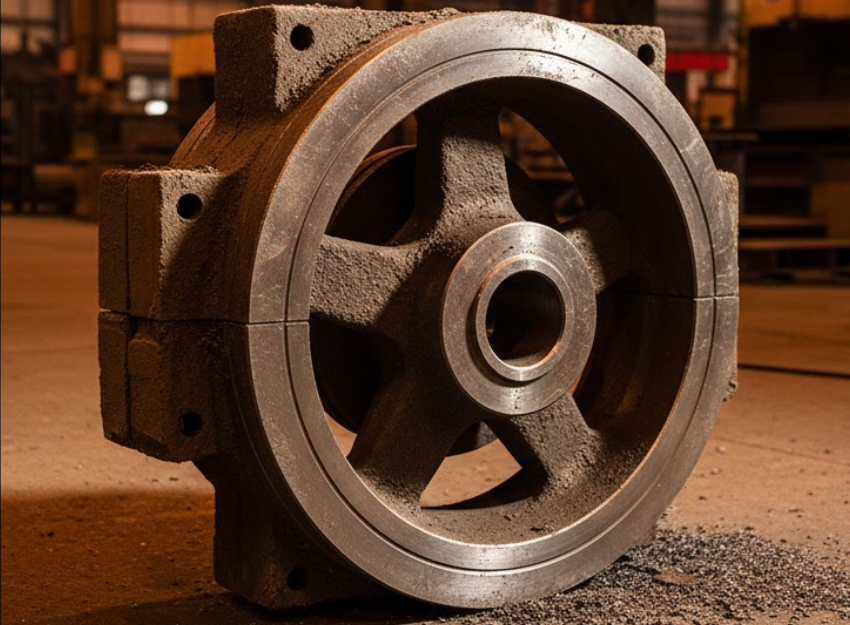
Specifying “ductile iron” on a purchase order is like ordering “steel” without a grade — you leave the foundry to decide your flywheel’s mechanical properties. Within ASTM A536 ductile iron alone, tensile strength varies by 2x and elongation varies by 9x across standard grades. That spread is wider than the entire gray iron family.
| Grade | Tensile (ksi) | Yield (ksi) | Elongation (%) | Hardness (BHN) | Flywheel Suitability |
|---|---|---|---|---|---|
| 60-40-18 | 60 | 40 | 18 | 130-170 | Shock-loaded, low-speed |
| 65-45-12 | 65 | 45 | 12 | 170-207 | General industrial (most common) |
| 80-55-06 | 80 | 55 | 6 | >190 | Higher speed, wear surfaces |
| 100-70-03 | 100 | 70 | 3 | 241-302 | High-stress, requires heat treatment |
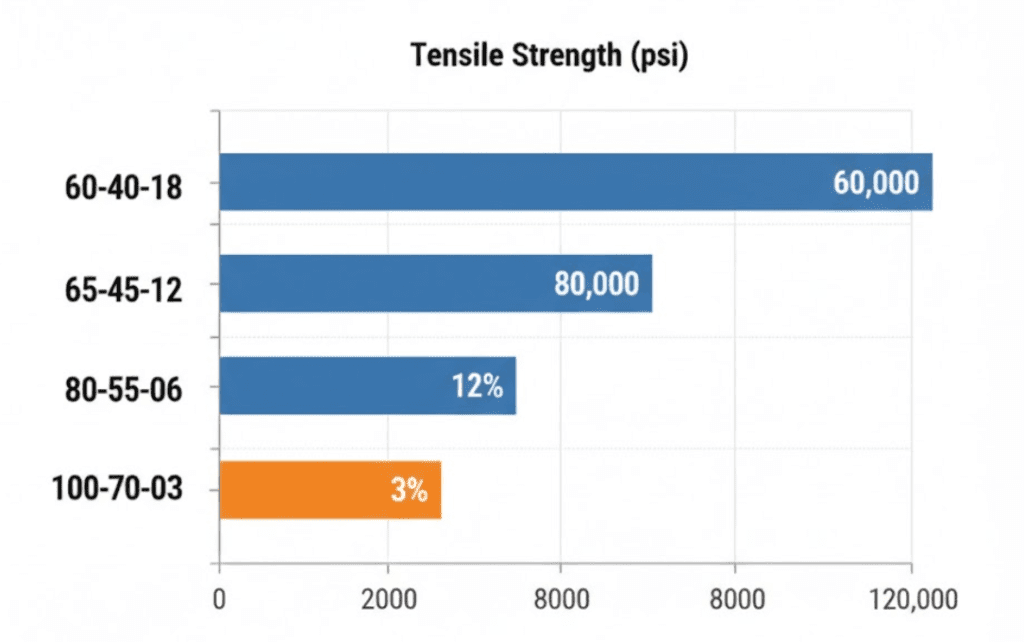
The grade naming convention encodes tensile strength-yield strength-elongation directly. Grade 65-45-12 is the most common as-cast grade for general machinery flywheels — balanced strength and ductility without requiring heat treatment. Grade 80-55-06 offers a step up in strength with reduced ductility, using a pearlitic matrix that also improves wear resistance on clutch contact surfaces.
Grades 100-70-03 and above require quench-and-temper or normalize-and-temper heat treatment, adding cost and lead time that must be specified upfront. Never assume the foundry will heat treat unless the PO explicitly requires it.
For low-RPM flywheels where vibration damping is valued, gray iron remains viable. Class 30 (30 ksi tensile, 174-210 BHN) handles basic applications. Class 40 (40 ksi tensile, 183-285 BHN) provides 33% more tensile strength — a meaningful difference for the same material type.
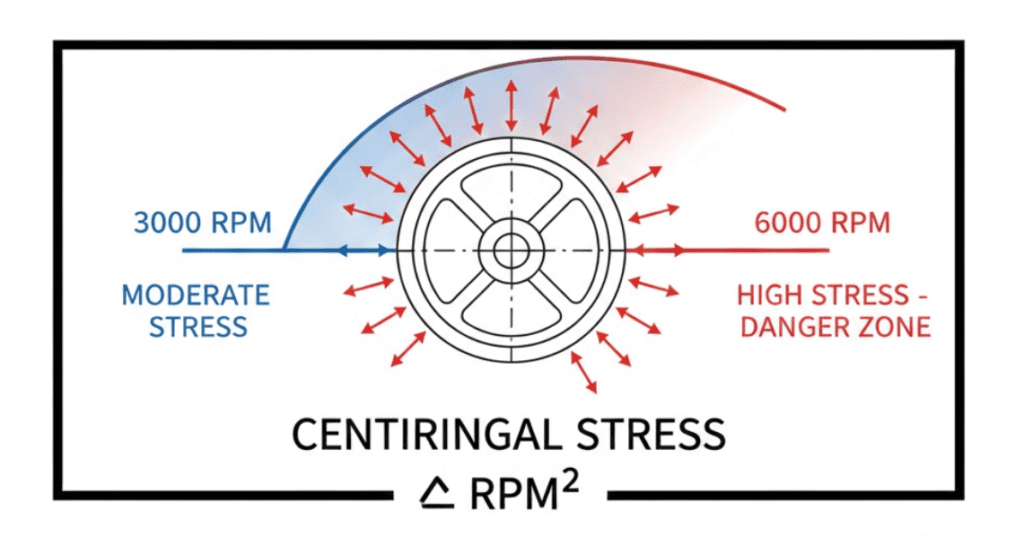
The ceiling for gray iron flywheels is generally around 6,000 RPM. Centrifugal stress increases with the square of rotational speed — a flywheel at 6,000 RPM experiences four times the stress of one at 3,000 RPM. Gray iron’s near-zero elongation means any crack propagates immediately to fracture. No amount of grade optimization changes that fundamental limitation.
When ductile iron grades cannot meet safety margins, ASTM A27 cast steel enters the picture. Grade 65-35 (65 ksi tensile, 24% elongation) and Grade 70-36 (70 ksi tensile, 22% elongation) combine high strength with high ductility. Steel sand castings cost more and demand tighter process control — higher pouring temperatures, more complex gating, and mandatory heat treatment for most grades.
The tradeoff is straightforward: steel provides the highest safety factor for high-RPM or safety-critical flywheels, but budget and lead time increase accordingly. For industrial flywheels running below 3,000 RPM, ductile iron 65-45-12 typically delivers adequate margins at lower cost.
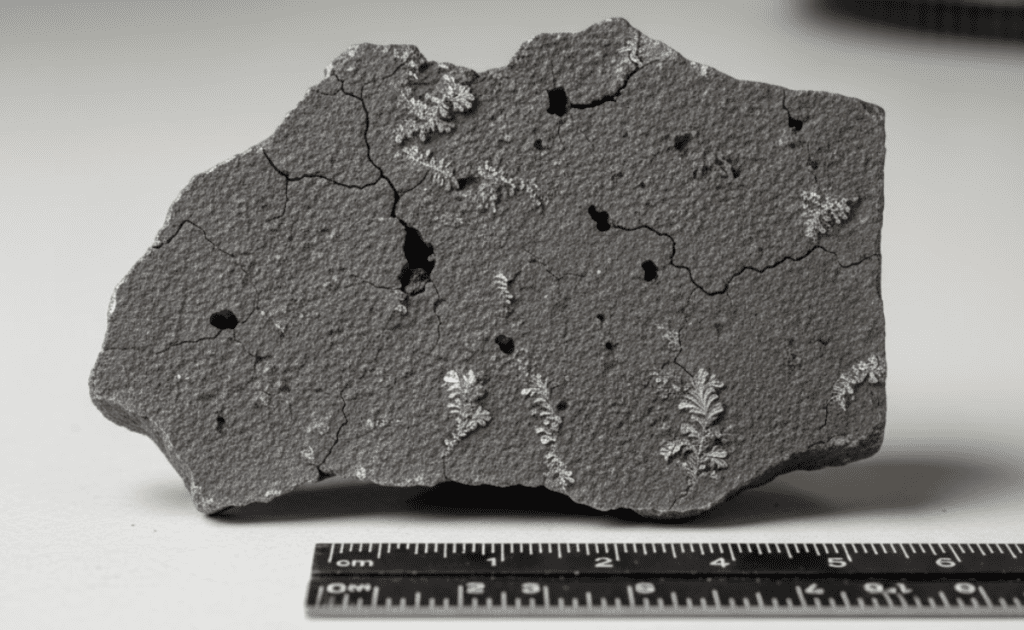
A flywheel failure published in the Journal of the National Academy of Forensic Engineers illustrates why quality inspection matters as much as material selection. A gray cast iron flywheel catastrophically fractured after only 24 miles of service. The investigation revealed porosity and dendritic formations at the crack initiation site — manufacturing defects invisible to visual inspection. The flywheel did not fail because gray iron was the wrong type. It failed because casting defects went undetected.
For flywheels, three quality standards deserve attention.
Dynamic balancing (ISO 1940) classifies flywheels under balance quality grade G6.3. Casting defects — porosity, voids, blowholes — are listed as direct causes of unbalance. The gating system design directly influences whether these defects form. Proper riser placement and controlled cooling rates prevent the shrinkage porosity that throws a flywheel out of balance before machining even begins.
Surface acceptance (ASTM A802) provides standardized visual reference comparators (SCRATA) with four acceptance levels across categories covering surface texture, porosity, gas discontinuities, and solidification defects. Specifying an acceptance level on the PO prevents subjective disagreements about what “acceptable” looks like.
Non-destructive testing is essential for flywheels above moderate RPM. Subsurface porosity and inclusions near the bore — where centrifugal stress concentrates — cannot be caught by visual inspection alone. A published failure analysis of a grey cast iron compressor rotor found that excessive carbon content and low impact energy caused fracture into four pieces during operation. The material was “grey cast iron” by type, but its composition was wrong at the grade level.
Specify NDT requirements alongside your material grade. For custom flywheel castings, radiographic or ultrasonic inspection of the hub and bore regions should be standard practice for any application above 1,500 RPM.
The most common specification mistake I see: buyers write “ductile iron” or “gray iron” on the drawing without an ASTM grade number. The foundry fills the gap with whatever is easiest to pour, and the buyer discovers the problem only after machining reveals hard spots — or worse, after a field failure.
Your flywheel casting specification should include the ASTM material grade, required mechanical properties with test bar requirements, dynamic balance grade per ISO 1940, surface acceptance level per ASTM A802, and NDT requirements for the hub and bore. Start with the application’s RPM and load profile, work backward to the grade that provides adequate safety margin, then specify the quality checks that verify the casting meets that grade.