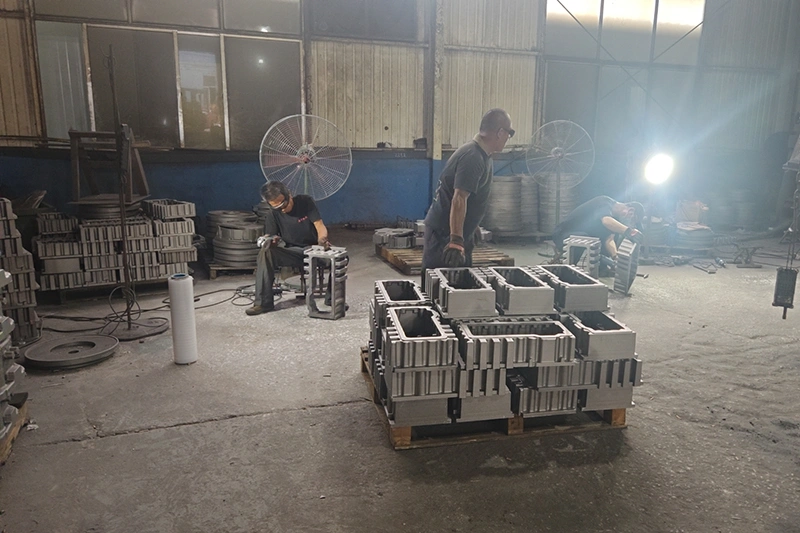
Picking the wrong steel type can derail an entire project. I’ve seen engineers specify cold rolled for structural beams (wasting budget) and hot rolled for precision housings (causing dimensional nightmares). Both mistakes cost time and money that nobody has.
Here’s the thing: hot rolled and cold rolled steel aren’t just different products. They’re fundamentally different materials with distinct mechanical properties, tolerances, and applications. The name refers to the manufacturing process, not the alloy composition. You can have the same grade of steel in both forms, but they’ll behave completely differently in your application.
The core difference comes down to temperature. Hot rolling happens above the steel’s recrystallization point. Cold rolling happens at room temperature. That single variable changes everything about the final product.
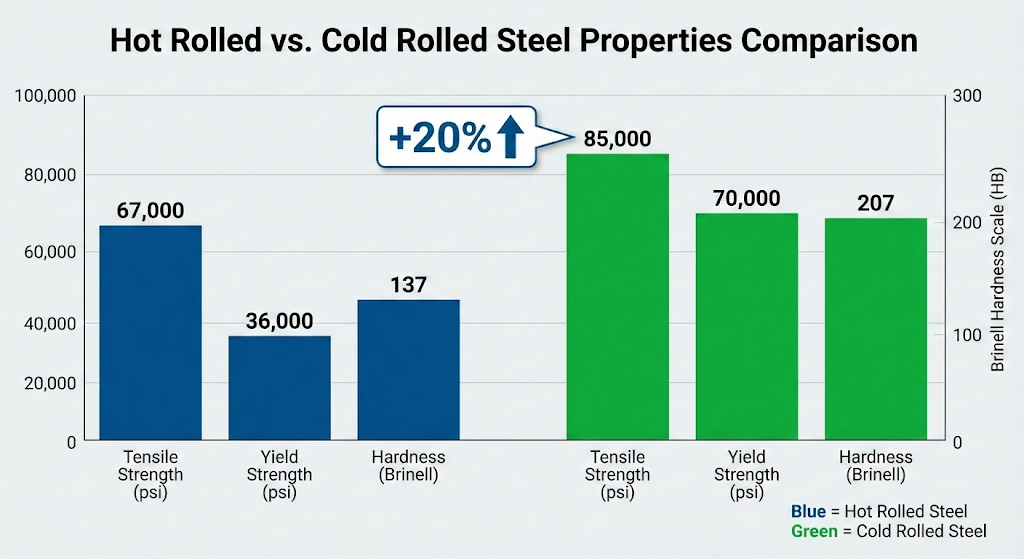
Hot rolling processes steel at temperatures above 1700°F (926°C), well above the recrystallization threshold. At these temperatures, the steel becomes malleable and easy to shape.
The heated billet passes through a series of heavy rollers that reduce its thickness and form the desired shape. During this process, the grain structure refines and casting defects heal. It’s an efficient way to produce large quantities of steel with good mechanical properties.
But there’s a catch. As the steel cools, it shrinks unevenly. This creates dimensional variability that you can’t fully control. The surface also develops mill scale, a bluish-black layer of iron oxides that forms when hot steel meets oxygen.
The result? Rough surfaces, rounded edges, and tolerances measured in millimeters rather than fractions of millimeters.
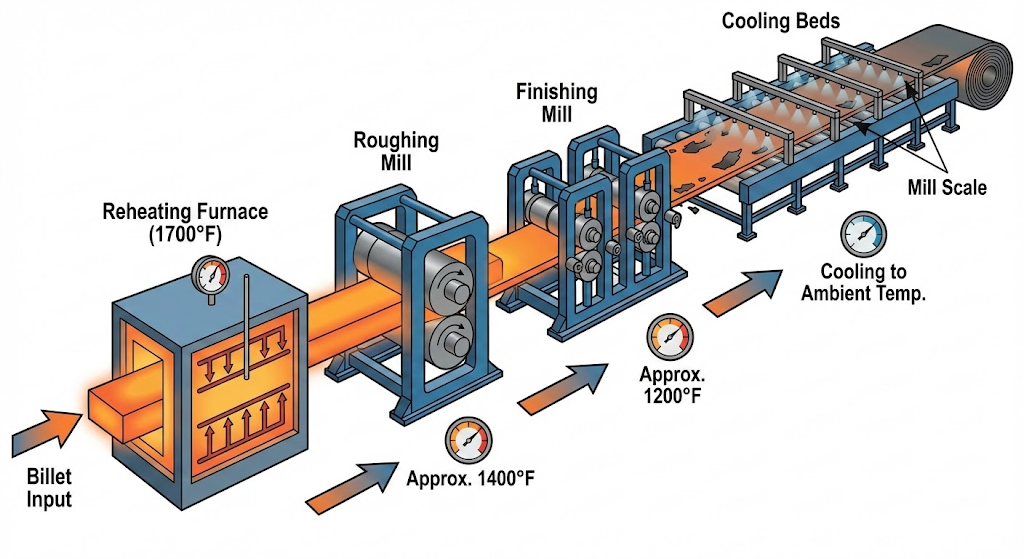
Cold rolled steel starts as hot rolled material that undergoes additional processing at room temperature. The extra steps add cost, but they deliver precision that hot rolling simply can’t match.
The process follows four main stages:
Room temperature processing means the steel work-hardens as it’s compressed. The crystal structure gets denser and more resistant to deformation. You get higher strength, but you also lock in internal stresses that can cause problems during machining.
The payoff? Smooth surfaces, sharp edges, and tolerances within 1mm. If you need precision, this is how you get it.
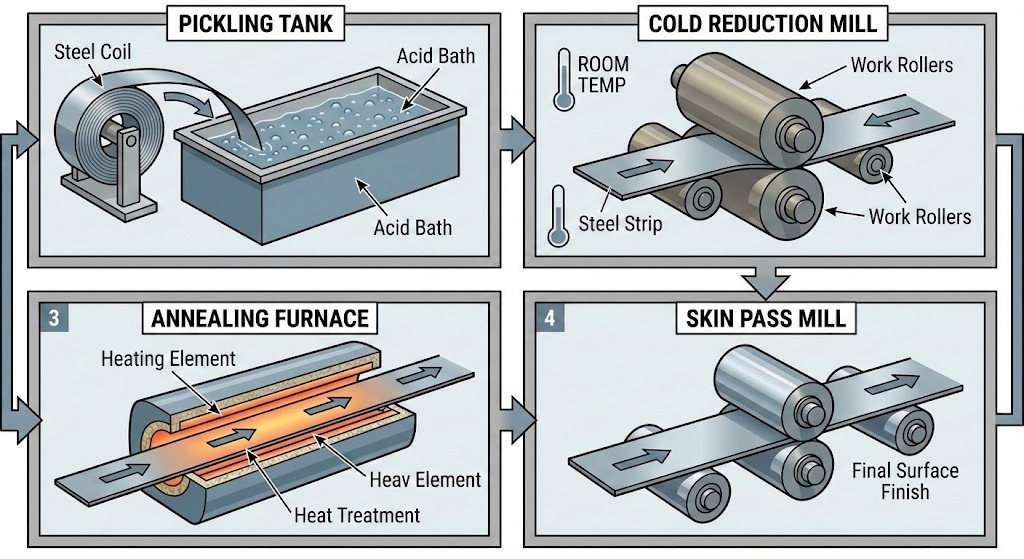
Cold rolled steel delivers roughly 20% higher tensile strength than hot rolled steel of the same grade. That’s not a trivial difference when you’re sizing structural members or selecting material for high-stress applications.
| Property | Hot Rolled | Cold Rolled | Difference |
|---|---|---|---|
| Tensile Strength | ~67,000 psi | ~85,000 psi | +20-26% |
| Yield Strength | ~36,000 psi | ~70,000 psi | Nearly 2x higher |
| Hardness (Brinell) | Lower | ~126 HB | Work-hardened |
| Ductility | Higher | Lower | Trade-off |
| Internal Stress | Low (normalized) | High | Requires relief |
The strength advantage comes from strain hardening during cold rolling. When you compress steel at room temperature, you increase dislocation density in the crystal structure. More dislocations mean more resistance to further deformation.
But there’s a trade-off. That same work hardening reduces ductility and introduces internal stresses. Hot rolled steel comes off the line normalized and stress-free. Cold rolled steel carries residual stresses that can cause warping if you machine it improperly.
Real specifications matter more than general comparisons. Here’s how two common grades stack up:
| Specification | ASTM A36 (Hot Rolled) | AISI 1018 (Cold Rolled) |
|---|---|---|
| Tensile Strength | 58-80 ksi (400-550 MPa) | ~64 ksi (~440 MPa) |
| Yield Strength | 36 ksi min (250 MPa) | 54-57 ksi (370-393 MPa) |
| Elongation | 20% min (8 in.) | 15%+ |
| Machinability | Good | 78% rating |
ASTM A36 remains the workhorse of structural steel. It’s defined by mechanical properties, not chemical composition. As long as the steel hits the strength targets, it qualifies.
AISI 1018 cold rolled is the go-to choice for precision parts. The 78% machinability rating makes it easy to cut, and the consistent properties reduce surprises during manufacturing.
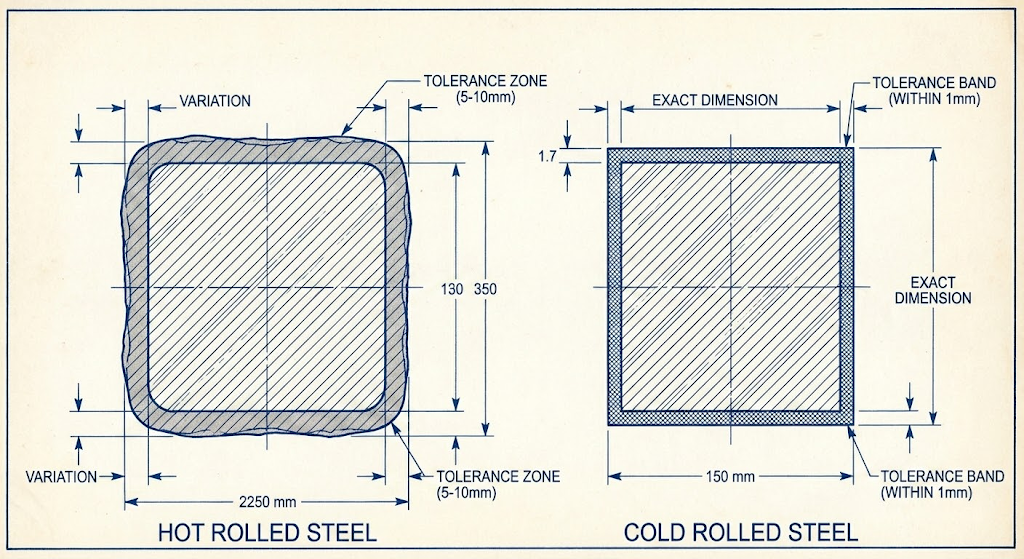
This is where the difference really shows. Hot rolled tolerances run 5-10mm. Cold rolled tolerances stay within 1mm. For precision applications, that gap is everything.
| Parameter | Hot Rolled | Cold Rolled |
|---|---|---|
| Thickness tolerance | 5-10 mm typical | Within 1 mm |
| Edge condition | Rounded | Sharp, precise |
| Flatness | Variable | Consistent |
| Out-of-squareness | Higher | ≤1.0% (trimmed edge) |
Hot rolled steel shrinks as it cools from 1700°F to room temperature. That cooling happens unevenly across the cross-section, and there’s no way to fully control the final dimensions. The steel literally moves after it leaves the rollers.
Cold rolling at room temperature eliminates thermal contraction from the equation. The rollers define the final dimensions directly, and the material stays put after processing. Minimal relaxation means what you roll is what you get.
If your application can live with 5-10mm variation, hot rolled saves money. If you need parts that fit together precisely, cold rolled is your only realistic option.
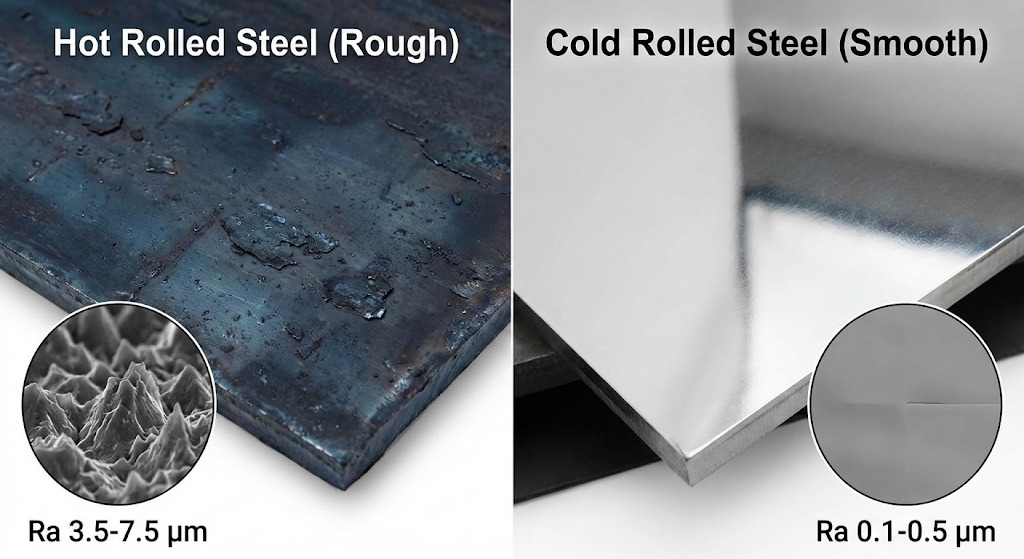
Surface roughness follows directly from the manufacturing process. Hot rolled surfaces measure 3.50-7.50 µm Ra. Cold rolled surfaces drop to 0.10-0.50 µm Ra. That’s an order of magnitude difference.
| Designation | Process | Ra Value (µm) |
|---|---|---|
| 1D | Hot rolled, pickled | 3.50-7.50 |
| 2D | Cold rolled, heat treated, pickled | 0.2-1.0 |
| 2B | Cold rolled, skin passed | 0.10-0.50 |
| 2R/BA | Bright annealed | 0.05-0.10 |
Hot rolled steel comes with mill scale that you’ll need to remove before coating or welding. Mill scale looks protective, but it’s electrochemically cathodic to the base steel. Any break in the scale creates a corrosion cell that accelerates rust formation.
Powder coating over mill scale? Bad idea. The scale bonds poorly to the base metal and can flake off, taking your coating with it. Welding through scale? You’ll get porosity and weak fusion.
Cold rolled steel arrives paint-ready. The smooth, scale-free surface accepts coatings directly and provides consistent adhesion. If surface finish matters for your application, cold rolled eliminates a prep step and improves results.
Cold rolled steel costs 30-50% more than hot rolled. That premium reflects the additional processing steps required to achieve tighter tolerances and better surface finish.
| Steel Type | Price Range (USD/ton) |
|---|---|
| Hot Rolled Coil (HRC) | $600-900 |
| Cold Rolled Coil (CRC) | $800-1,200 |
| CRC Premium over HRC | 30-50% (~$280-320/ton) |
The $280-320/ton premium makes sense when you need what cold rolled delivers. Tight tolerances eliminate secondary machining. Paint-ready surfaces skip prep operations. Higher strength allows thinner gauge material.
But if you’re building structural frames or railroad tracks, that premium buys you nothing. Hot rolled handles the job at lower cost with no functional penalty.
Match the material to the application. Don’t pay for precision you won’t use.
Material selection follows application requirements. Here’s when each type makes sense.
The hot rolled vs cold rolled decision comes down to four factors: tolerance requirements, surface finish needs, strength requirements, and cost constraints. Work through them in that order.
Start with tolerances. If you need precision, cold rolled is your only practical option. Hot rolled can’t deliver sub-millimeter accuracy without secondary operations that may cost more than the cold rolled premium.
Check surface requirements next. Coating adhesion, appearance, and corrosion resistance all favor cold rolled. If you’d need to prep hot rolled surfaces anyway, the cold rolled premium might actually save money.
Evaluate strength needs. Cold rolled’s 20% strength advantage lets you use thinner material for the same load capacity. Run the numbers. Sometimes the weight savings justify the cost.
Finally, consider cost. If none of the above factors require cold rolled, hot rolled delivers equivalent functionality at lower price. Don’t buy precision you won’t use.
Match the material to your application. That’s how you get the best results without wasting budget.