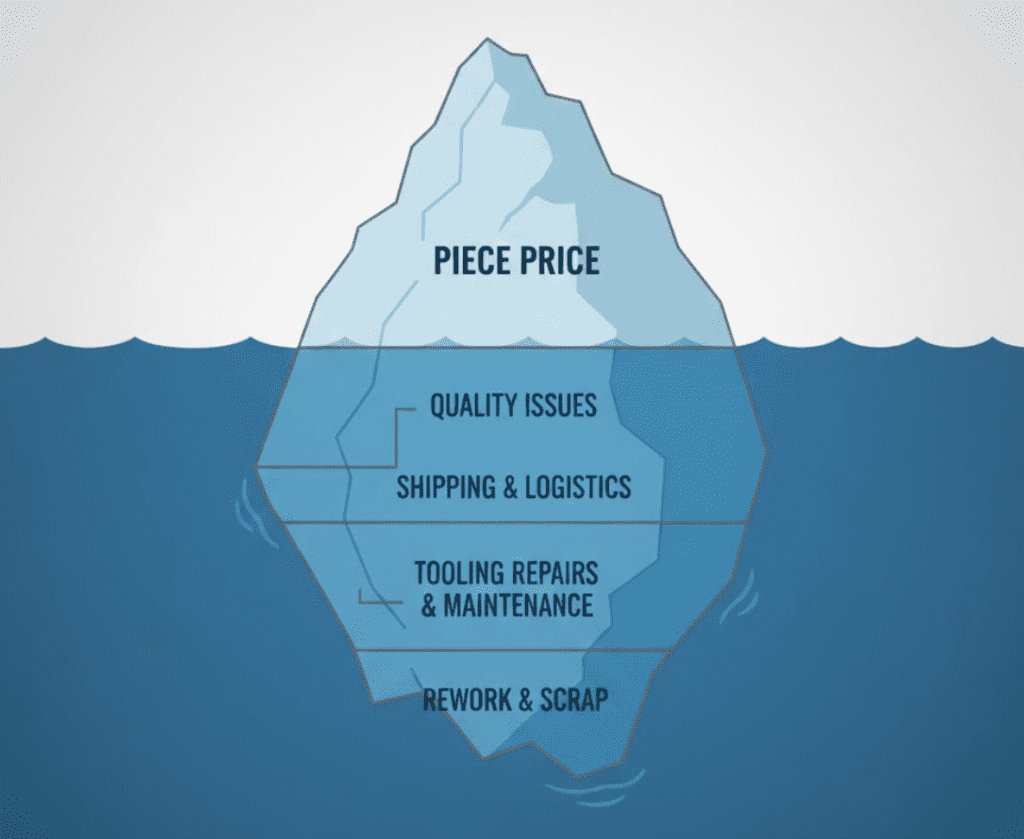
What determines sand casting cost? The answer depends on whether you evaluate piece price alone or total cost of ownership. According to the American Society for Quality, quality-related costs can account for 15-40% of total manufacturing expenses when not proactively addressed. That gap between quoted price and actual cost catches many procurement teams off guard.
From a sourcing perspective, sand casting costs break down into five areas: material, tooling, volume, quality, and supplier capability.
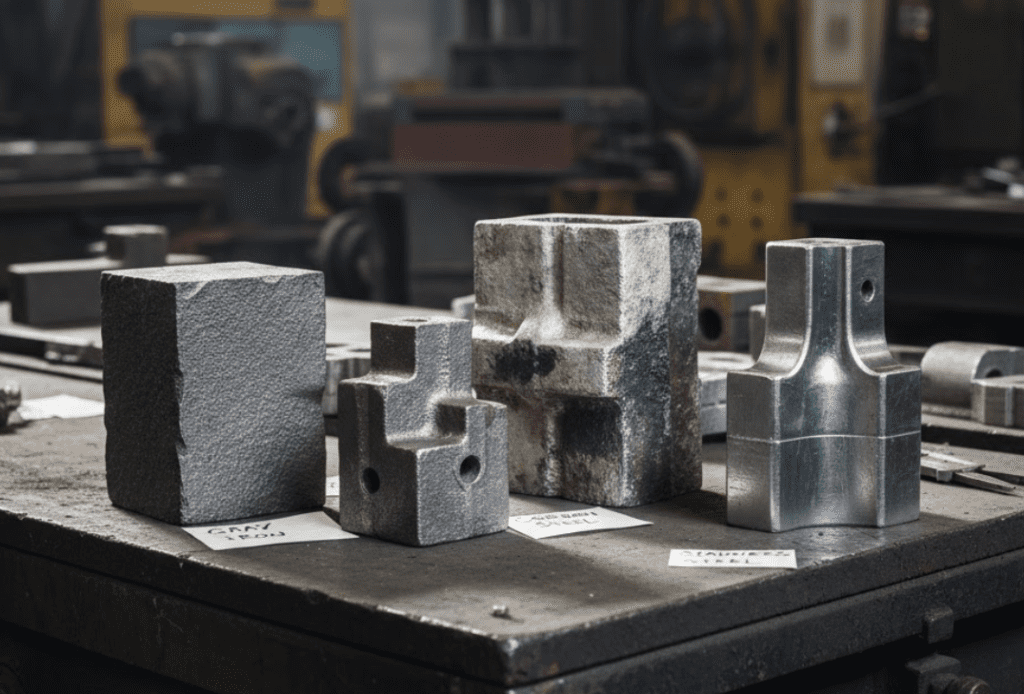
Raw material cost is the largest single factor in sand casting pricing, typically representing 30-40% of operational expenses.
Gray iron castings through green sand molding run approximately $1.27-2.23/kg for raw castings without machining. Ductile iron costs slightly more at $1.43-2.71/kg. Carbon steel castings range from $1.04-1.18/lb ($2,300-2,600/ton), while stainless steel commands a premium at $2.00-2.12/lb.
These figures are ex-factory prices from Chinese foundries, excluding shipping, packing, and duties. Domestic pricing typically runs higher but includes shorter lead times and simpler logistics.
Material grade selection is your first cost lever. Over-specifying alloy grade increases price without improving performance. A casting that functions perfectly in gray iron HT200 does not benefit from ductile iron GGG-50 unless your application demands the added strength and ductility.
Tooling represents a one-time, non-recurring cost that directly affects first-order economics.
Sand casting patterns typically range from $500 to $7,500 depending on complexity. A manual green sand pattern using resin costs $800-1,600, while aluminum patterns for higher volumes run $1,000-2,500. Shell molding iron patterns cost $1,000-2,500, and automatic molding patterns range $1,500-3,000.
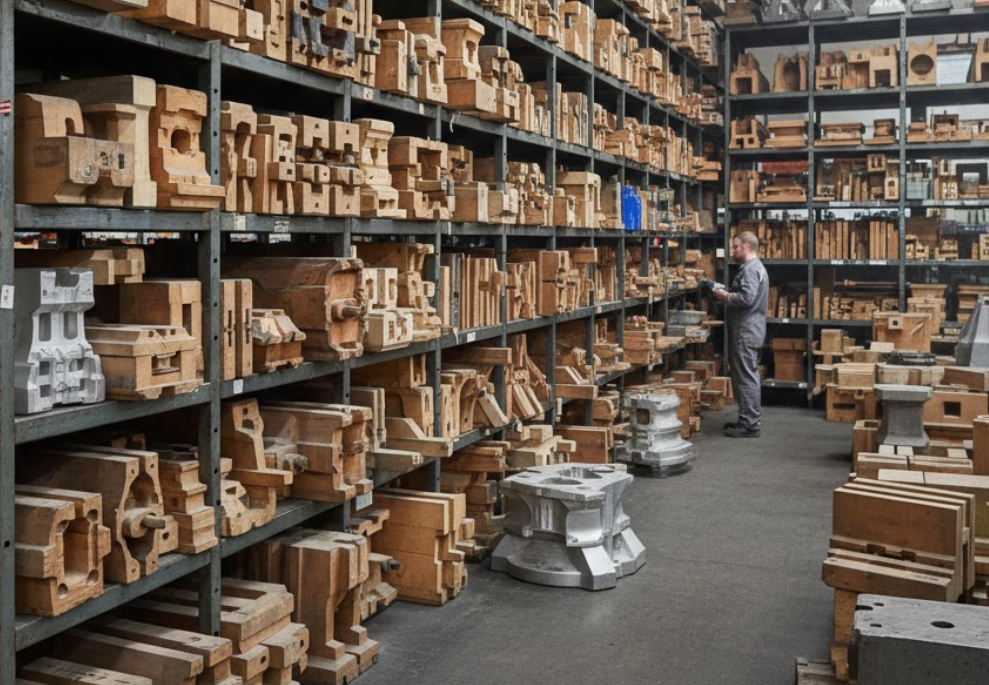
Compare this to die casting tooling at $7,500-$75,000. Sand casting’s lower tooling investment makes it economical for prototype runs and low-to-medium production volumes where die casting tooling cannot be amortized.
The total cost of ownership for tooling includes not just the pattern but also modifications, repairs, and replacement over the production lifecycle. A $2,000 pattern that requires $500 modifications after first article inspection costs $2,500 in reality.
Volume economics in sand casting follow predictable thresholds rather than linear discounts.
Sand casting and die casting reach equivalent unit cost at approximately 9,000 parts, according to Cambridge Materials engineering data. Below that threshold, sand casting’s lower tooling cost provides better economics. Above it, die casting’s faster cycle times compensate for higher tooling investment.
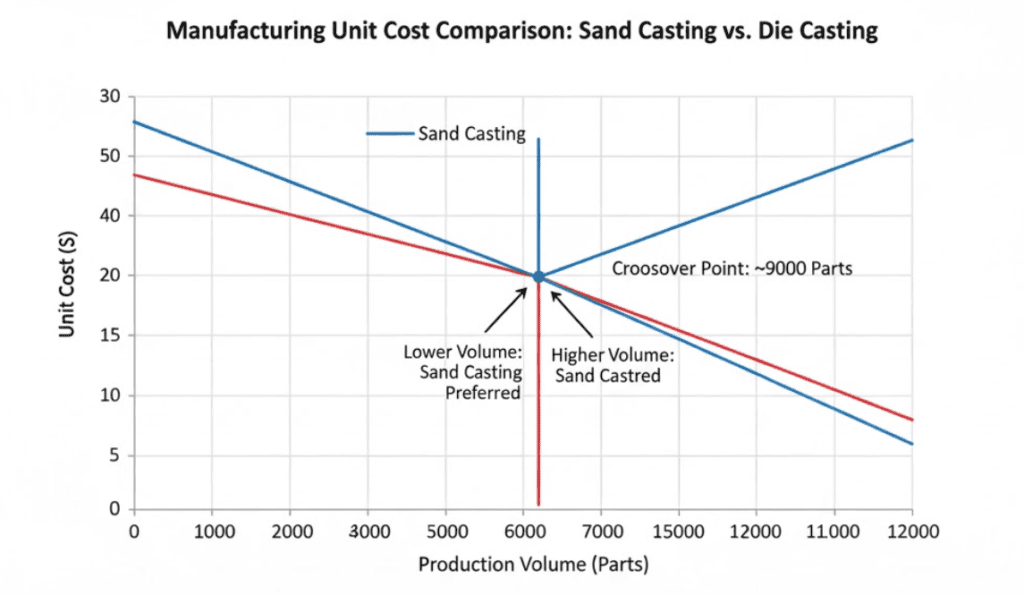
Quantity price breaks typically structure at 100, 300, 1,000, and 5,000+ pieces. The largest per-unit reduction occurs at the first threshold where setup costs spread across more units. Subsequent breaks offer smaller incremental savings.
Small batch economics favor domestic sourcing. For orders under 5,000 units, automation and setup efficiency in North American foundries can match offshore piece prices when you factor in shipping, duties, and carrying costs.
Quality costs compound in ways that piece price alone does not capture.
Average casting yield across 93 steel foundries surveyed was 53.3%, with best performers at 72.7% and worst at 33.2%. Nearly half of poured metal becomes scrap, and remelting that scrap accounts for approximately 7% of total casting cost.
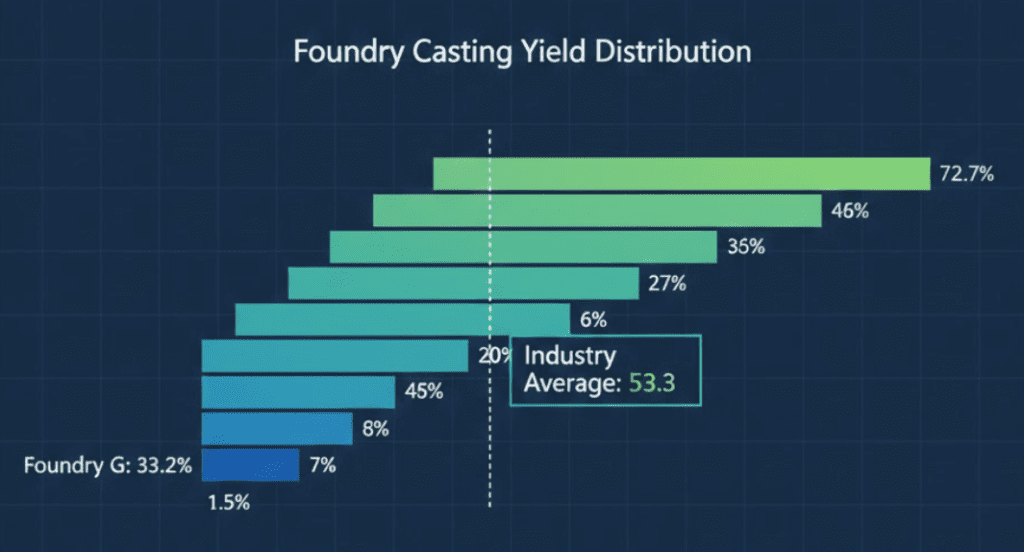
Scrap rates vary widely between foundries, ranging from 3% to over 25%. A 2.65% scrap reduction at one steel foundry saved $514,000 annually across just 28 patterns. The foundry achieving 3% scrap and the one running 25% do not quote the same price, but the gap in quoted price rarely reflects the true capability difference.
The hidden costs that erode offshore savings include shipping logistics, quality issues, communication barriers, inventory carrying costs, and supply chain disruption risks. Projects where the initial offer looked 10-15% cheaper often result in foundries coming back with material surcharges, tooling repair fees, or expensive rework after field defects.
Foundry melting efficiency illustrates the capability gap. A highly efficient foundry achieves melting costs of $0.30/kg for cast iron, while low-volume furnaces with expensive electricity run $1.50/kg. That 5x difference stems purely from foundry capability, not geography.
Comparing quotes requires looking beyond piece price to capability indicators.
Ask prospective foundries about their scrap rate. Greensand foundries running internal scrap below 1% are doing well. If a supplier cannot or will not disclose this figure, that tells you something about their process control.
A pump manufacturer learned this lesson when offshore impellers failed in chemical processing environments after two years. Investigation revealed the castings did not meet alloy specifications, and the foundry had sold the design to aftermarket counterfeiters producing inferior copies. The customer lost two years of production and customer trust before returning to domestic sourcing.
Questions that reveal supplier capability:
Suppliers who answer these questions transparently demonstrate the process control that leads to consistent quality and predictable costs.
Sand casting cost ranges from under $1/kg for simple gray iron to over $2/kg for stainless steel, with tooling adding $500-$7,500 depending on complexity.
The real determinant of project cost is supplier capability, which affects yield, scrap, and quality consistency in ways that compound over production volume. A 5% yield difference or 10% scrap variation over a 10,000-piece order outweighs a $0.05/kg price difference.
For your next sourcing decision, start with the questions that reveal capability rather than the quotes that obscure it. Foundries that share their process metrics openly tend to deliver the consistency that makes total cost predictable.