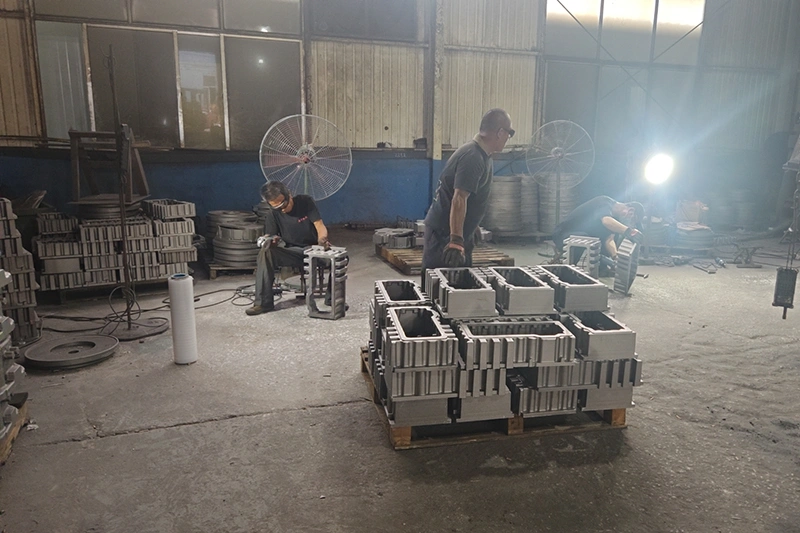
As older design engineers retire, a new generation inherits their projects — but not always their casting knowledge. Counterweights and housings rank among the most frequently specified sand-cast components for excavators, loaders, and cranes, yet engineers often treat them as the same type of casting job. They are not. A 2,000 kg excavator counterweight and a gearbox housing for the same machine require different materials, different molding processes, and different tolerance specifications. Getting this distinction right at the quoting stage prevents costly redesigns later.
Counterweights exist to add mass in a compact space. Housings exist to enclose, align, and protect rotating components under load. These opposing functions drive every downstream decision — from alloy selection to dimensional tolerances.
Major foundries recognize this split operationally. Hefei Casting & Forging, a 100,000-ton-per-year facility serving Caterpillar, Terex, and SANY, runs separate production lines: a KW static-pressure molding line for housings, transmission cases, and valve bodies, and a dedicated resin sand line for counterweights and large structural components. The equipment, sand systems, and quality checks differ between lines.
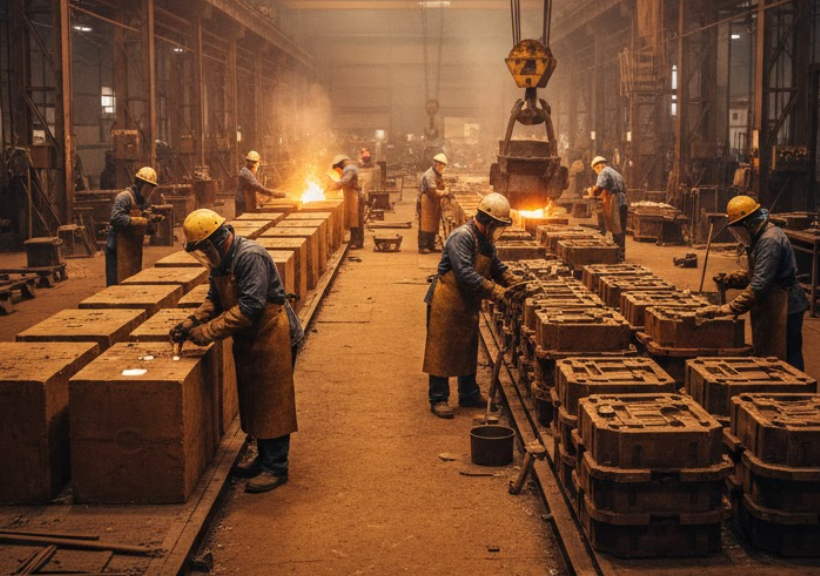
For engineers and procurement managers, the practical takeaway is straightforward: specify counterweights and housings as separate line items with separate requirements, even when both come from the same foundry.
Gray iron (ASTM A48 Class 30 or Class 40) is the default counterweight material for most construction equipment. Three properties make it the standard choice.
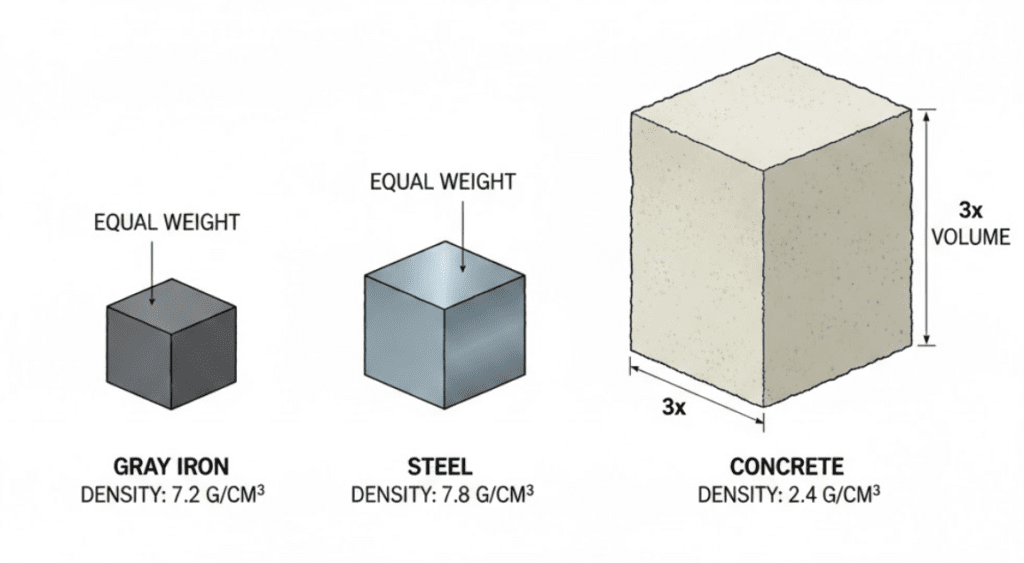
Density. Gray iron’s density of 7.15-7.25 g/cm3 packs maximum weight into minimum volume — roughly three times denser than concrete and comparable to steel at 7.8 g/cm3. For excavators and loaders where chassis space is fixed, this density advantage drives the material choice.
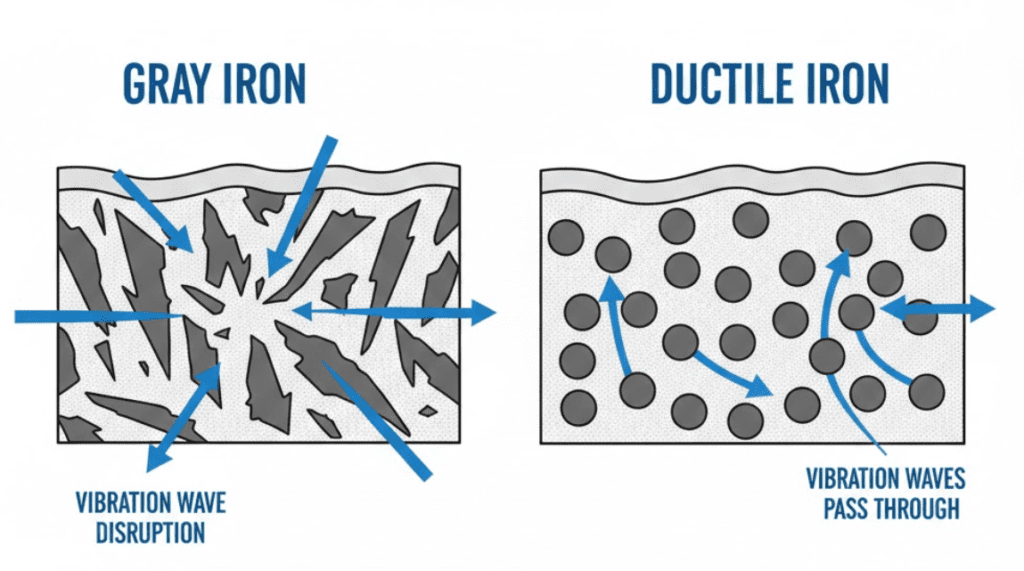
Vibration damping. Gray iron provides roughly four times the vibration damping of steel and twice that of ductile iron. The flake graphite structure acts like thousands of tiny shock absorbers distributed through the metal matrix, each one breaking up vibration waves. On equipment with diesel engines and hydraulic hammers, a counterweight that also dampens vibration reduces fatigue stress on the frame and mounting hardware.
Cost. Gray iron is one of the least expensive casting alloys per kilogram, and its simple geometry keeps mold costs low.
Steel counterweights (7.8 g/cm3) make sense only when space constraints are extreme — large crawler cranes, for example, where counterweight packages can reach 100-240 tonnes and every cubic centimeter of density counts. For the vast majority of loaders, excavators, and compact equipment, gray iron delivers the right balance of density, damping, and cost.
Concrete is occasionally used for non-precision ballast, but it cracks under impact, cannot anchor mounting hardware reliably, and occupies three times the volume of cast iron for the same weight.
Housings protect gears, bearings, and shafts while maintaining precise alignment under load. The priority shifts from mass to mechanical performance: tensile strength, yield strength, dimensional stability, and impact resistance.
Ductile iron (ASTM A536) is the standard housing material for construction equipment. Grade 65-45-12 delivers 65 ksi tensile strength, 45 ksi yield strength, and 12% elongation — far exceeding gray iron’s 40 ksi tensile. The higher-strength Grade 80-55-06 (80 ksi tensile, 55 ksi yield) suits gearbox housings under heavy cyclic loads.
Ductile iron also offers a coefficient of thermal expansion (CTE) that closely matches the steel bearings and gears it encloses. This CTE compatibility maintains critical clearances as the housing heats during operation — a property gray iron shares but aluminum does not.
Aluminum housings (A356-T6, 310 MPa tensile) appear attractive for weight savings, but construction equipment rarely benefits. Aluminum requires approximately three times the cross-section to match iron’s stiffness. Bearing bore tolerances must tighten by 0.0005-0.001 inches to prevent race slippage, and galling during press-fit installation occurs more readily than with iron. For mobile construction equipment where stiffness, damping, and thermal stability outweigh weight reduction, ductile iron remains the right call.
Typical housing specifications include wall thickness of 5-50 mm depending on pressure requirements, and machined surface roughness of Ra 1.6-6.3 um at bearing interfaces.
Not all sand casting processes deliver the same results. The two primary options for construction equipment components — green sand and no-bake (chemically bonded) sand — differ in dimensional accuracy, surface finish, size capacity, and cost per part.
Green sand works best for counterweights and other geometrically simple, high-volume parts. Typical castings range from a few ounces to 500 lbs, though pieces up to 7,000 lbs are possible. Green sand achieves ISO 8062 tolerance grades of CT10-CT12 with manual molding, or CT9 with automated molding. Surface finish runs 250-900 RMS. For counterweights, these tolerances and finishes are more than adequate — the part gets painted, not machined to tight specs.
No-bake (resin sand) suits housings, transmission cases, and any component with tight tolerances or complex internal passages. No-bake handles castings from 1 lb to over 50,000 lbs and produces CT9-CT10 tolerances with surface finishes of 150-600 RMS. The rigid, brick-like mold withstands the pressure of large metal volumes without the dimensional drift that can occur in green sand.
Before designing the pattern, consider this: the machining allowance savings from no-bake’s tighter as-cast tolerances often offset its higher mold cost. For housings requiring machined bearing bores and mounting faces, specifying no-bake from the start reduces total part cost.
| Parameter | Green Sand | No-Bake (Resin Sand) |
|---|---|---|
| Best for | Counterweights, simple geometry | Housings, complex geometry |
| Tolerance (ISO 8062) | CT9-CT12 | CT9-CT10 |
| Surface finish | 250-900 RMS | 150-600 RMS |
| Size range | Ounces to 7,000 lbs | 1 lb to 50,000+ lbs |
| Tooling | Metal (withstands compaction) | Wood or plastic (lower cost for short runs) |
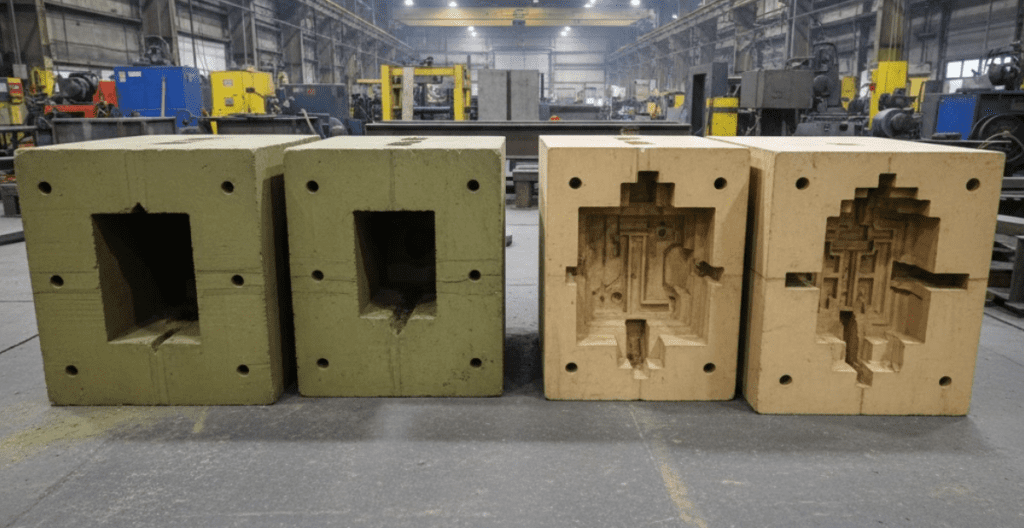
Three design parameters cause the most rework when engineers overlook them in the initial specification.
Draft angles. The draft angle rule of thumb is 2 degrees nominal, with 1 degree minimum on outer walls and 2-3 degrees on inner walls. Skipping or underspecifying draft is one of the most common mistakes foundries report from younger engineers. Without adequate draft, the pattern cannot release cleanly from the sand, and the foundry either rejects the design or adds draft unilaterally — which changes your part dimensions.
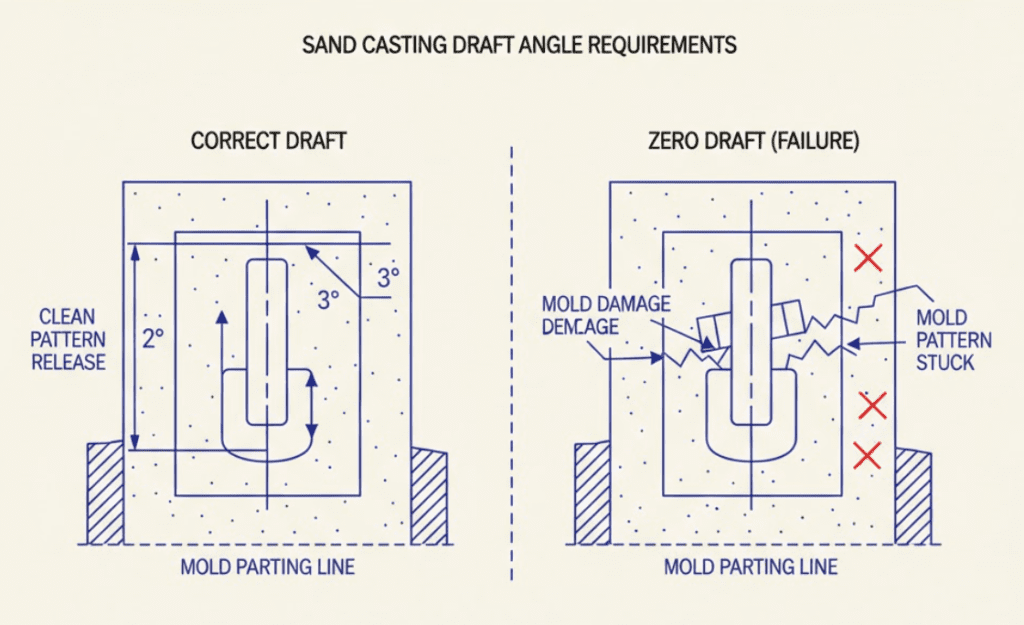
Shrinkage allowance. Different alloys shrink at different rates during solidification: gray iron contracts 0.8-1.0%, ductile iron 0.5-1.2%, and steel approximately 2.0%. The pattern must be oversized to compensate. Specifying the alloy before pattern fabrication is non-negotiable; changing materials after the pattern is made means scrapping the pattern.
Minimum wall thickness and ribs. Sand castings require a minimum wall of approximately 3.8 mm (0.150 in) to ensure proper metal flow. Ribs should be 0.6-0.8 times the adjacent wall thickness to avoid hot spots during cooling. For custom counterweights, wall thickness is rarely a concern — the part is solid or near-solid. For housings, uniform wall transitions prevent the shrinkage voids and warping that lead to rejected parts.
The strongest specification starts with a conversation, not a drawing. As the Steel Founders’ Society of America notes, tolerances are normally decided by agreement between the foundry and customer — they are negotiated, not dictated from a handbook.
Before sending an RFQ, define these items clearly: alloy grade with ASTM or EN standard designation, critical dimensions requiring machining (versus as-cast surfaces), draft angle requirements or permission for the foundry to add draft, inspection requirements (dimensional, hardness, radiographic), and annual volume estimates.
Engage the foundry during design, not after. A five-minute conversation about draft angles, wall thickness, and tolerances before pattern fabrication prevents the kind of costly iteration that turns a routine casting project into a schedule problem.