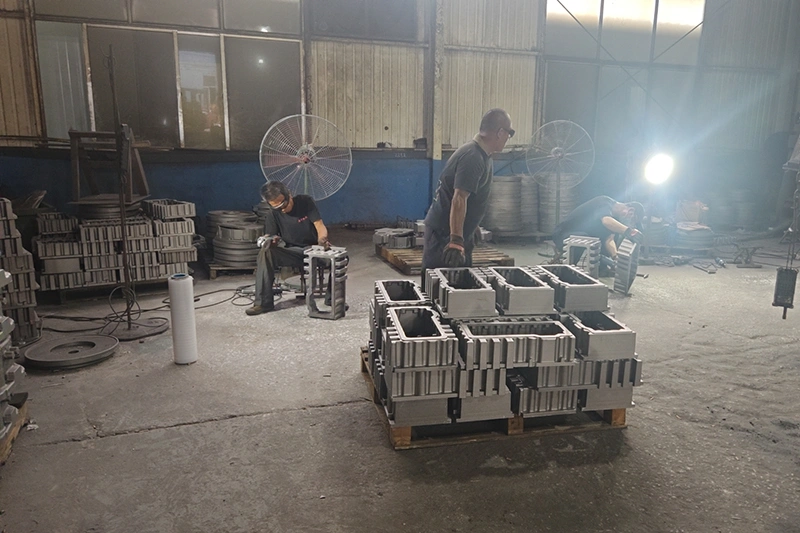
Nineteen white iron mill liners, each manufactured to ASTM A532 specifications, fractured within hours of installation at a mining operation. Every liner passed chemistry, hardness, and NDT inspection. The root cause had nothing to do with casting quality — improper mill shell alignment created bending stresses the liners were never designed to handle.
That failure illustrates a pattern across mining operations: the casting itself is rarely the weak link. The failures come from mismatched materials, missing heat treatment steps, or specifications that stop at the material grade and ignore everything downstream. Sand casting produces the majority of heavy-duty mining components, from crusher liners to mill shells. Getting the casting right starts well before metal is poured.

Sand casting dominates mining component manufacturing because no other process handles the combination of size, alloy range, and geometric complexity these parts demand. Foundries routinely produce mining castings from 100 kg mantle liners up to gyratory crusher components exceeding 10 tons. Hodge Foundry, one of the largest in North America, casts individual mining parts up to 200,000 lbs with gear blanks reaching 26 ft in diameter.
The components fall into two broad categories. Wear parts — crusher jaw plates, cone crusher mantles, concaves, mill liners, chute liners, and impactor blow bars — are consumables that absorb the punishment of processing abrasive ore. Structural and drive components — housing shells, gear blanks, bearing pedestals, and frame segments — carry loads and maintain alignment rather than resist wear.
This distinction matters at the specification stage. Wear parts and structural parts require entirely different alloy families, testing protocols, and often different foundry specializations. A foundry optimized for high-manganese wear castings may not be the right source for ductile iron structural components.
The typical approach — listing materials and mining components in separate columns — leaves buyers guessing which alloy suits their application. The missing link is the wear mechanism. Mining wear falls into three distinct categories, and each one maps to a specific material family.

Gouging abrasion involves high imposed stresses from coarse materials striking the casting surface with force. Jaw crusher plates, cone crusher mantles, and impact crusher blow bars all operate in this regime. The material of choice is austenitic manganese steel, specified under ASTM A128 (also known as Hadfield steel).
Manganese steel starts soft — approximately 187 to 220 BHN as-cast. Under repeated impact, the surface work-hardens to 500 BHN or higher while the core remains tough. According to JADCO Manufacturing, manganese steel can last up to ten times longer than mild steel in high-impact environments.
The critical limitation: work hardening depends entirely on impact. When abrasion from fine sand or other materials wears the surface without impact, manganese steel performs no better than mild steel. JADCO documented coal crusher hammers that lasted six months processing hard Eastern coal but failed within three weeks after switching to softer Powder River Basin coal — same machine, same hammers, entirely different wear mechanism.

High-stress abrasion involves crushing gritty abrasives between two surfaces under localized stress. Cone crusher liners processing medium-hardness ore and certain mill liners operate here. Alloy steels with chromium-molybdenum additions provide the balance of moderate toughness and abrasion resistance this regime demands. At Dexing Copper Mine, Asia’s largest, standard manganese liners failed through three simultaneous wear modes. Switching to a modified CrMoVTiRe manganese steel composition increased liner working life by over 150%.
Low-stress abrasion occurs where particles slide across a surface under low operating stress — chute liners, slurry pump casings, and feed hopper linings. Chrome white iron, specified under ASTM A532, excels here. These alloys reach 500 to 600 BHN hardness through hard chromium carbide phases formed during solidification.
Penticton Foundry reports that chrome white iron outlasts AR400 plate by a factor of ten and AR600 by a factor of three in sliding abrasion service. Where moving parts are involved, however, toughness matters — white iron’s brittleness makes it a poor choice for impact-heavy applications. When tramp metal (stray bolts, broken drill bits) enters the system, tough manganese steel survives while brittle white iron fractures.
Structural and drive components — housings, gear blanks, pedestals — typically use ductile iron, which combines castability with impact resistance and fatigue strength. Ductile iron mining gears achieve a minimum 285 Brinell hardness with power ratings from 400 to 3,750 horsepower.
Sand casting is not just the cheapest way to produce mining components. For many parts, it is the only viable process.
High-manganese steel cannot be forged. Its work-hardening properties resist the deformation that forging requires. Any crusher jaw plate, mantle, or blow bar made from ASTM A128 manganese steel must be cast. Sand casting handles these specialty alloys without the temperature limitations that restrict die casting to lower-melting-point metals.
Size removes most alternatives as well. Mining crushers and mills require components that weigh several tons and measure meters across. Investment casting and die casting cannot produce parts at this scale. Sand molds, built as floor molds for the largest pieces, accommodate virtually any dimension.
Tooling economics reinforce the choice. Sand casting patterns cost roughly $2,000, compared to $20,000 or more for permanent metal molds. Mining wear parts are replaced frequently — sometimes every few months in aggressive ore — so production volumes rarely justify higher-tooling processes. Pattern modifications for design changes cost a fraction of retooling a permanent mold.
Forging produces stronger grain structure and better fatigue resistance, which matters for crankshafts and connecting rods. But mining wear parts fail by surface abrasion, not fatigue. The metallurgical advantage of forging adds cost without addressing the actual failure mode.
As-cast manganese steel is brittle and unusable. Grain boundary carbides make it crack under the first impact. Heat treatment transforms it from a brittle casting into one of the toughest engineering materials available.

The process is a solution anneal: heat the casting to 1800-1950 F (980-1065 C), hold to dissolve carbides into the austenite matrix, then water quench rapidly. A slack quench — cooling too slowly — sharply reduces toughness. After heat treatment, manganese steel achieves Charpy V-notch impact energy up to 100 ft-lbs at room temperature.
One non-negotiable constraint: manganese steel must never be reheated above 500 F (260 C) after treatment. Welding, flame cutting, or grinding that exceeds this temperature re-precipitates carbides and embrittles the part. Field repairs require specialized low-heat techniques.
For thick mining castings, ramp rates during the solution anneal must be kept slow. Manganese steel has roughly 33% lower thermal conductivity than standard alloy steel, meaning aggressive heating creates thermal gradients that crack the casting before it even reaches treatment temperature.
Mining castings push sand casting design rules to their limits. Wall thicknesses for cone crusher liners reach 200 mm, far beyond typical sand casting ranges where minimums sit at 5-6 mm for ferrous alloys. These thick sections require careful gating and riser design to prevent shrinkage porosity.
Standard sand casting design guidelines apply with mining-specific modifications. Draft angles of at least two degrees allow pattern withdrawal. Fillet radii at internal corners reduce stress concentration — critical for white iron parts that fracture at stress risers. Uniform wall transitions prevent hot spots that concentrate shrinkage defects.
For manganese steel castings specifically, foundries often use olivine or chromite sand instead of standard silica. Olivine sand is silica-free and compatible with basic metals like manganese steels, while chromite sand offers a very high fusion point of 1850 C and high thermal conductivity that promotes faster solidification.
Specifying a mining casting by material grade alone is like specifying a car by engine size — it tells you something, but not enough to avoid problems.
A complete mining casting specification should address material chemistry with ASTM grade and acceptable ranges, mandatory heat treatment process and verification method, hardness requirements at specific locations, NDT requirements (radiographic or ultrasonic for critical sections), dimensional tolerances and machining allowances, and installation interface requirements.
That last item catches most people off guard. The 19 liners that fractured within hours at the mining operation described in Modern Casting journal passed every material and quality check. The failure came from downstream — the mill shell mating surfaces were out of alignment, creating bending loads the brittle white iron could not absorb. Prevention required laser scanning the mill shell before liner installation, not better castings.
Operating conditions belong in the specification too. According to McLanahan, poor crusher feed alone reduces liner life by up to 70%. A foundry cannot compensate for feed distribution problems with better metallurgy.
One procurement warning: foundries do not always include the required quantity of alloying elements. For manganese steel, carbon content is the primary factor controlling wear resistance, not manganese percentage. Request mill certificates with full chemical analysis and verify independently on critical orders. The cost of third-party testing is trivial compared to premature failure in a crusher that processes thousands of tons per day.
Start every mining casting project by identifying the dominant wear mechanism — gouging, high-stress, or low-stress abrasion. That single determination narrows the material family before any foundry conversation begins.
Specify beyond the grade number. Include heat treatment requirements, post-treatment temperature limits, NDT scope, and installation interface dimensions. The castings that fail earliest are rarely the ones with wrong chemistry. They are the ones where specification stopped at the material data sheet.