A single Boeing 747 contains over 18,000 forged components. This reflects a fundamental truth in manufacturing: when strength and reliability matter, forging delivers what other processes cannot.
But choosing the right forging method is where most engineers and procurement managers get stuck. Hot or cold? Open die or closed? The wrong choice means overpaying for tolerances you don’t need—or underspecifying parts that fail in service.
This guide breaks down the main forging types by temperature and die configuration, compares their strengths and trade-offs, and provides a decision framework for selecting the right method for your application.
Forging methods are classified by two primary criteria: temperature and die configuration. Most real-world applications combine one temperature method with one die type to achieve the desired balance of formability, precision, and cost.
| Classification | Types | Key Differentiator |
|---|---|---|
| By Temperature | Hot, Warm, Cold | Affects formability, tolerances, surface finish |
| By Die Type | Open Die, Closed Die (Impression) | Affects part complexity, tooling cost, production volume |
| Specialized Methods | Upset, Roll, Press, Flashless | Optimized for specific geometries or production requirements |
The temperature determines how easily metal flows during deformation. Hot forging allows complex shapes with lower forces, while cold forging produces tighter tolerances and work-hardened surfaces. Die type determines whether material flows freely (open die) or fills a precisely machined cavity (closed die).
For high-volume automotive and aerospace parts, closed die forging with hot processing dominates. For large custom shafts and rings, open die forging remains the preferred choice. Understanding these combinations helps you specify the right process from the start.
The temperature at which metal is forged fundamentally changes its behavior, the equipment required, and the properties of the finished part.
| Property | Hot Forging | Warm Forging | Cold Forging |
|---|---|---|---|
| Temperature (Steel) | 950–1260°C | 650–1000°C | Room temperature |
| Typical Tolerance | ±1.0–2.0 mm | ±0.5–1.0 mm | ±0.3 mm |
| Surface Finish | Scale formation | Moderate oxidation | Excellent |
| Forming Force | Lowest | Moderate | Highest |
| Best For | Complex shapes, large parts | Balance of properties | Precision, high volume |
Hot forging heats metal above its recrystallization temperature, making it highly malleable. This allows manufacturers to form complex geometries with relatively low press forces.
The trade-off is surface quality. Heating steel to these temperatures causes oxidation, creating a layer of scale that must be removed in post-processing. Tolerances are looser compared to cold forging, typically requiring secondary machining for critical dimensions.
I recommend hot forging when you need complex shapes, when working with materials that are difficult to form cold (like high-carbon steels or titanium alloys), or when part size exceeds what cold forging equipment can handle.
Warm forging operates in the temperature range between hot and cold processes. It provides better formability than cold forging while producing less oxidation and tighter tolerances than hot forging.
The challenge is precise temperature control. The process window is narrower, requiring more sophisticated heating and monitoring equipment. Industry research indicates the 540–720°C range has the greatest commercial potential for steel, offering an optimal balance between formability and dimensional accuracy.
Warm forging makes sense when you need tolerances tighter than hot forging can deliver, but your geometry or material won’t cooperate with cold forming.
Cold forging shapes metal at or near room temperature. The process produces excellent surface finishes and tight tolerances—down to ±0.3 mm according to industry specifications. Work hardening during cold forming actually increases the strength of the finished part.
The limitation is formability. Cold forging cannot handle high-carbon steels (above 0.5% carbon content) or low-ductility alloys. Complex geometries require multiple forming stages or simply aren’t feasible. The higher forming forces also demand more robust tooling and presses.
For high-volume fasteners, automotive components, and precision parts that need minimal machining, cold forging is hard to beat. The upfront tooling investment pays off quickly in reduced per-part costs.
Die configuration determines how metal flows during forging and, consequently, what shapes are achievable and at what cost.
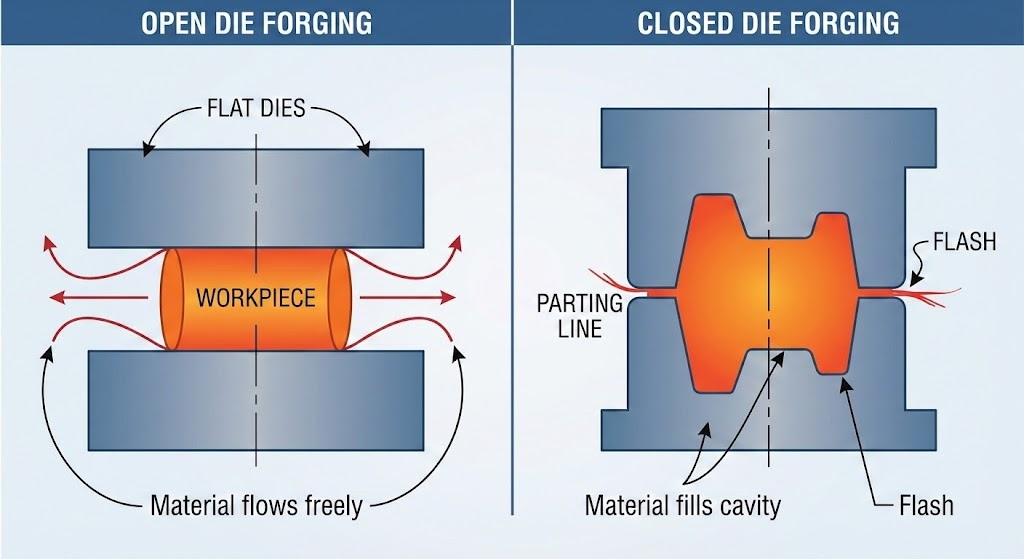
Open die forging shapes metal between flat or simple-contour dies. The workpiece is not fully enclosed, allowing material to flow laterally as it’s compressed.
This method excels at producing large parts—shafts, rings, and cylinders weighing several tons—that would be impractical or impossible to forge in closed dies. Tooling costs are significantly lower since dies don’t require complex machining. The repeated deformation also produces excellent grain structure throughout the part.
The downside is dimensional precision. Open die forgings require substantial machining to achieve final dimensions. Production rates are slower than closed die methods, making this process better suited for custom or low-volume work.
For shafts over 500 kg, hollow cylinders, or one-off prototype parts, open die forging is typically the most economical choice.
Closed die forging, also called impression die forging, forces metal into a die cavity that defines the final part shape. The result is a near-net-shape component requiring minimal machining.
The process generates flash—excess material that squeezes out between die halves. This flash can account for 20 to 45% of the starting material, representing significant waste. However, the consistency and production speed often justify this inefficiency for high-volume applications.
Die costs are substantial. Machining complex die cavities requires specialized equipment and skilled toolmakers. Die maintenance and replacement can account for up to 20% of overall production costs in precision forging applications.
For automotive, aerospace, and industrial components produced in quantities above 10,000 per year, closed die forging delivers the best combination of dimensional accuracy and per-part economics.
| Factor | Open Die | Closed Die |
|---|---|---|
| Tooling Cost | Low | High |
| Part Size Range | Up to several tons | Limited by press capacity |
| Dimensional Precision | Requires machining | Near-net shape |
| Production Volume | Low to medium | Medium to high |
| Material Efficiency | High (minimal waste) | 55–80% (flash waste) |
Beyond the basic temperature and die classifications, several specialized forging methods address specific production requirements.
Upset forging compresses the length of a workpiece to increase its diameter—essentially a heading operation. The process grips bar stock in a die and applies axial pressure to form enlarged sections like bolt heads or flange bases.
Production speed is the standout advantage. Fully automated upset forging systems can produce up to 4,500 parts per hour, making this the fastest forging method available. The process dominates fastener manufacturing, where billions of bolts, screws, and rivets are produced annually.
Roll forging uses rotating cylindrical dies to progressively reduce cross-section and increase length. The workpiece passes between dies multiple times, with each pass refining the shape.
The method produces excellent grain flow orientation along the part’s length, improving fatigue resistance in long, thin components. Axles, leaf springs, tapered shafts, and hand tools commonly use roll forging to achieve both shape and mechanical properties.
Press forging applies slow, continuous pressure rather than the rapid impact of drop forging. Hydraulic or mechanical presses squeeze the workpiece through the full die depth, ensuring uniform deformation throughout the part thickness.
This controlled approach works better for large parts where impact forces might not penetrate deeply enough. Aerospace components, heavy machinery parts, and thick-section forgings often require press forging to achieve consistent grain structure from surface to core.
Flashless forging encloses the workpiece completely within the die cavity, with no gutters for excess material to escape. All starting material becomes finished part.
Near 100% material utilization makes flashless forging economical for expensive alloys like titanium or nickel-based superalloys. The process also eliminates the flash removal step, reducing production time by 10–20% compared to conventional closed die forging.
The trade-off is tighter process control. Billet volume must precisely match the die cavity, requiring careful preform preparation and consistent raw material dimensions.
Selecting the optimal forging method requires balancing five key factors: part size, geometry complexity, tolerance requirements, production volume, and material constraints.
| Your Requirement | Recommended Approach |
|---|---|
| Part weight over 500 kg | Open die forging |
| Complex geometry with internal features | Closed die + hot forging |
| Tolerances of ±0.3 mm or tighter | Cold forging |
| Production volume over 10,000/year | Closed die or upset forging |
| Prototype or low-volume run | Open die forging |
| Maximum strength (work hardening) | Cold forging |
| High-carbon steel (>0.5% C) | Hot forging only |
| Aluminum or copper alloys | Cold or warm forging |
Start with these questions:
What is your production volume? Low volumes favor open die forging, where tooling costs are minimal. High volumes favor closed die methods that spread die costs across many parts.
What tolerances do you require? If final dimensions are critical and you want to minimize machining, cold forging or precision closed die forging delivers the tightest tolerances. If machining is already planned, hot forging offers more flexibility.
How complex is the part geometry? Simple shapes (shafts, rings, blocks) work well with open die forging. Complex shapes with thin sections, ribs, or asymmetric features require closed die methods.
What material are you using? Cold forging only works with ductile materials and lower carbon content steels. High-alloy steels, titanium, and superalloys typically require hot forging.
What are your cost constraints? Weigh tooling investment against per-part costs. High die costs in closed die forging pay off quickly at high volumes but can be prohibitive for small runs.
Not every part benefits from forging. Understanding when casting offers advantages helps you make better manufacturing decisions.
Choose forging when:
Choose casting when:
Consider this: 90% of automotive cylinder heads and engine blocks are cast, not forged. These parts have complex internal cooling passages that would be impossible to forge. The casting process accommodates these geometries while meeting durability requirements.
| Factor | Forging | Sand Casting | Investment Casting |
|---|---|---|---|
| Strength | Highest | Moderate | Moderate to High |
| Surface Finish | Requires machining | Rough | Excellent |
| Internal Complexity | Very limited | Good | Excellent |
| Tooling Cost | High | Low | Moderate |
| Best Volume | High | Low to Medium | Medium to High |
For most industrial applications requiring high strength and durability, closed die forging with hot or warm processing delivers the best balance of mechanical properties, dimensional consistency, and production efficiency—the reason this combination dominates automotive and aerospace manufacturing.
That said, the “best” forging type depends entirely on your specific requirements:
When discussing your project with forging suppliers, specify your volume requirements, tolerance needs, material grade, and any critical mechanical properties. These factors determine which forging method delivers the best value for your application—and help you avoid paying for capabilities you don’t actually need.