You’ve seen them thousands of times. Those sturdy posts standing guard outside storefronts, lining sidewalks, and protecting pedestrian plazas. Yet most people have no idea what they’re called.
They’re bollards. And they’re everywhere.

A bollard is a short, sturdy vertical post designed to control traffic, protect pedestrians, and secure spaces from vehicle intrusion.
Most bollards stand between 36 and 48 inches tall. They’re typically made from steel, concrete, or plastic. You’ll find them anchored firmly in the ground, creating barriers that vehicles can’t easily pass through while still allowing pedestrians to walk between them.
Think of bollards as the bouncers of the street. They decide who gets in (people on foot) and who stays out (cars and trucks).
Bollards fall into two main categories: how they’re installed and what they do.
| Type | How It Works | Best For |
|---|---|---|
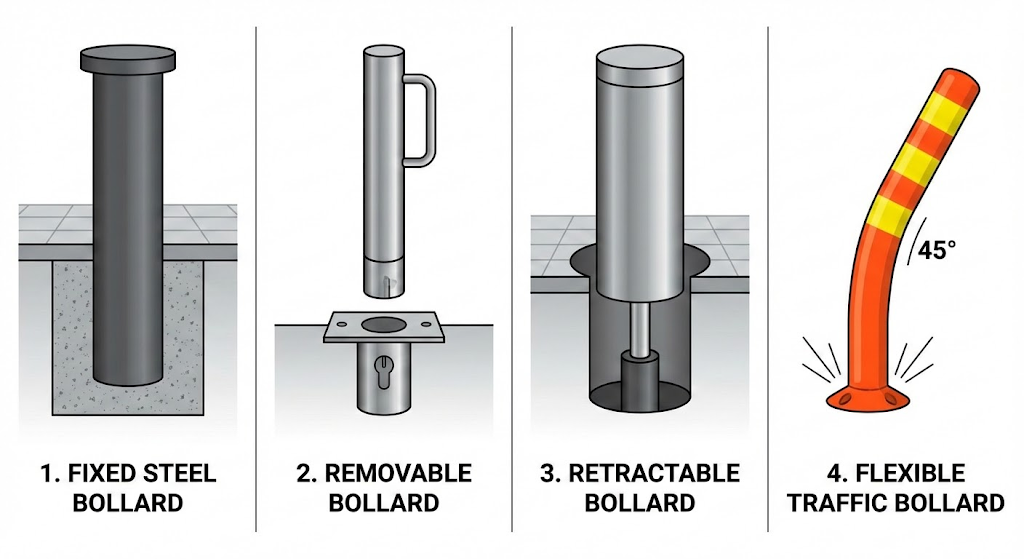
| Fixed/Permanent | Anchored 18-24 inches deep in concrete | Storefronts, building perimeters, permanent barriers |
| Removable | Lock into ground sleeves, can be taken out | Areas needing occasional vehicle access |
| Retractable | Rise and lower mechanically | Parking garages, controlled-access zones |
| Flexible | Bend on impact, spring back upright | Traffic guidance, bike lanes |
Fixed bollards are the most common. You’ll see them outside stores, around gas station pumps, and protecting outdoor dining areas. They’re the workhorses of the bollard world.
Removable and retractable options solve a tricky problem: what if you need to let vehicles through sometimes? A delivery truck needs access. Emergency vehicles need a clear path. These bollards offer flexibility without sacrificing security.
Flexible bollards serve a different purpose entirely. They’re not meant to stop vehicles. Instead, they guide traffic and mark boundaries. When a driver accidentally clips one, it bends and bounces back. No damage to the car, no broken bollard.
Security bollards are built to stop vehicles cold. The serious ones carry crash ratings. An M50-rated bollard can stop a 15,000-pound truck traveling at 50 mph. These protect government buildings, stadiums, and high-risk targets from vehicle attacks.
Traffic bollards manage the flow of cars and pedestrians. They mark parking spaces, separate bike lanes, and keep cars out of pedestrian zones. They’re more about guidance than heavy-duty protection.
Decorative bollards prove that safety doesn’t have to be ugly. These combine function with style. You’ll see ornate cast-iron bollards in historic districts and sleek stainless steel designs outside modern buildings.
Lighted bollards pull double duty. They protect and illuminate. Some use solar power. Others connect to the electrical grid. Either way, they make spaces safer at night while marking boundaries during the day.
Once you start noticing bollards, you’ll see them everywhere. Here are the most common spots:
You’ll also spot them at banks (protecting drive-through lanes), convenience stores (shielding entrances), and restaurants (defining outdoor seating areas).
The material determines how long a bollard lasts, how much protection it offers, and how good it looks. Here’s the breakdown:
| Material | Strength | Lifespan | Best For |
|---|---|---|---|
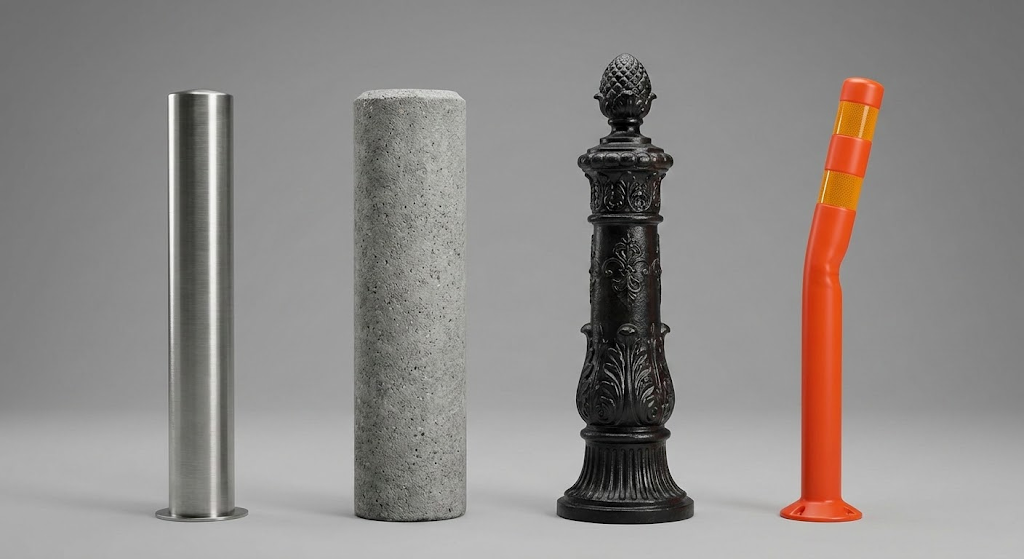
| Steel | Very high | 20-30 years | Security, general protection |
| Stainless Steel | Very high | 25+ years | Coastal areas, modern aesthetics |
| Concrete | High | 20+ years | Heavy-duty security, permanent installations |
| Cast Iron | Medium-high | 30+ years | Historic districts, decorative applications |
| Plastic/Rubber | Low | 5-10 years | Traffic guidance, temporary use |
Steel bollards dominate the market. They’re strong, affordable, and versatile. A standard 6-inch diameter steel bollard filled with concrete can stop most passenger vehicles. For serious security, steel bollards meet ASTM crash ratings.
Stainless steel costs more but resists corrosion better. In coastal cities or areas with harsh winters (lots of road salt), stainless steel outlasts regular steel by years.
Concrete bollards are heavy and tough. They often contain steel rebar reinforcement. You’ll see them as simple cylinders or decorative planters. The downside? They can crack in extreme temperature swings.
Cast iron offers traditional charm. Historic districts favor these for their ornate designs. They match vintage lampposts and architectural details.
Plastic and rubber bollards bend. That’s the point. They mark lanes and guide traffic without damaging vehicles that bump into them. They need replacing more often, but they’re cheap.
Bollards are short posts that protect people, guide traffic, and secure spaces.
You’ll find them throughout urban environments. Outside the store where you shop. Around the plaza where you eat lunch. Along the sidewalk where you walk to work. They’re often unnoticed, but they’re essential.
Next time you pass one of those sturdy posts, you’ll know exactly what you’re looking at.