You’re staring at a custom metal part you need for your project. The terminology hits you like a wall: foundry, molten metal, die casting, sand molds. It sounds like something only engineers with decades of experience could understand.
Metal casting is actually one of humanity’s oldest and most intuitive manufacturing processes. People have been doing it for over 6,000 years. The basic concept is simple: melt metal, pour it into a mold, let it cool, and you have a solid part.
By the time you finish reading this guide, you’ll understand exactly how metal casting works, which method fits your needs, and when to choose it over other manufacturing options.
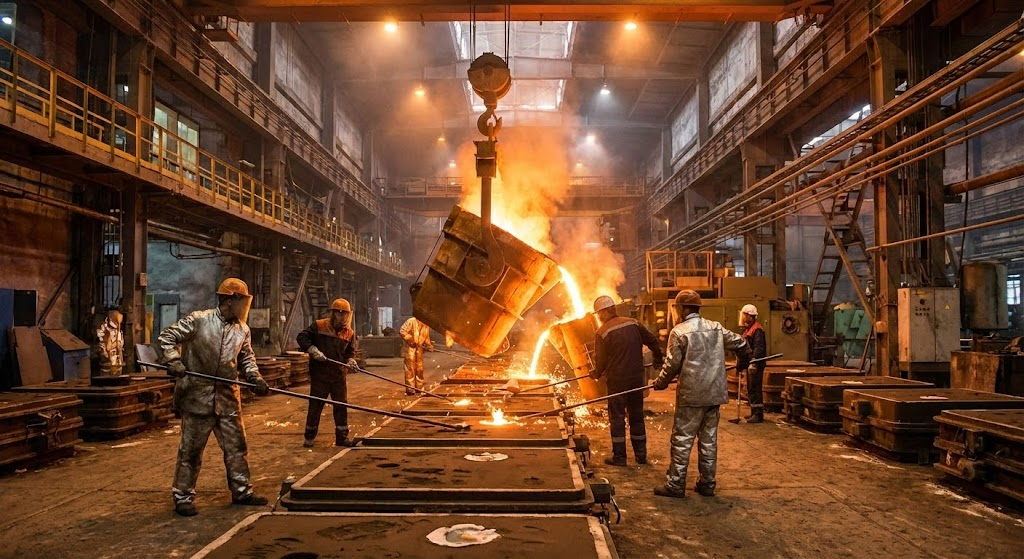
Metal casting transforms liquid metal into solid shapes using molds. Think of it like making ice cubes—except you’re working with molten aluminum at 1,220°F instead of water.
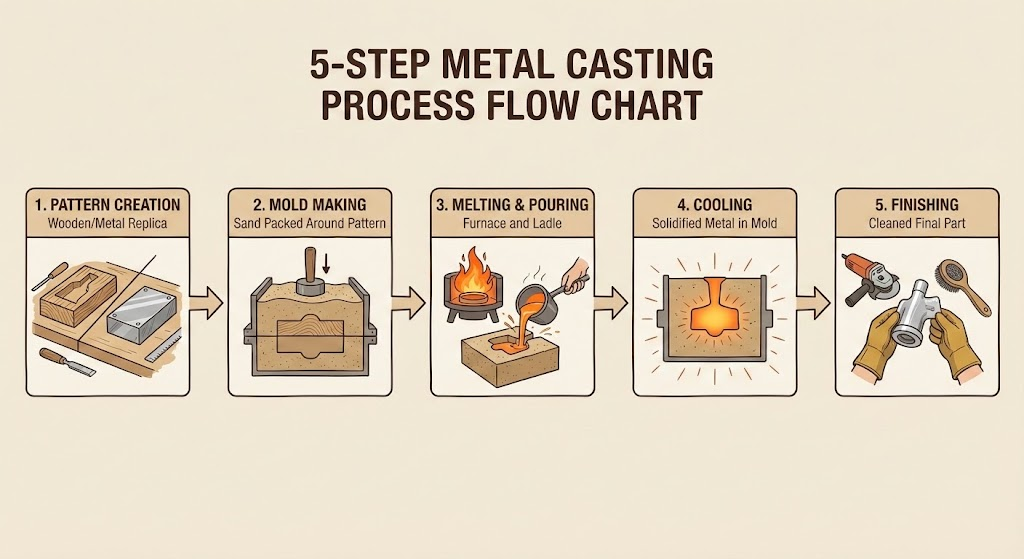
Every casting method shares the same five fundamental steps.
The pattern is a replica of your final part. Patternmakers build it slightly larger than the finished piece to account for metal shrinkage during cooling. Most patterns come from wood, plastic, or metal, depending on how many castings you need.
A wooden pattern works fine for a handful of parts. If you’re making thousands, you’ll want a durable metal pattern that won’t wear out.
The mold creates the cavity where molten metal will flow. Workers pack molding material—often specially formulated sand—around the pattern. When they remove the pattern, the sand retains the exact shape of the part.
This hollow cavity is your mold. Every detail from the pattern transfers to the mold surface.
Furnaces heat metal until it becomes liquid. Aluminum melts at around 1,220°F. Steel requires over 2,500°F. The choice of metal determines the furnace type and the precautions needed.
Workers pour the molten metal into the mold through channels called sprues and runners. The liquid metal fills every corner of the cavity, capturing even fine surface details.
The metal needs time to solidify. Small aluminum parts might cool in minutes. Large steel castings can take hours or even days.
Once solid, workers break away expendable molds or open permanent ones to extract the part. The casting emerges as a rough version of the final product.
Raw castings have excess material attached—gates, runners, and sometimes flash around the edges. Finishing removes this extra metal through cutting, grinding, or machining.
Some parts need additional surface treatment. Others require heat treatment to achieve specific mechanical properties. The level of finishing depends on how tight your tolerances need to be.
Metal casting divides into two fundamental categories based on whether the mold survives the process.
Expendable mold casting destroys the mold to remove each part. Sand casting and investment casting fall into this category. You make a new mold for every casting.
Permanent mold casting reuses the same mold for thousands of parts. Die casting and gravity permanent mold casting use durable steel or iron molds that last through high-volume production runs.
Each casting method excels in different situations. Sand casting dominates for large, low-volume parts. Investment casting delivers precision for complex shapes. Die casting wins on speed for high-volume production.
| Method | How It Works | Best For | Typical Applications |
|---|---|---|---|
| Sand Casting | Packs sand around a pattern to form the mold | Large parts, low to medium volumes | Engine blocks, pipe fittings, manhole covers |
| Investment Casting | Coats a wax pattern with ceramic, then melts the wax away | Complex, precise parts with tight tolerances | Turbine blades, jewelry, medical implants |
| Die Casting | Injects molten metal into a steel mold under high pressure | High-volume production of smaller parts | Phone housings, automotive components, hardware |
| Permanent Mold | Pours metal by gravity into a reusable metal mold | Medium volumes with consistent quality | Automotive wheels, cookware, hand tools |
I recommend sand casting for beginners exploring custom parts. It has the lowest tooling costs and the most flexibility for design changes. You can produce a single prototype or scale up to thousands of parts using the same process.
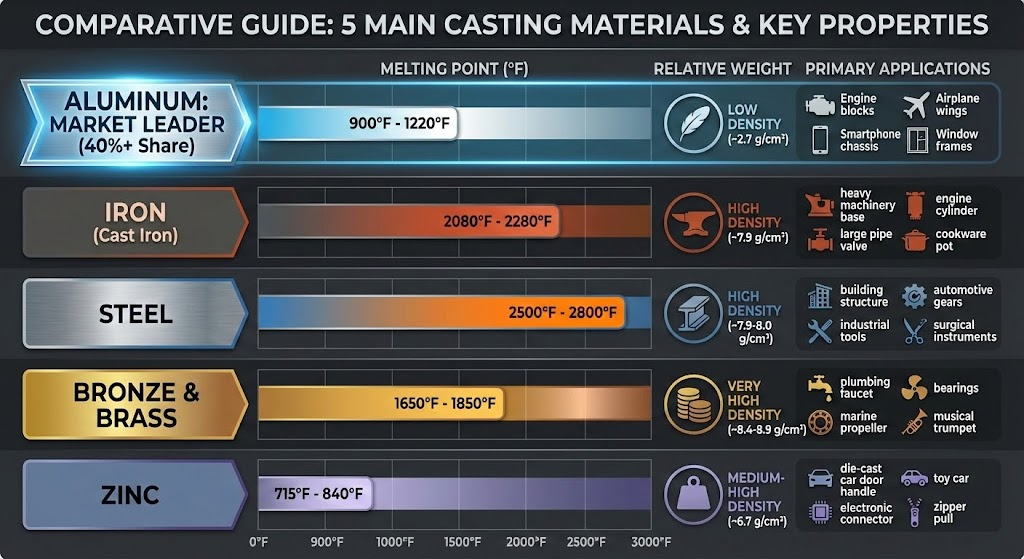
Almost any metal can be cast, but five materials dominate industrial production.
Aluminum leads the market with over 40% of all casting revenue. Its low melting point (1,220°F) makes it forgiving for beginners. Aluminum castings resist corrosion, conduct heat well, and weigh about one-third as much as steel. You’ll find them in automotive parts, cookware, and aerospace components.
Iron remains the most widely cast material by volume. Gray iron offers excellent vibration damping and machinability—perfect for engine blocks and machine bases. Ductile iron adds strength and flexibility, handling higher loads without cracking.
Steel delivers superior strength for demanding applications. Cast steel parts handle heavy loads, high impacts, and extreme wear. Mining equipment, railroad components, and construction machinery rely on steel castings.
Bronze and brass combine beauty with durability. These copper alloys resist saltwater corrosion, making them ideal for marine hardware and plumbing fixtures. Artists have cast bronze sculptures since ancient times.
Zinc excels in die casting for small, detailed parts. It melts at just 787°F and flows easily into intricate mold cavities. Electronics housings, locks, and decorative hardware often feature zinc die castings.
The right manufacturing method depends on your specific requirements. Casting wins in certain situations and loses in others.
You need complex internal cavities or undercuts that machining cannot reach. Casting creates these features as part of the process.
Your production volume exceeds 50 parts. The tooling investment starts paying off, and per-unit costs drop below machining alternatives.
Material efficiency matters for your budget or sustainability goals. Casting wastes far less raw material than subtractive processes.
The part geometry is too complex for efficient machining. A single casting can eliminate multiple machining operations and assembly steps.
You need only 1-10 parts. CNC machining delivers parts in days without tooling investment. Metal 3D printing handles complex geometries in small quantities.
Tolerances are extremely tight. Machining achieves precision that casting cannot match. Many castings still require machining for critical dimensions.
Maximum strength is essential. Forged components withstand 50% more fatigue cycles than castings. For safety-critical applications, forging may be worth the added cost.
Metal casting transforms molten metal into solid parts using molds. The process dates back over 6,000 years, yet it still powers modern manufacturing.
Castings surround you—in your car’s engine, your kitchen cookware, your bathroom fixtures, and the infrastructure of your city. Understanding how they’re made helps you communicate with foundries, evaluate suppliers, and choose the right manufacturing approach for your projects.