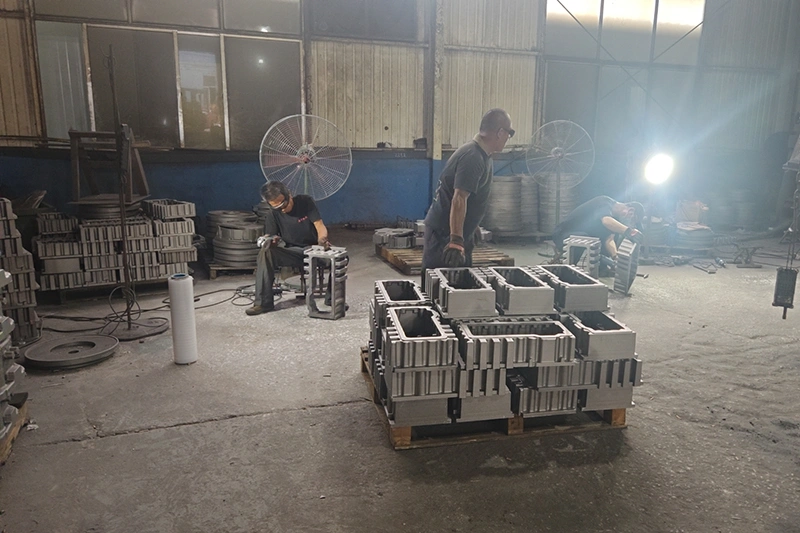
Reclaimed sand is foundry sand that’s been used to make casting molds and then cleaned and processed to use again. Foundries recover up to 90% of their molding sand through reclamation systems, turning what would be waste into a valuable material that performs nearly as well as virgin sand.
The lifecycle of foundry sand follows three distinct stages. First, virgin sand arrives at the foundry mixed with binders like bentonite clay or chemical resins to create molds for metal casting. After the molten metal cools and the casting is removed (a process called shake-out), the sand is now considered “used sand” contaminated with burnt binder residue, metal particles, and heat damage.
This is where reclamation comes in. The used sand goes through cleaning processes that remove contaminants and restore the sand grains to near-original condition. This reclaimed sand can cycle back into production multiple times, with some foundries reusing the same sand batch dozens of times before it becomes too degraded.
When sand can no longer meet quality standards even after reclamation, it becomes “spent foundry sand.” About 8,000 tonnes of sand end up in landfills annually from an average foundry without reclamation systems. Foundries with reclamation can reduce this waste by 70% or more while cutting their raw material costs.
The economics are compelling. Reclaimed sand costs about $1 per ton to process mechanically, compared to purchasing and shipping new specialty sand. For foundries using high-quality silica sand or specialty molding materials, these savings add up quickly.
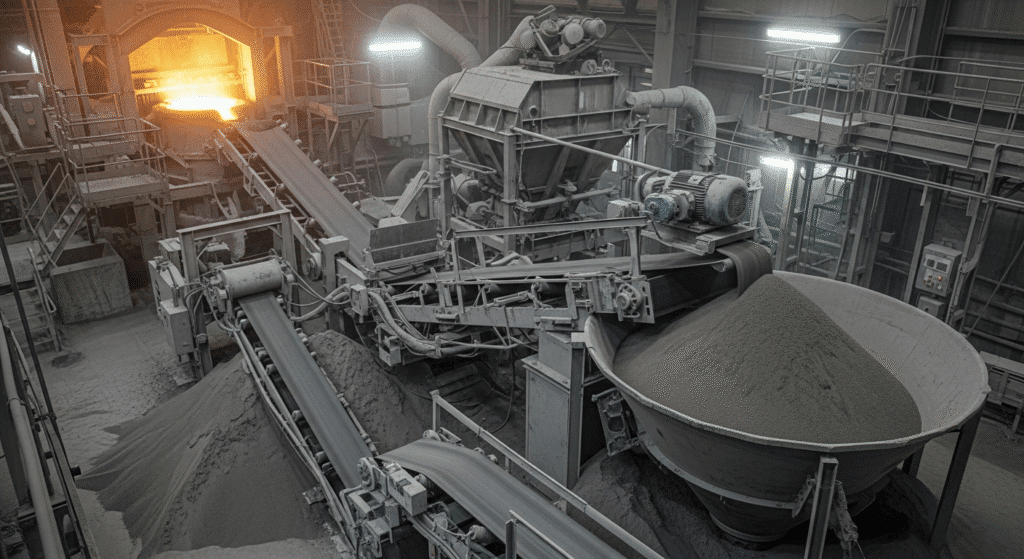
Foundries use three main reclamation methods, each designed to remove different types of contaminants and binder residues from used sand. The choice depends on the binder type, foundry size, and quality requirements.
Mechanical reclamation uses physical force to scrub burnt binder residue off individual sand grains. Vibratory mills and pneumatic scrubbers generate intense friction that breaks down binder coatings without damaging the sand itself.
Here’s how the process works step by step. Used sand enters a vibratory chamber where rotating paddles or high-speed air currents create collisions between sand grains. These collisions break apart clumps and chip away at binder films coating each grain. The system then uses air classification to separate the cleaned sand from the dust, metal particles, and pulverized binder waste. Magnetic separators pull out any remaining metal contamination before the sand returns to storage silos.
The entire mechanical cycle takes 15 to 30 minutes per batch. Most systems achieve Loss on Ignition (LOI) values between 0.5% and 1.5%, which matches virgin sand performance. LOI measures the organic residue left on sand after heating it to 1,000°C for one hour.
Processing costs run around $1 per ton, making mechanical reclamation the most economical option.
Thermal reclamation burns organic binders completely off sand grains using high temperatures between 600°C and 720°C. The sand passes through a heated fluidized bed chamber where direct flame combusts all organic material, leaving sand grains chemically clean.
The process starts with mechanically reclaimed sand (thermal reclamation can’t handle large chunks). A screw conveyor feeds sand into the thermal chamber where it mixes with hot combustion gases. The heat destroys chemical bonds between binders and sand, turning organic compounds into carbon dioxide and water vapor. After 10 to 15 minutes of heating, the sand exits through a cooling system that drops the temperature to 50°C before storage.
Thermal reclamation produces the cleanest results, with LOI values below 0.1%. That’s even lower than new virgin sand, which typically measures 0.29% LOI. This ultra-clean sand reduces casting defects and improves surface finish quality.
The trade-off is cost. Thermal systems run $6 to $8 per ton due to energy consumption.
Non-ferrous foundries favor thermal reclamation because it completely removes organic compounds that could contaminate aluminum or copper castings. The process is also nearly dust-free compared to mechanical methods, improving workplace air quality.
Wet reclamation uses water and chemical treatments to dissolve or suspend binder coatings, allowing physical separation of contaminants from clean sand. This method excels at removing inorganic binders that resist mechanical scrubbing and don’t burn cleanly in thermal systems.
First, high-shear mixing breaks up sand clumps while water dissolves soluble binders. Hydro-cyclonic separators then spin the sand slurry at high speed. Centrifugal force drives heavier sand grains to the outside while lighter clay particles and carbon stay suspended in the water core. The underflow stream recovers at least 40% of the sand, while the overflow captures 60% or more of the bentonite clay for reuse.
Vibrating screens remove the final water content, producing sand ready for remixing. The entire wet process removes 98% of adhering residues, surpassing what mechanical or thermal methods can achieve alone.
Many foundries combine methods. Sand goes through wet reclamation first to remove most contaminants, then thermal treatment burns off any remaining organic matter. This two-stage approach delivers the best quality while managing energy costs.
Nearly all foundry sand types can be reclaimed, but the methods and success rates vary significantly based on the binder system used. The two main categories are green sand (clay-bonded) and chemically bonded sand.
Green sand molding dominates the foundry industry, with 85% of metal casters using this water-activated clay system. The mixture combines silica sand, 3% to 10% bentonite clay as a binder, 2% to 10% coal dust for surface finish, and 3% to 4% water.
Most green sand systems operate as continuous loops. Fresh sand and binders are added to compensate for material lost during casting, while reclamation maintains consistent quality by removing degraded components. A well-managed system can run indefinitely with only 10% to 30% virgin material additions.
Chemically bonded sands use synthetic resin binders instead of clay, offering higher strength and better dimensional accuracy for complex castings. Each resin type has different reclamation characteristics.
| Binder Type | Reclamation Rate | Best Method | Special Considerations |
|---|---|---|---|
| Furan resin | 95%+ | Mechanical/Thermal | Rigid polymer structure makes binder easy to detach through physical scrubbing alone |
| Alkaline phenolic | 70-80% | Thermal preferred | Sodium and potassium oxides accumulate after 90% reclamation, requiring 10% virgin sand additions to maintain mold strength |
| Phenolic urethane | 60-90% | Thermal | Most effective method for completely eliminating hazardous organic compounds from sand |
Most chemically bonded sand operations start with mechanical reclamation to break down large core remnants, then add thermal treatment for final cleaning. This staged approach balances processing costs against sand quality requirements.
Thermally reclaimed sand often exceeds virgin sand quality, with LOI values below 0.1% compared to 0.29% for new sand. Mechanically reclaimed sand matches virgin sand performance when LOI stays between 0.5% and 1.5%. Proper reclamation produces fewer casting defects and better surface finishes than poorly maintained virgin sand systems.
Spent foundry sand moves to beneficial reuse applications outside the foundry. Silica-based spent sand from iron, steel, and aluminum foundries can safely replace virgin materials in asphalt, concrete, pipe bedding, and structural fill. The EPA classifies properly managed spent foundry sand as safe for these construction uses. Without beneficial reuse programs, spent sand goes to landfills.
Processing costs range from $1 per ton for mechanical systems to $6 to $8 per ton for thermal reclamation. Capital equipment costs vary widely based on capacity and technology. Small mechanical units for 5 to 10 tons per hour might cost $200,000 to $500,000, while large thermal systems processing 50+ tons per hour can exceed $2 million. Most foundries see payback periods of 2 to 4 years through reduced sand purchases and disposal costs.
Foundries processing less than 1,000 tons per year may find reclamation systems too expensive, while operations above 5,000 tons per year usually achieve strong ROI with mechanical systems and can justify thermal systems above 15,000 tons annually.