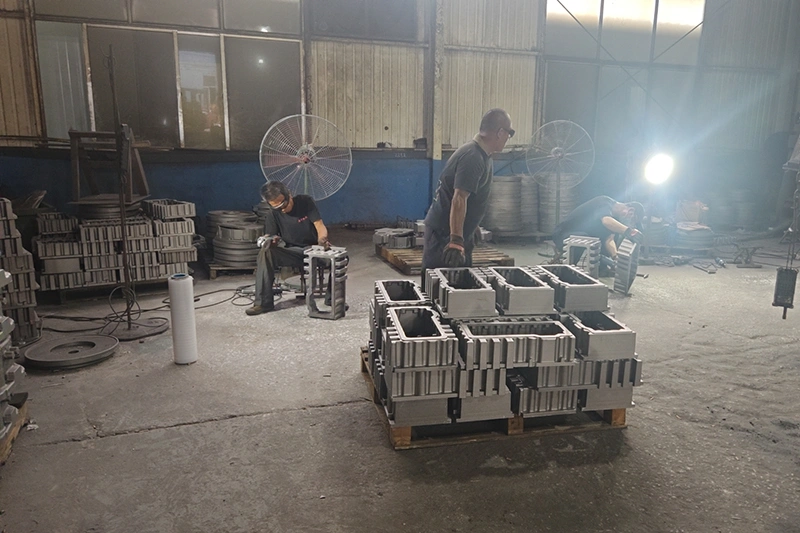
CF8M — the cast equivalent of 316 stainless steel — carries a Pitting Resistance Equivalent Number (PREN) of roughly 25. The industry-accepted threshold for seawater corrosion resistance is 32. That seven-point gap explains why materials engineers on Eng-Tips have reported perforation of 316L castings in seawater within weeks, not years.
“Saltwater” is not a single corrosion environment. A valve body bolted above the waterline faces a fundamentally different attack than a pump housing sitting in stagnant seawater. In my experience analyzing failed marine castings, the alloy family was rarely the root cause. The environment classification was. Getting this distinction right before selecting a cast grade prevents the majority of premature marine casting failures.
Marine environments divide into distinct zones, each with different corrosion mechanisms and rates. According to the U.S. Department of Defense Waterfront and Coastal Structures knowledge base, the splash zone produces the highest corrosion rate at approximately 0.95 mm/year for carbon steel, while the submerged zone averages 0.2 mm/year. That is a 3-5x difference depending on the specific location.
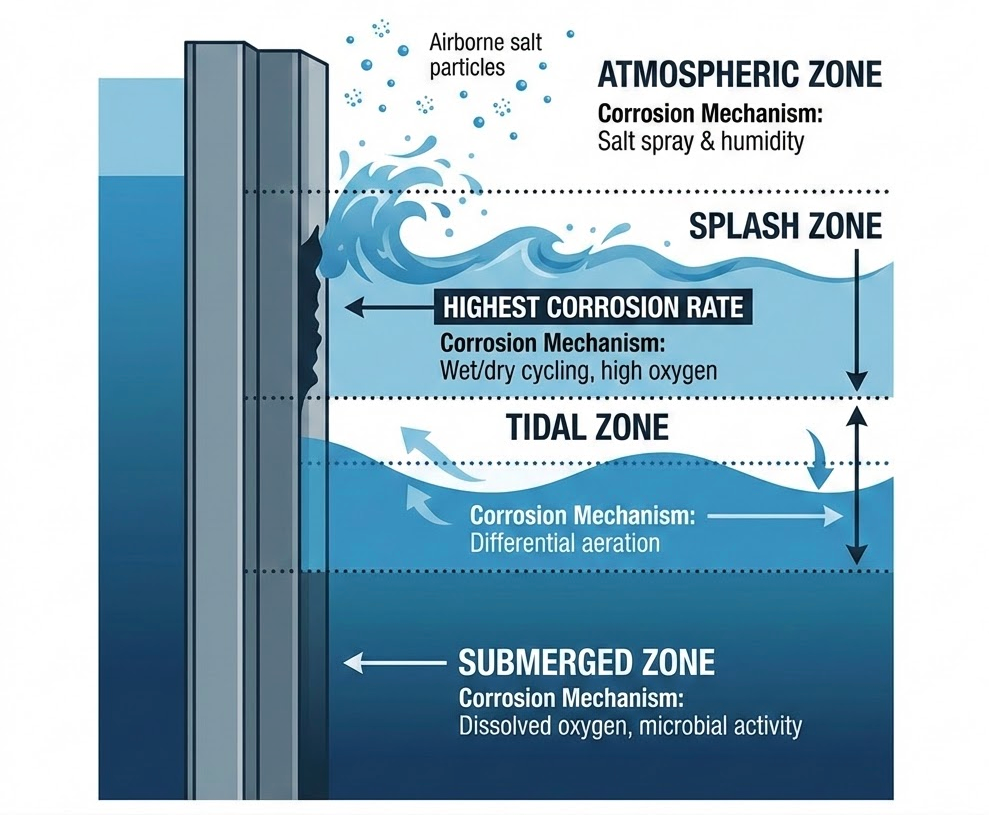
The metallurgical reason for this gap is that each zone attacks metals through a different mechanism. The splash zone concentrates chlorides through repeated wetting and evaporation, destroying passive oxide films on stainless steels. The tidal zone combines mechanical erosion with chemical attack. Submerged zones promote crevice corrosion and microbiologically influenced corrosion (MIC) in stagnant areas, while continuously flowing seawater can actually protect some alloys by maintaining their passive film.
ISO 12944-2 classifies marine environments as C5 (Very High Corrosivity), but this single classification obscures the zone-level differences that determine whether a specific cast alloy will survive or fail. A casting specification that simply says “marine service” without identifying the zone is incomplete.
Cast stainless grades use different designations than their wrought counterparts. Specifying “316” on an RFQ for a casting is technically incorrect — the proper designation is CF8M per ASTM A743, with CF3M for the low-carbon variant. This matters because cast microstructures behave differently than wrought in corrosive environments.
CF8M (cast 316) works reliably in atmospheric marine exposure and intermittent splash zones where the passive film can reform between wetting cycles. The problem begins in continuously submerged or crevice-forming geometries. As one materials engineer on Eng-Tips put it: “where the seals touch, where any mud settles, where any biological slime grows you will get crevice corrosion.”
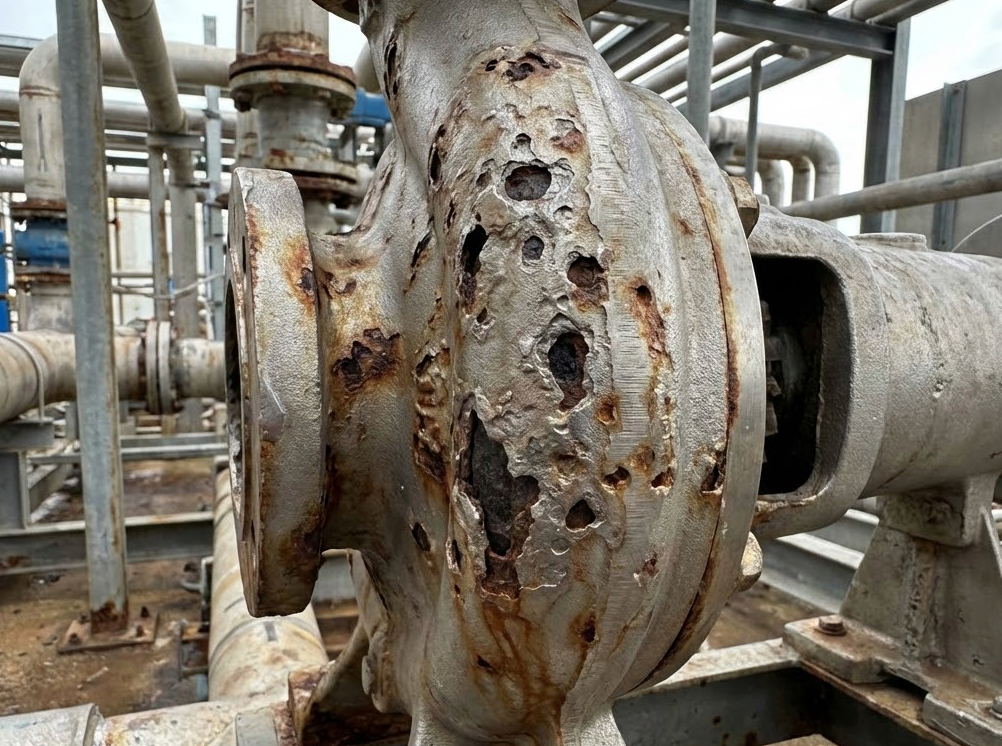
The situation has worsened over time. Modern 316 is typically produced at the minimum specification — 16% chromium and 2.0% molybdenum — compared to the 17% chromium and 2.5% molybdenum that was standard when much of the corrosion data was generated in the 1960s and 1970s. This lower alloy content further reduces the already marginal PREN.
For submerged marine castings, cast duplex stainless steel grades offer a major step up. CD3MN (cast 2205) carries a PREN of 34-36, clearing the seawater threshold. Super duplex grades exceed PREN 40, meeting the NORSOK standard for offshore seawater service. The tradeoff is castability — duplex alloys require tighter process control during melting and solidification to maintain the correct ferrite-austenite balance.
When I see a CF8M casting that failed in seawater, the first question is always about the operating zone, not the alloy choice. A CF8M valve in an above-water piping run is perfectly adequate. The same valve submerged in a stagnant seawater sump will pit through. The alloy did not change. The environment did.
Nickel aluminum bronze (NAB) C95800, cast per ASTM B148, is the proven workhorse for demanding submerged marine service. The Copper Development Association reports corrosion rates of 5.6-12.2 micrometers per year for properly composed C95800, averaging roughly 0.3 mils per year. Navy studies have documented dealloying limited to approximately 6 mm over 15 years of continuous seawater service.
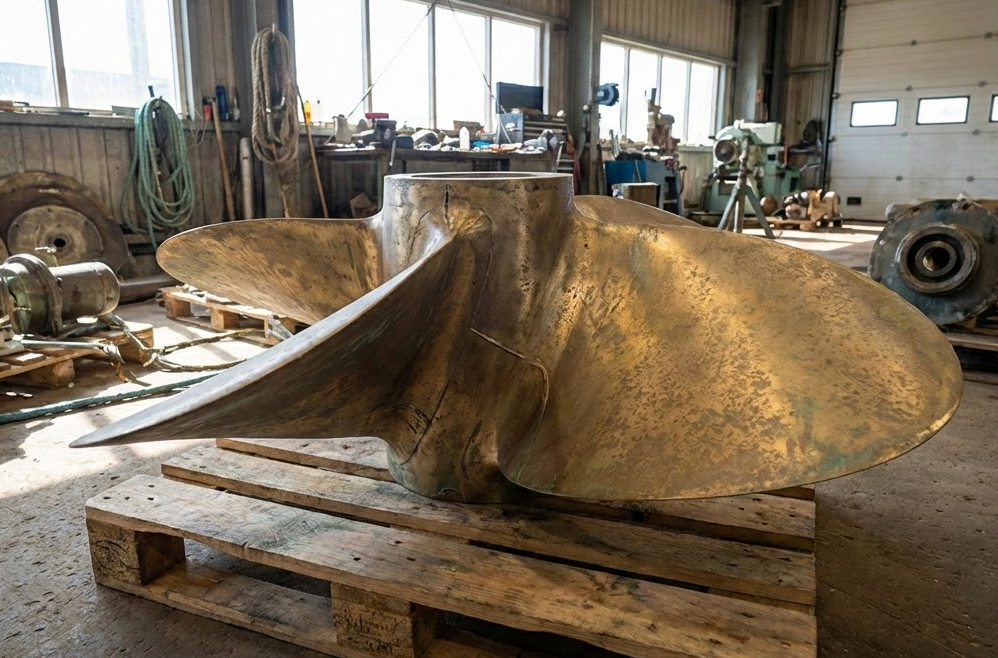
NAB’s advantage over stainless in submerged applications comes from its self-healing oxide film and superior cavitation resistance. It does not require cathodic protection in most configurations. However, composition control is critical. Alloys falling below the 8.5% aluminum minimum in UNS C95800 showed 3.7x greater mass loss in peer-reviewed seawater exposure testing published by the National Library of Medicine. The metallurgical reason is that insufficient aluminum prevents the protective oxide from forming properly.
Small, dispersed cast defects also serve as preferential corrosion sites where chloride ions concentrate, according to the same peer-reviewed study. This makes radiographic inspection and process control essential for marine NAB castings.
Copper-nickel alloys (C70600 for 90/10, C71500 for 70/30) take a different approach to seawater resistance. Their protective cuprous oxide film stabilizes over 3-7 years, reaching a long-term corrosion rate of approximately 0.001 mm/year according to the Copper Development Association and LaQue Corrosion Services data. Unlike stainless steels, copper-nickel failure is velocity-driven rather than zone-driven: 90/10 handles flow up to 3.5 m/s, while 70/30 extends to 4.0 m/s. Exceeding these limits strips the protective film faster than it regenerates.
The selection framework starts with the environment, not the alloy catalog. Classify the operating zone first, then match the cast grade to the severity level.
| Marine Zone | Corrosion Mechanism | Recommended Cast Grades | ASTM Standard |
|---|---|---|---|
| Atmospheric | Airborne chlorides | CF8M, CF8 | A743 |
| Splash | Chloride concentration, film destruction | CF8M (minimum), CD3MN preferred | A743, A890 |
| Tidal | Erosion + chemical attack | CD3MN, C95800 | A890, B148 |
| Submerged (flowing) | Passive film maintenance | C95800, C70600/C71500 | B148 |
| Submerged (stagnant) | Crevice corrosion, MIC | CD3MN minimum, super duplex preferred | A890 |
Galvanic compatibility is the second checkpoint. Pairing a 304 or 316 stainless casting with a NAB component in the same seawater circuit creates a galvanic cell that accelerates corrosion on whichever metal is more anodic. Keep dissimilar cast metals close in the galvanic series, or electrically isolate them.
Cost scales roughly with corrosion performance. CF8M sits at the baseline. CD3MN (cast 2205) costs considerably more. Super duplex castings reach 4-5x the cost of ductile iron. NAB C95800 falls between duplex and super duplex depending on size and complexity. Specifying a higher-tier alloy than the zone requires wastes budget; specifying lower guarantees early failure.
Three steps prevent most marine casting failures. First, classify the operating zone — not just “marine” but specifically atmospheric, splash, tidal, or submerged, with flow conditions noted. Second, select the cast alloy grade by its cast designation (CF8M, CD3MN, C95800), not the wrought equivalent. Third, reference the applicable ASTM casting standard (A743/A744 for stainless, B148 for NAB, B584 for tin bronze) so the foundry knows the acceptance criteria.
The casting that fails in seawater usually had an acceptable alloy. What it lacked was an accurate environment classification on the specification sheet.