Your reclaimed foundry sand is an asset worth protecting. Every ton you reprocess represents material cost savings and reduced landfill expenses, but only if it meets the strict specifications your casting operations demand.
Quality testing catches problems before they reach your molding floor. A single day of production delays from sand defects can cost more than a year’s worth of testing equipment and labor. Foundries that skip rigorous testing schedules typically lose 5-15% of production to casting defects that could have been prevented.
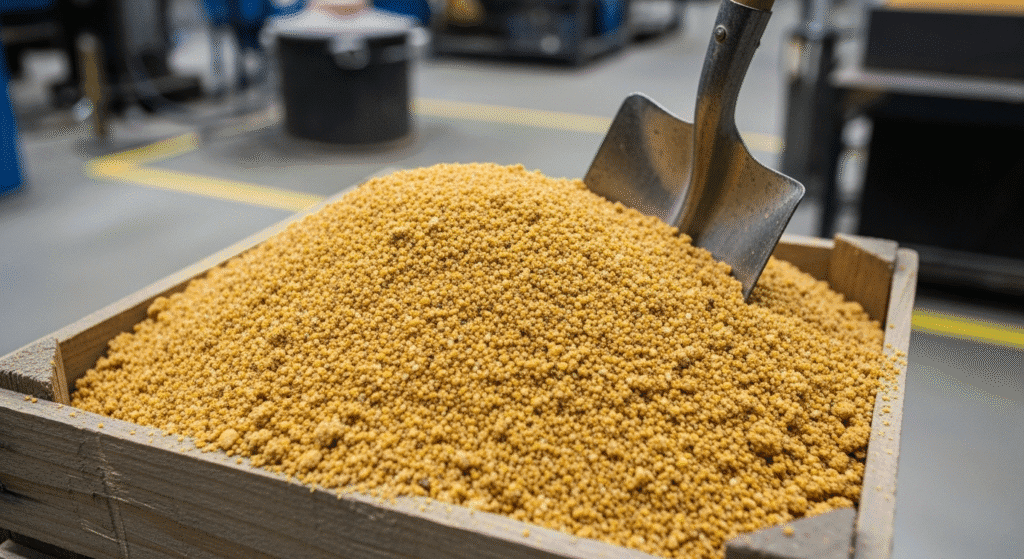
The first step in evaluating reclaimed sand is understanding its physical structure. You need to know the Grain Fineness Number (GFN), particle size distribution, and the percentage of fines (particles smaller than 200 mesh) that compromise permeability.
Test your sand’s particle size distribution against the AFS (American Foundry Society) standard. Most foundries accept sand with a GFN between 100 and 200, depending on your casting requirements. Iron foundries typically prefer GFN values between 140 and 160 for optimum surface finish and permeability balance.
Clay serves as your sand’s binder, holding grains together during compression. Without adequate clay, your molds lose strength. With too much clay, you lose the permeability needed for gases to escape during casting.
Test two specific clay measurements. Active Clay Content uses the methylene blue (MB) test to measure the amount of clay that actually participates in binding. Loss on Ignition (LOI) measures all organic materials and moisture that combusts when heated to 900°C. A rising LOI often signals increased combustibles or unburned binder residue, both problems in reclaimed sand.
For reclaimed sand, you should also test for strongly bound versus loosely bound clay. Reclamation can reactivate clay, but sometimes it becomes chemically bound in ways that reduce its effectiveness. Compare your MB clay results to your LOI—if LOI is significantly higher than expected, you likely have combustible contamination that the reclamation process didn’t fully remove.
Acid Demand Value (ADV) and pH testing reveal the sand’s chemical state. ADV measures how much acid the sand requires to reach a target pH. For reclaimed sand, ADV helps you understand whether bentonite has been properly reactivated or if it’s been deactivated by thermal processing.
High ADV indicates the sand is more basic and may struggle to reactivate clay binder. This is especially important with thermally reclaimed sand, where deactivated bentonite appears as high ADV but poor performance. pH testing complements ADV—a pH between 6 and 8 is typical for reclaimed sand ready for production.
Don’t rely on ADV or pH alone. Use these tests alongside clay content analysis to get the full picture. You might have acceptable pH but insufficient active clay, which means your sand will form weak molds.
Permeability testing measures how easily gases escape through your sand. Use the standard AFS 5224-13-S method: a 2-inch diameter by 2-inch tall cylindrical specimen receives 2,000 cubic centimeters of air at 10 grams per square centimeter pressure. The faster the air passes through, the higher your Permeability Number (PN).
Most iron foundries aim for PN values between 100 and 200. Thinner-wall castings need higher permeability (200+) to prevent gas defects. Heavier castings can tolerate lower permeability (80-100).
Test compression strength alongside permeability. Green compression strength (sand in its molded state) and dry compression strength (after the mold has set) both matter. AFS 5202-09-S covers these measurements. Your reclaimed sand should achieve at least 90% of the strength values you’d see in virgin sand for similar clay content.
Bending strength is the most critical indicator of core quality—it determines whether your cores maintain integrity during pouring. The AFS standard three-point bending test has been the industry benchmark for decades. If your cores fail bending tests, they’ll fail in production.
Water has two distinct roles in your sand. Temper water binds to clay platelets and activates the binder—this is the water you need. Free water sits between sand grains and causes expansion, steam, and surface defects—this is the water that kills casting quality.
Measure total moisture content daily using standard oven drying methods or real-time moisture sensors. But total moisture alone doesn’t tell you if you have the right balance. A foundry might have 4% total moisture split as 2% temper water and 2% free water—or it might have 2.5% temper and 1.5% free. The distribution determines your casting quality, not just the total.
Control moisture during mulling (mixing). Your muller must properly activate clay by mixing water into the clay-sand matrix. Insufficient mulling time leaves you with inadequate temper water. Over-mulling can introduce extra free water. Most foundries achieve optimal results with 3-5 minutes of muling time, depending on equipment and sand volume.
Test daily for moisture, compactibility, permeability, and green compression strength. Add weekly clay content, pH, and LOI testing. Run comprehensive monthly assessments including particle size, bending strength, and dry compression strength. This schedule catches 90% of quality problems before they reach production.
Mechanical reclaimed sand retains more original clay properties but leaves surface contamination. Thermal reclaimed sand burns off binders but may deactivate bentonite if temperatures exceed 450°C. Thermal sand often shows higher ADV values, requiring different acceptance criteria. Use the same tests for both, but interpret results differently—mechanical sand usually shows faster clay recovery; thermal sand requires longer to reactivate.
Compare your test results against AFS standards. Most iron foundries target Permeability Number 100-200, active clay content 4-8%, GFN 140-160, and green compression strength 15-25 psi. Your specific acceptance ranges depend on your casting alloy and geometry. Pull baseline data from your best historical production runs, then use those numbers as your quality targets.
Test permeability, compression strength, and moisture in-house—these require only moderate equipment investment ($30,000-50,000 for a basic lab). Grain size analysis (sieving) is also manageable in-house. Send clay content, metal content, and environmental leaching tests to certified external labs. External testing costs $400-800 per comprehensive sample but provides defensible third-party documentation.
Daily quick tests (permeability, moisture, strength) take 60-90 minutes. Weekly deep analysis adds another 2-3 hours for clay testing and pH analysis. Monthly comprehensive assessment with particle size analysis requires 4-6 hours. Environmental leaching tests through external labs take 2-3 weeks for results. Plan your testing schedule to fit lab turnaround times.
Options depend on which parameters fail. If permeability is low, remove fines through dedusting or secondary reclamation, or increase fresh virgin sand in your blend. If clay content is insufficient, add virgin material or adjust reclamation processing. If environmental leaching results are poor, the sand cannot be reused—send it to disposal. Many foundries maintain a blend of reclaimed and virgin sand to manage variability.
Environmental testing is required only if you intend to reuse the sand in beneficial applications (roads, fill, concrete) or if you’re disposing of it in ways requiring proof of non-hazardous status. Sand returning to your casting process doesn’t require environmental testing. Check your state regulations—some states require documentation; others don’t. EPA guidance supports beneficial reuse of iron, steel, and aluminum foundry sand.